Anne Atkins

  • Home
  • Bink Bonkers
  • Non-Fiction
  • Novels
  • Journalism
  • Speaking
  • Broadcasting
  • Biography
  • An Elegant Solution
  • Thoughts for the Day
  • Anthem for Mary and David Briggs
  • Love Strong as Death
  • Contact
man-286479_1920.jpg

The letter

January 26, 2019 by Anne Atkins

Mid January 2009

Did he say, “You’d better read this”?

Or have I imagined that? Was he too stunned even to speak?

He was standing, right there by the side of the kitchen table we’d had specially made for our vicarage in Parson’s Green, near the window of that little cottage which stood right on the pavement, looking out over the street and the C of E primary school Rosie attended. Where she must have been even at that moment.

And as I said before, swaying slightly, as if he’d been sandbagged.

I took it from him. It was four pages long. And it was written on official church writing paper. A proper, formal letter. Signed by several people, I suppose.

What... how... expressions fail me.

Thus must Peter Sutcliffe’s wife have felt, when she heard the charges against him.

I remember reading an account of the Cambridge rapist’s wife or girlfriend or partner, or whatever she was: that she should have realised... that he used to demand sex four times a day and still not be satisfied... why hadn’t she worked it out?

I had been married to Shaun for thirty years – had loved him all that time – and I knew none of this about him.

I’d had no idea.

He was guilty of Gross Misconduct. Over and over again.

I read it again. He’d done all this stuff?

Hadn’t he been the much-loved and respected parson of Parson’s Green? Hadn’t he put a nearly-dead and vicious church on its feet and filled it with life and love and a future?

And again, a third time.

I didn’t even have room for all these jangling thoughts. All the discrepancies between the man I loved and the one in these pages.

At some stage I must have taken a deep breath. Perhaps finished my mug of tea, always near me and topped up for the first two hours after breakfast.

Started again. 

And read it for the fourth time. Properly. Word for word and sentence by sentence. No longer skipping and swirling over the phrases in a whirl of panic, but weighing and assessing all these dreadful claims and accusations.

And the evidence for them.

Bear in mind Shaun only read it once. And he was in the midst of a debilitating breakdown. True, he was talking again now. And applying for jobs, with my help.

But he wasn’t Shaun. He couldn’t think, or evaluate, or do anything demanding. I don’t think he was even reading again. The paper, perhaps. But not proper, theological books.

Nor, it appears, was I. On first reading. Or second or third. In that giddying first fug of horror.

It wasn’t until I read it for the fourth time. And examined what I was reading.

That the mists began to melt.

“Shaun,” I said. “This is bollocks.”

“What?”

“This letter. It’s a load of nonsense.”

“What is?”

“It’s just made up crap.”

“Is it?”

“There’s nothing here. You haven’t done any of this stuff.”

“Haven’t I?”

That’s how convincing it was. Smoke and mirrors.

January 26, 2019 /Anne Atkins
Employment in the Church of England, Gross Misconduct Accusation
Comment
jesus-3499151_1920.jpg

Good Shepherd

January 25, 2019 by Anne Atkins

Early January 2009

I stared, hard, at the worst it could get.

Usually, if you face a searing fear full on, it creeps away a bit ashamed. Of course a two-inch spider in the bath isn’t going to jump out and bite me. Of course the sky isn’t going to fall on my head when I go outside.

The worst it could get was that we would be homeless again. This time, permanently.

Split up again. Permanently.

Actually, that is pretty bad, isn’t it?

Bear in mind that Shaun had recently suffered a devastating breakdown, and was not on fighting form. So I was doing all this on my own.

A very close, wise, dear friend said to me, “You’ve got to cut all your other children loose, and just look after Rosie.” 

Cut Bink loose? How could she survive...? She might be an adult, technically, but she was ill. And Serena, Alex, Ben…

I know from my own experience that it’s nonsense to consider over eighteen “adult”. I went on needing my own parents until they were so frail they needed me. (And well beyond. I could often do with my mother’s help and advice, still now.)

Something we do well to bear in mind when making provision for foster children.

Very early January. I was having tea with a member of the church. Her husband was the ringleader trying to destroy us: I knew that. But she wasn’t.

We sat either side of her warm fire, nursing our mugs. Suddenly, I burst out, “What is to become of us?” She said nothing. “Have you ever wished,” I asked her, “that you had no children?”

“No,” she said. “I haven’t.”

“I do.”

Two days later I invited her and her husband to our cottage. He had once been a help to us. I got the impression he wasn’t as important in his great big London goldfish bowl as he’d like to be. So he derived satisfaction from flexing his fins in the much smaller church one instead.

“Do you honestly believe,” I asked him, “that Shaun has done anything wrong?”

“If course not,” he said.

Shaun was bringing in a tray of tea.

“What you’re doing will ruin him. And us. You realise that?”

That was when he gave his explanation. “He is is holding up the work of the Gospel. He’s got to go.”

I will never forget those words as long as I live.

Is this the Gospel, the good news, that feeds the hungry and clothes the poor and visits those in prison?

It was soon after this that I asked Shaun my question.

He was just inside the little kitchen and I on the threshold: the room was too small for two, really.

“Shaun?”

“Hmm?”

“Why should we bother to keep believing? God doesn’t answer prayer. And Christians behave worse than anyone.”

My godmother, at my baptism, had given me bible, Authorised Version, red leather, gold tooling, with illustrations in bright colours, suitable for a child. Its cover has been hanging by a thread for decades. I treasure it still.

“Think of the character of Jesus,” he said. “Who else do you think He could have been?”

I saw that Good Shepherd, in my children’s bible, in cheerful primary blues and reds, dark hair to His shoulders and soft eyes straight ahead, carrying a lost lamb home over His shoulders. 

Who else, indeed, could He have been?


(It was soon after this, that Shaun received the letter I referred to. I can’t put it off any longer...)

January 25, 2019 /Anne Atkins
Why keep believing?
1 Comment
aircraft-2497005_1920.jpg

Fear

January 24, 2019 by Anne Atkins

January 2009, from my diary

“When I wake in the morning – or rather, just before I wake, in the moment when my consciousness begins to stir – I have a sense of foreboding, every day. A sadness that another day has dawned and yet again, I am not home. Where am I? Somewhere wrong, I know, but I can never quite remember where. The worry squeezes me, like a bully with his hands in a vice either side of my head, pushing in.

“My body is so much heavier than it used to be. I used to wake every day at about seven, shake the sleep off my ears like a dog coming out of water, sit up and relish my mug of tea and the sun on my bed. Now, the sleep drags me back down under, I can’t rouse myself, can’t push it off and open my eyes. My leaden body weighs down on the bed; I can’t lift a limb, an eyelid, my head.

“The entire household waits for me to wake them, take them tea, rouse everyone one by one – sometimes over and over again through the morning and sometimes well into the afternoon. I must get up, must wake up, I must. Pull myself out of this bed.

“Evan Davies is visiting a designer in California. The Bishop of Southwark is doing Thought for the Day. It must be ten to eight.

“If it were the Chief Rabbi speaking, surely I could wake...

“I am pulled back down into the darkness of wherever it is I have come from.

“It is half past eight and the Today Programme sports roundup. I am panting heavily, breathless, as if I have run too far and burnt my lungs. As if I am ill.

“Suddenly and with an abrupt movement I find enough will power to make myself sit up. I push myself onto shaky legs and stumble into the bathroom like an old person, shuffling, bent.

“I am like this every morning now, and have been for four years. Mornings used to be my best time: now they are filled with despair, every day, for the first ten or twenty minutes – or perhaps two hours – till my consciousness mind can take over, shake me out of it and make me face the day.”

I had never been so frightened in my life.

We had been homeless once before, for eight searing months in 2005-6, when Shaun was first employed by the Oxford church and they failed to provide anything after the rental accommodation ran out.

That time, we always knew it would end.

This time, if we lost the roof over our heads...

On the face of it, we just had to sit tight. Shaun was entitled to work. He had offered to return. Repeatedly. He simply had to turn down the offer and keep reiterating this.

You are in an aeroplane which is plummeting towards the ground. You know you have to keep calm, strap on your parachute, jump out, count to twenty, pull the cord. You tell yourself over and over that parachutes work, they are carefully checked, this is what they are for.

There is nothing to be frightened of.

Is there?

January 24, 2019 /Anne Atkins
Employment in the Church of England, Employment rights
1 Comment
doll-576791_1280.jpg

Meeting

January 23, 2019 by Anne Atkins

3rd January 2009

Shaun had an appointment for coffee with the two churchwardens the day after my birthday, 3rd January. This was so they could offer the generous financial assistance we’d been told about by the bishop, to enable him to find a new post.

I thought it would be friendly to offer them hospitality, so I invited them to the cottage. No, they wanted Shaun to go into Oxford.

“Have you told them our car’s broken down?” (Alex or Ben must have borrowed the lovely green car our friend Jane had just given me.)

They offered to fund a taxi.

This was a church where money signified everything; which could have taught Scrooge a thing or two about how to save a penny here and there. And yet they wanted to pay, rather than come to our home.

Rather than have me anywhere near the negotiations.

They really didn’t want to be on our territory. It was getting more interesting by the moment…

So I prayed, waited, wondered.

I went out into the street as soon as I heard Shaun return.

“Well?”

“Wait for me to get inside.”

We sat down so he could tell me.

“And?”

“They had a tape recorder.”

I said nothing for about half a minute.

“They what?”

“They said, as soon as I arrived, did I mind if they taped the meeting. Said their shorthand isn’t good.”

A tape recorder?

These were supposed to be friends. Fellow Christians. Members of the same church. Offering us help.

And taping it.

“Well.” I took a deep breath. “Good,” I said slowly. “That’s good,” I said again.

Shaun’s memory has always been impeccable. Mine is accurate when it matters. The church’s memory had not been. There had been a number of promises, clearly given, subsequently reneged on and quite emphatically unremembered.

“There can’t be any misrepresentation.”

“Quite. I agreed on condition I would be given a copy.”

Oh, and one of them had kept repeating, without prejudice.

Like the tape recorder.

Here, auntie, here is your Christmas present. Given with all my love… and without prejudice, of course.

The bishop had told us the church was concerned for us, and felt responsible for Shaun’s welfare. That they wanted to offer us financial support as a friendly gesture. Some recompense for the way we’d been treated, and to help Shaun find a new post.

They were indeed offering a settlement.

£7,000.

Minus any work which needed doing to the cottage. In exchange for Shaun’s renouncing his post. And his right to work.

And our accommodation.

Seven grand could easily have been spent on that dilapidated little cottage without even starting. It had been falling to bits ever since we moved in. (It was also – we were soon to discover – illegally dangerous: our first summer there, Shaun had slipped on the kitchen floor, torn his quadriceps tendon and done permanent damage; the staircase was condemned by the Council before we left.)

And our last removal costs – by custom, payable by the receiving church – had been £8,000.

It was so absurd it seemed barely frightening. At first, anyway…

It amounted to no money at all.

If Shaun relinquished his post we would be destitute. Not even a roof over our heads.

“What did you say?”

“I said I wanted to return to work. Repeatedly.”

“And?”

“They kept saying they thought I wanted a settlement.”

“How could we afford a settlement? Where are the children to live?”

“Quite.”

Shaun had relinquished a six-bedroom vicarage in Fulham, with lifelong tenure, in order to work for that Oxford church; in exchange for the promise of another lifelong post, and accommodation as stipulated for a Church of England vicar.

He would never – could never – have given up our London home for anything less. We are responsible for five children.

I have the transcript of the meeting still. So I have their reply in black and white.

“Where would we live?” Shaun repeats to them, on the tape.

This was not a merchant bank, nor a retail chain, nor a government department he worked for. It was the Church. Jesus’ family on earth. Espousing His values.

I have sometimes deplored the Church of England’s apparent sentimentality when it comes to money, seeming almost to amount to wastefulness; occasionally done so in print. Nevertheless, it is not an organisation where profit and efficiency should be the primary concern.

“That is a question for you, frankly,” says the churchwarden, on the tape. “Isn’t it?”

It was indeed…

So, what now?

January 23, 2019 /Anne Atkins
Comment
christmas-1879768_1920.jpg

Light of the world

January 22, 2019 by Anne Atkins

Christmas 2008

Our neighbours – now much-loved and very dear friends – lived in the Manor House. We, in Manor Cottage: modest staff quarters, once part of their estate.

They were going away for Christmas. Would we like to use their house?

Would we?!

We invited my cousins to join us. They could have the cottage, as we would be in the house. They didn’t tell us until much later, but even with only four of them, for just one night, in the little cottage seven of us lived in for several years, it felt claustrophobic and cramped.

Christmas Eve: Bink, Alex and Ben were invited to sing at midnight mass in London and to a lavish dinner beforehand. In a throw-back to the dread mid-years of her illness, Bink missed her lift by hours and hours.

Shaun would drive her. (Perhaps that’s why we’d suddenly needed a car?)

I alone all that evening of 24th, Rosie asleep in the cottage, numerous trips to the Manor House. We always put our decorations up on Christmas Eve so there was much to do. Backwards and forwards, again and again, along the brief stretch of pavement between the two houses (it was far too dark and hazardous to use the slippery old stone steps and gap in the fence we’d made between our gardens), both doors left open because my arms were full: tree, Stilton, goose, candles... Cava in the Manor House fridge.

When all was done I popped the cork, alone on a bar stool enjoying their medieval vast stone kitchen chimney, savouring my isolation. I am not solitary by nature. But just occasionally, for a delicious few hours, once every few years...

Our teenagers safe in London. Shaun back before midnight. Still signed off work, so all the family would be able to go to church together on Christmas Day.

But for Rosie I would have gone to midnight communion myself, in the church opposite… welcome glass of hot punch in the street afterwards from the grumpy pub landlord. Without Bink, Alex and Ben there would be no choir in the little village church.

Shaun and I went to bed long before the others got in.

It was an iconic Christmas, in the oak-panelled Manor hall, thirty foot long, vast inglenook at one end. Many happy previous evenings spent there: mulled wine at Hallowe’en; dinner parties; champagne shared at two previous Christmases. 

Our tree was lit up with its numerous tree-candles. The long oak trestle table laid with silver and linen, sparkling blood-red table-candles, matching candle-holders made of leaves and flowers. No light at all but the flames and the fire, dancing points reflected in the dark wood.

It was a good Christmas. I felt like a proper hostess again, though none of it was ours.

Lavish roast bird, flaming pudding, crackers to pull with whistles of different lengths so we had to co-ordinate into tunes.

A long time later, my cousin told me that she would catch my face in response, and dread. Her son voiced that he’d never seen me so not-myself.

“No,” she agreed.

Shaun gave me a wooden cheese safe. I loved it, and put it in the Manor House larder. It looked good there: it was the right temperature and proportions.

When the time came to take our belongings back to the cottage, I had no idea what to do with it.

We had nowhere to put it. The cottage was far too small.

It dominated that tiny kitchen.

Would my little cheese safe ever have a home? Would we, again?

To find that out, we would have to wait for Shaun’s New Year meeting with the churchwardens.

And you will have to wait till tomorrow…

January 22, 2019 /Anne Atkins
Homelessness at Christmas
Comment
rover-1907463_1920.jpg

Kind car.

January 21, 2019 by Anne Atkins

Mid December 2008

It was a Friday night when my father rang. My mother wasn’t well and he didn’t know what to do any more. Too exhausted to make decisions. Both of them ninety now.

Normally I would have dropped everything and driven over but I had a crisis of my own. For the first time in over four years, my weekly column hadn’t run: the editor thought it hadn’t hit the right note. Worse, she was right: I was too preoccupied with Shaun’s situation, and the mysterious “help” the churchwardens were now offering...

I was terrified. If I lost it, almost all my income would go overnight. What chance then of Shaun’s taking an unpaid “house for duty” post such as the one he’d recently applied for? As if our future weren’t frightening enough.

I set aside the next day, Saturday, for writing three really strong columns to file early for Christmas. Then rang Serena, who was with a friend in London. Yes, they would both go to Cambridge immediately.

As soon as they left my parents, my father rang again. Again needing help. I rang the emergency doctor without telling him, dreading an argument.

“Go,” I said. “Don’t take no for an answer, don’t let my father turn you away at the door. You must see my mother, whatever objections he raises.”

Then rang an ex-copper friend, in Cambridge training to be a vicar: my father had taught him New Testament Greek. He was with them within minutes and stayed till the small hours.

The doctor took one look at my mother and called an ambulance, saving her life. She was in hospital for a week.

The following weekend my father was even more exhausted: setting off at eight in the morning on his moped in the snow; staying at the hospital till ten at night; making sure my mother ate; eating her leftovers himself to keep going. 

Near collapse.

So Shaun and I borrowed a car – ours had just broken down – and went to Cambridge to look after them. On the Friday and Saturday nights we stayed with friends half an hour away. They would look after us.

It seems such a tiny detail...

I was cooking my parents’ breakfast: I made coffee for my mother; but when I tried to make my father a pot of tea he gave me an old, cold mug-full, left over from goodness knows when, and insisted I heat it up in the microwave.

It was too depressing to bear.

We were spending all our ill-spared weekend and several hundred pounds shopping and cooking and filling their freezer with appetising meals for the next fortnight, and he wouldn’t let me make him a fresh pot of tea.

I turned my face away, cleaning mushrooms and washing up and busying myself as I was, so he wouldn’t see my streaming tears. For a full half hour I chopped and wept.

That evening I sank my head on our friend Jane’s shoulder and bawled.

“I can’t do it,” I sobbed. “I can’t look after them all. My parents, my children. I can’t take any more.” She held me and understood. They had a lovely dinner ready for us.

Sunday morning, Jane was leaning against the Aga with a mug of tea.

“I’ve been thinking,” she said, gazing out of the window, “all night, what might be useful.  You’ve had a hard week.”

A hard week? How had this last been harder than the previous hundred?

“I’m getting rid of that car. I quite understand if this would be more of a nuisance to you than a help, but it’s yours if you’d like it.”

I’d forgotten our car.

Midweek, two am on the way back from the Mail on Sunday Christmas party, nothing but a skimpy cocktail frock because I thought I’d be warm in the car. The breakdown service found me on the verge of hypothermia and put me in their warm van, in contravention of all rules. Wrapped me in silver foil and gave me sweet black coffee, and got me home at four am.

Car breakdown is nothing. Lots of people’s cars break down. It’s a normal part of life.

When you’ve been without a home, having no car doesn’t register. It certainly didn’t put the last seven days onto my roster of difficult weeks.

I thanked her. And didn’t even bother to go outside and look at it.

I offered it to Alex and Ben when we got home, as they seemed more keen to have a car than I was. But just before Christmas, for some reason I can’t now remember, we needed a car, so Serena took the train to Hertfordshire and picked it up.

Too good for the boys, Shaun said.

On Christmas day he took me for a ride in it... Leather upholstery, wooden dashboard, analogue clock, CD and tape player and individually heated seats. Racing green, as all cars should be. Jane had put new tyres on it for me.

The only car I’ve ever loved. The only one ever called mine.

Ten years ago…

I sprayed the scratches out; one of the back doors fell off and I taped it back on; when the ceiling started to collapse Shaun ripped it all out so we could still see through the back window. Recently, garage mechanics and family members kept asking when we were getting rid of it.

Never, I said. Never.

A car doesn’t need an intact ceiling or all four doors working.

But alas, a couple of weeks before this last Christmas, 2018, Shaun was stranded for hours in the middle of nowhere and it was costing us hundreds every few months.

It now sits on our drive, dead at last.

(I must now hire a car for tomorrow night, for Thought for the Day on Wednesday. Shaun says I’ll hate it: all buttons and gizmos.)

And of course the reason I loved mine was because of the loving friendship. Such kindness in a time of such terror. Thank you, Jane!

Ten lovely years.

Dear car.

January 21, 2019 /Anne Atkins
Sandwich generation, Looking after parents
Comment
IMG_3104.JPG

Inevitables...

January 20, 2019 by Anne Atkins

Sunday

When I was young, I think I sort of believed great works of art existed in perpetuity, almost before the creation of the world.

As if Lear and Hamlet and Othello were already complete, down to the last exquisite word and phrase and well-known quote, while Shakespeare was still in the womb; like the eggs in a foetus’s ovaries.

I suppose you could see it as a kind of idolatry: my enthusiastic adolescent soul’s passion for beauty.

My friend Francis Grier, organist and now composer, when he was still a teenage organ scholar at King’s Cambridge and I looked up to him as a demi-god, told me he believed Bach never put a note wrong: if you changed one semi-quaver, you would diminish the whole.

“But Frank,” I said, “I feel exactly the same about Shakespeare. Every word...” So, he agreed, we were quits.

As if such great works are so perfect, it is inconceivable that they could ever have been different, even in the slightest degree.

Which means, if you nudge the idea a bit further, that Mozart could never have lived another day. If he had, such wonders would have ensued from his pen, so magnificent, so world-changing and breathtakingly beautiful, it’s impossible they could have remained unwritten and not had their intended existence.

Which in turn must mean he was destined to die when he did.

I suppose I began to question this as I watched my own creative process.

If Shakespeare’s works were predestined, it seems logical that Vaughan Williams’ were. And if his, why not his friend my grandfather’s much more humble compositions?

And if my grandfather’s, why not mine?

But if mine were predestined...?

That walk I took, when I happened across that astonishing, shockingly vibrant bluebell wood which inspired a scene in my second novel, On Our Own... If I hadn’t chanced to go for a walk that day and take the path which led that way, I would never have written the passage.

I surely would have written the scene in a completely different way? If I hadn’t gone on the vicars’ wives’ conference from which I was taking the walk, I might not have written it at all, perhaps?

And yet there is still part of me which can’t imagine a world without Bach’s Double Violin Concerto, or Sonnet 33... even though I realise Sonnet 33, with its so sad pun on sun and son, couldn’t have been written if Shakespeare’s own son Hamnet hadn’t died.

Which leads me to a similar feeling about people’s lives...

My grandmother lived to 84. So, ever since, I’ve thought of her as having been destined to live to 84. That was her allotted lifespan.

But that doesn’t feel so true any more, because I have saved my father’s life so often. If he hadn’t come to live with us, he would have died shortly after my mother did. in his early nineties.

Friday night, for instance. Two nights ago.

If I’d been with my friend Helen, in Tate Britain as originally planned, I wouldn’t have been at home to insist the doctor came to the house. My father’s carer had simply asked for a telephone call.

And if the doctor hadn’t come to the house... indeed, if Shaun and I hadn’t stopped with him and talked to him for so long, so that he noticed my father’s oxygen level dropping from 95 to 89 when he measured it again ten minutes later...

Well, my father would be dead now.

This, and several other very similar instances over the last nearly decade since my parents came to live with us and I’ve saved my father’s life several times, mean that I now know, for a near certainty, that if I’d cancelled work that day nine and a half years ago, when my mother got an ear infection, so that I’d been at home to back Serena up when she called the ambulance and my father overruled her... things would have been very different.

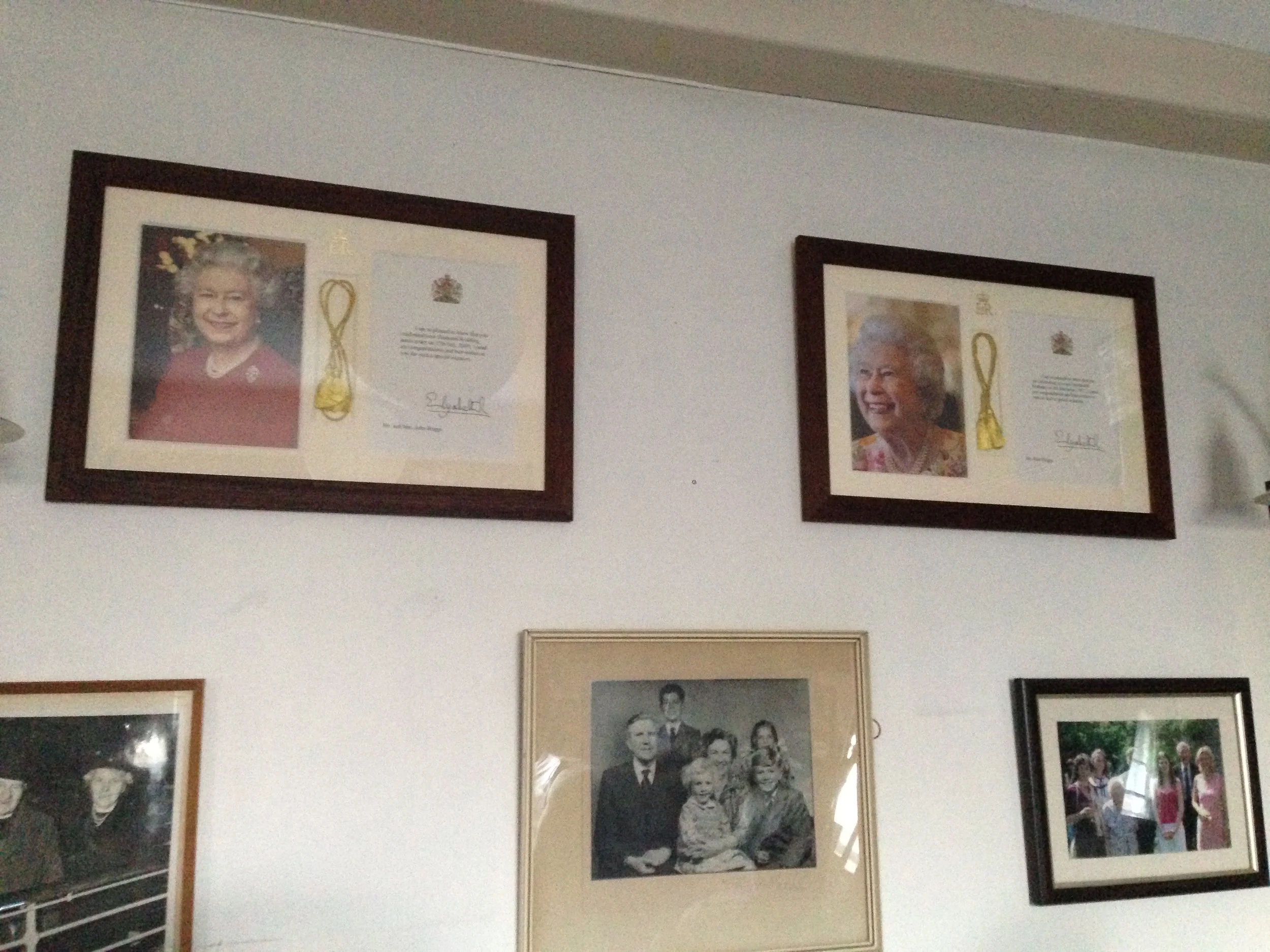
In which case my mother wasn’t necessarily destined to live to 91, but would have lived to 92, perhaps 93, and there would now be three cards from the Queen framed in my father’s bedroom instead of two.

One would have been for my parents’ Platinum Wedding, which we all would have celebrated together in our new home in a first glorious summer.

My mother might have lived longer than Serena’s dog, Hamlet. (Who might not have died aged ten, but might have reached eleven if Serena hadn’t just had such a large vet’s bill for a litter of sickly kittens, and not had any money left.)

And so it goes.

And what does all this make of Bink’s pain? If it wasn’t inevitable?

If Bink wasn’t necessarily going to be ill till her early thirties... For instance if we hadn’t let her go into hospital when she was 16...

If, if, if...

Then there might be the novels she hasn’t written or concerti she hasn’t played or paintings her childhood talent seemed so generously to promise.

And I suppose ultimately what this means, what it makes of Bink’s hurt and loss and struggle and all the wonderful and beautiful things she hasn’t yet done, is that God sees a bigger plan. It means that somehow – though I can’t really understand how, given the trouble He puts into creating exquisite things Himself – He doesn’t rate Hamlet or Paradise Lost as highly as I do.

Or rather He rates other things even higher.

Such as Bink’s eternal soul.

Perhaps He was quite happy for my mother to join Him before we wanted her to. Perhaps He wasn’t that bothered about a third card from the Queen. Nor (more to the point) our longing for her to be with us a little longer. And our pain that she wasn’t.

Be that as it may, I’m doing all I can to save my father’s life.

He’ll be back from hospital in a day or two. He has to be. We haven’t yet quite finished Æneas IV together, and read of Dido’s dramatic death.

(And of course, if Virgil had been born a woman or a slave, we wouldn’t have had any of his so beautifully predestined work anyway.)

January 20, 2019 /Anne Atkins
How creative process works, Predestination free will and creative process
Comment
stinking-bishop-cheese-3539_640.jpg

Bosh piss-up

January 19, 2019 by Anne Atkins

December 2008

I promise I am not postponing that letter deliberately, to tantalise…

I realised that I couldn’t have remembered the date of its arrival quite correctly, so have been back to my notes, everything I wrote at the time, to check. I find I had blanked out quite a lot.

Understandably, really

There was Christmas in between. And a fair bit else, besides.

I don’t do crosswords, as Shaun does. And I am dyslexic. So it was a while before I realised “bishop” can be an anagram for “stitch-up”.

Since Shaun’s breakdown we had been seeing our bishop once a month. Friday afternoons. Prayer, advice and help.

Well, prayer and advice...

That is to say, a cup of tea anyway. He did manage that. I suppose because his wife probably made it.

He was always absolutely charming – to be honest, you don’t get to be a bishop if you aren’t always absolutely charming; either that, or a woman – and it felt good to have him on our side. Though obviously, of course, being a bishop, he wasn’t taking sides...

He must be on everyone’s side…

Right?

Anyway, by late November, Shaun deemed himself well enough to work again. He might be dreading it, but knew he must. So he told the bishop during our November cup of tea that he was now ready for a phased return.

To our astonishment, the bishop discouraged the idea. Rather emphatically, in fact. Shaun shouldn’t even think about such a thing. He should concentrate on getting well.

Oh??

Really...?

Surely… the important thing was to establish his right to work again?

On the other hand our wonderful Kensington bishop, John Hughes, nearly twenty years earlier, had explained to our small children that he was primarily a shepherd. His job was to pastor, to care for, his clergy.

So... maybe this bishop was worried about Shaun’s health? I mean, why else would he say that?

Well?

It was around this time, too, that I wrote to Archbishop Rowan. Quite a few friends, over quite a long time, had said our situation was so shocking we should bring it to his attention.

I’d already met him professionally, introducing him as speaker for National Marriage Week, at a launch in the House of Commons a few years earlier. So I asked advice of the person who had introduced us.

“There is no one in the world,” he told me, “too busy to spare fifteen minutes. Ask him for a quarter of an hour, exactly. No a moment more.”

So I did. Hardcopy, and email.

I don’t suppose he ever saw the letter. An official replied, inviting Shaun to meet him in Lambeth. 

When we mentioned this to our bishop he raised his eyebrows. As if impressed. Or rather, actually, almost as if slightly disconcerted...

So Shaun went to London in a suit, came back in a good mood and said the official had been most encouraging, and agreed that the way we’d been treated was extremely unjust.

“And?”

“And, what?”

“What else? What help is he going to give us?”

“Well, he suggested I should get another job.”

What??

That was the sum total of what Lambeth would do for us?

Saints preserve us... 

Could we not have worked that out for ourselves?

It was during Shaun’s next episcopal cup of tea, in December, that the bishop dropped his little bombshell. It was the only time I wasn’t able to attend, so Shaun went on his own.

Perhaps it was just as well, I thought afterwards. I react. Shaun listens, reflects, mulls... and doesn’t speak until much later.

(On the other hand, perhaps it wasn’t entirely a coincidence...)

The bishop had told him, Shaun reported back, that the church wanted to support him in finding a new post. So much so, that they were willing to pay him not to work.

Oh yeah?

“How long for?”

The bishop had been a bit vague on that point. Perhaps a year’s stipend? Shaun hazarded.

“And what then? If you still have no job to go to?”

He hadn’t gone into that aspect of the plan.

“And if you find other work in less than a year? Can you keep the money?”

Well... I suppose so. Though he hadn’t gone into that either.

“And where do we live in the meantime?”

That, too, hadn’t exactly been specified.

This whole plan seemed rather like C of E doctrine. When it is trying to be ecumenical. (Fudge it enough, and everyone will be able to sign up because it won’t mean anything.)

The one thing the bishop had seemed absolutely sure about was that the church honestly wanted to help us.

Really. Genuinely.

Which was indeed truly remarkable.

Shaun was to meet up with the churchwardens in the New Year, 3rd January, so they could offer him all this lovely gushing assistance and support they suddenly wanted to give him.

Oh, look, here’s another anagram of “bishop”! I think I’m getting the hang of this.

(Do you think I could help set the Times crossword clues? I expect they have some disability-inclusion-requirement, so a quota of dyslexics must contribute. Count me in!)

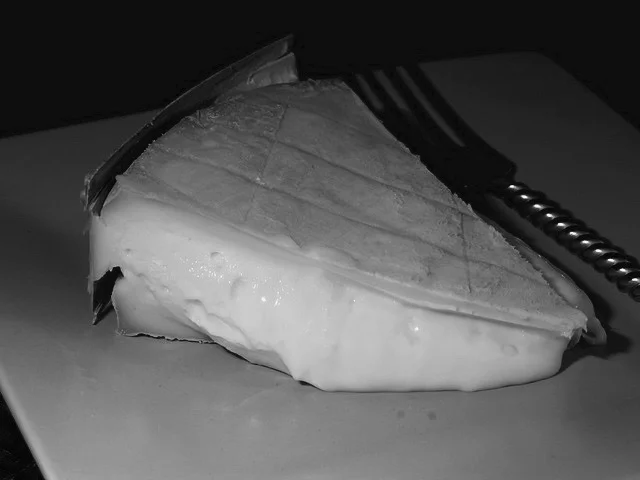
“Bosh piss-up.”

That works, doesn’t it?

January 19, 2019 /Anne Atkins
Stinking bishop
Comment
egg-583163_1920.jpg

Sandbagged

January 18, 2019 by Anne Atkins

Late Autumn 2008

There was nothing for it but to widen the search.

(That, and look up the Archdeacon of Cambridge to see how near he was to retirement. Not quite sixty-five. Clergy can retire at seventy. That was that, then. Another five years, and I would have detonated in screaming depression, all of us squashed in that lovely but minute little cottage. And Shaun working for an ecclesiastical lunatic asylum. Or not, any more...)

“Here’s one you’ll like,” he showed me. “Looking for a preacher-teacher. Evangelical. Haven’t lost the vicarage: five bedroom Edwardian house. Edge of London.”

We all have our limitations. All of us. In common with the rest of humanity, I can’t do everything. Geographical inflexibility is my annoying little Achilles’ stumbling block. That, and mixed metaphors.

I don’t know why. I suspect Serena may have a similar trait, her deep-roots drinking in places she has loved.

I used to hate family holidays – absolutely loathe them – because I got homesick. Even as a child, I knew this was eccentric. Other children missed their parents. I missed my bedroom, my garden, my spinney deep with cow parsley and its secret hiding places. I couldn’t bear being away from the quarters we lived in, not even our own house, muddled into the school my father was head master of in the middle of Cambridge.

Long-standing readers of this blog may remember the placement Shaun had in that idyllic village in Yorkshire, when we’d been married for about two years. I lasted half a week before dissolving into hysterical sobs and having to return to Cambridge alone, for the rest of the month. He was subsequently offered a job there, which he would have loved...

Funnily enough, I could move to Nepal or Malawi or Kerala easier than to Chesham or Cheadle. It would be so different and exotic, I would dive in and relish the strange colours and smells and curries.

But I had tried suburbia before – Shaun’s first curacy, in Barnet – and couldn’t wait to escape. Persil Country. Shaun happened to let slip that he was the only man in the street who didn’t have his shirts ironed for him...

Which was why a move to Oxford had seemed obvious. That, Cambridge and Parson’s Green: the three places I loved like members of my own family. Now, just Cambridge and Parson’s Green left.

Suburbia, eh?

I smiled bravely, and took the proffered specifications.

Nor have I ever been at home in Evangelicalism, really. I embraced it, when I married Shaun, because I love him. But now that an Evangelical church had treated us the way it had... well, I would have found any other churchmanship easier to enthuse about.

We couldn’t afford for me not to. If he would like it...

Poor Shaun probably spent several days on that blasted job application, before he found me hiding in the cupboard I called my study, in tears.

“Whatever’s the matter?”

It wasn’t the suburbia. It wasn’t even the Evangelicalism. It was the bloody Yamaha.

“The what??”

Page one of the specs. The church’s pride and joy. A spanking new, top-of-the-range, electronic Yamaha keyboard... “to lead the worship”. In place of the organ. Almost as bad as getting rid of the vicarage.

Worse. You can’t even sell an organ for anything.

(Just think: this could have been us. My favourite youtube of all time.)

“You muppet. Why on earth didn’t you say? There’s no point in my applying if you would be so unhappy there.”

Bath. Royal Mile. Never been to Bath in my life but the Royal Mile sounded fun. Georgian terrace vicarage. 

Time was – and not that long ago – when a clergy job application meant being rung up, asked if you were interested and then invited (with your wife) to come and meet a few folk. If you all got on, felt God was in favour (and your wife liked the curtains) that was it.

When Shaun was appointed to his living, it happened like this. I bicycled past the vicarage and fell in love. No but really. Like with a person. The same anatomically improbable gasp of butterflies in the pit of the stomach.

So a retired clergy friend rang someone or other as a result of which Shaun drove to London from our summer holiday to have a chat with the churchwardens. And then returned to the New Forest, where we’d borrowed a cottage, as the new P of P Green.

Believe it or not, in many ways this was a lot better than the current system (vindictive Archdeacons notwithstanding). When the dear old C of E tries to heave itself lumbering into the twentieth century it invariably gets it wrong and is still fifty years behind the rest of us anyway. If it stuck to what it was good at... ah well: too late now. Cat out of the can of worms already.

Shaun and I worked on that Bath application together. For a week. All twenty-six pages of it. I believe he never even got an acknowledgement. Thirty-five other clergy applied. The church almost certainly appointed someone they knew – and had decided on – already. You know: the curate, or someone. Unless the bishop had picked his own poppet and made it look like a democratic decision.

Which means thirty-five other clergy (and their spouses) also wasted a week.

See what I mean?

This process could presumably have gone on for ever.

Except that one morning, I think a Monday, I suppose it must have been early December, Shaun received a letter. He opened it, read it – it was several pages long – and swayed as if he’d been sandbagged.

January 18, 2019 /Anne Atkins
Employment in the Church of England, Experiencing breakdown
2 Comments
cross-2168323_1920.jpg

Discrimination

January 17, 2019 by Anne Atkins

Late autumn 2008

There was one advantage to Shaun’s being signed off work. For the first time since our move to Oxford at the beginning of 2005, he had time to apply for other jobs.

When we had moved into a six-bedroom Victorian vicarage in Parson’s Green, in the early ’90s, we had offered my parents a home with us. We would have loved it if they’d moved in straight away – my father could have run the church music; my mother taught maths – but only in their 70s, they were still far too independent to give up their own home.

They knew the invitation stood, though, for as long as we could honour it.

By the time we moved to Oxford fifteen years on, the balance was beginning to tip in favour of being near family, rather than where they had lived and worked for half a century, in Cambridge, where my mother still had several dozen private pupils. If the church had bought us a house similar in size to the one we were leaving (as we had initially been given to believe, when Shaun had accepted the post) the arrangement would have been perfect. My brother lives in Oxford, so they would have been near both of us.

Alas, as you will know if you have read this far, the church did not do this. On the contrary, for a while it provided nothing for us at all. So instead of our being able to house my parents, they had to house the few of us who could fit into their three-bedroom house, while the rest scattered elsewhere. (And Serena’s poor Great Dane had to live in the boot of a car...)

When we were eventually housed it was in a cottage so small we could barely breathe. Miles from Oxford.

It was also becoming heartrendingly evident that my parents, now nudging ninety, could no longer care for themselves. Several times, we’d had panic runs over to Cambridge to cook them meals; or rung a friend nearby to rush over and get my mother into hospital. The last time, my only income (my weekly column on the Express) also hung in the balance as well as my mother’s life: I couldn’t attend to all of it.

It was bad enough being torn in several pieces trying to care for our various children... 

Shaun and I even had a conversation about moving onto the sofa in the tiny sitting room so we could give them our bedroom. But we were barely surviving as it was.

Three of our children were at Cambridge University: two had disabilities and needed our support. My parents lived there. It made sense to move to the city we both loved. The other city… now Oxford had become unbearable to us.

Clergy jobs do not lie thick on the ground. A tiny smattering of Cambridge posts had been advertised in the four years since Shaun had been working in Oxford. He had applied for all. Not been short-listed for any.

Slightly surprising, perhaps...

Now a job had come up in a village just outside Cambridge, tailor-made. Every quality they were looking for, he had in bucketloads, and more besides. Even down to the “child of primary school age if possible”, so he could have links with the C of E school. And it still had its original vicarage, so we’d all be able to fit in.

The difficulty, Shaun objected, was that it was completely unpaid. We would have nothing to live on.

“Shaun,” I said, “we’re desperate. We’ve just got to leave. Somehow. Anyhow. We’d have somewhere to live. You can drive a taxi… anything.” I rang a Cambridge tutorial company who said they could use him for fifteen hours a week.

He posted his application on Friday. Just to be sure it arrived in time, I rang the Archdeacon’s office on Monday.

It hadn’t.

“Don’t you remember me?” his PA said. “We were in the same class at school!”

She asked me to resend his form, and I asked her about the job. It transpired that no one else had applied. I wasn’t surprised: completely unpaid. Shaun was many times over-qualified. She thought it just possible that one other person might, unofficially…

Bound to be short-listed, then.

He wasn’t.

This was so bizarre we asked our Bishop to look into it. He wrote to his counterpart in Ely.

A week later he had a letter. The Archdeacon of Cambridge didn’t like me. Me, not Shaun. Take, for example, the way I’d interfered over this job, ringing to see if Shaun’s application had arrived. (Because Shaun was in the middle of an effing breakdown! And his PA and I were at school together…)

For three and a half years, Shaun hadn’t applied for jobs anywhere else. For three and a half years, only Cambridge. For three and a half desperate and inadequately-housed years, we hadn’t had a hope. The Archdeacon had black-balled him every time. And not even had the Christian charity to tell him.

Now, what do you suppose happened at this point?

1. Shaun sued the C of E for millions, for appalling and inappropriate discrimination?

Or 2. Our Bishop said to his counterpart Bishop, “Come on, mate. This is outrageous. Call your Archdeacon to order, before this gets into the Daily Mail! Or indeed the law courts.”

Or 3. Our Bishop said to Shaun, “You’d better forget jobs in Cambridge then, hadn’t you?”

And yet none of this even compared to what was to happen next...

January 17, 2019 /Anne Atkins
Employment in the Church of England
4 Comments
friends-1149841_1920.jpg

Together

January 16, 2019 by Anne Atkins

Autumn 200

Shaun had been ill before. When he was twenty-one, just before I knew him, he’d had what was then diagnosed as glandular fever.

And as a vicar in the ’90s, after a very difficult first few years in an initially very tricky parish, after the trouble-makers had left and the church was beginning to become the happy and united family it soon was, he suffered from possibly the same stress-related ailment: two six-month bouts of ME. 

Members of the congregation at that time kept asking me if I was all right; telling me it must be hard; asking how they could help. It wasn’t hard at all. (Not for me!) Shaun slept most of the time and emerged in the evenings, fully himself. The church ran itself.

Nothing like this.

Now he was gone. The most striking thing about Shaun has always been his incisive intelligence. He couldn’t do a crossword. Read a book. Grasp the simplest things.

And of course, life was a lot more difficult now than it had been in the parish we were beginning to love so much.

I never cancel speaking engagements.

And yet I did: speaking at a fringe event at the Conservative Party Conference in early October. I can’t even remember exactly why... It must have been shortly after his breakdown. A simple, unimportant decision which was to have a devastating impact, indirectly, a year later. 

I even missed a talk I was supposed to give: again, a first (and last) for me. I was due in Durham at three o’clock to give a lecture at four, and somehow remembered this as having to catch a train from Oxford at three. By the time I realised my mistake, at around lunchtime, I couldn’t find any way of getting there on time. I even rang my brother to see if he could fly me up there. I was mortified. How could I have been so irresponsible?

I then forgot the Today Programme 50th birthday party, which even my producer hadn’t been invited to, for which I’d long procured an invitation for Shaun as well and had been looking forward to for some time.

None of this was like me, at all.

(There was one more engagement I nearly cancelled: to speak for a group of churches in Bedford, a place I’d never visited. Although I’d been scrupulously discreet about Shaun’s breakdown with anyone who might be interested in employing him – terrified that it might affect his prospects, and therefore ours of leaving – I thought it right to tell the organisers, in case I didn’t make it. None of these people would be Shaun’s prospective future employers, after all. But I did go, and when I arrived they told me they’d all been praying for us. Including the new head master of Bedford School, one of the elders, whom I was then introduced to… An amusing little irony of God’s which I enjoyed very much, when the time came.)

At Shaun’s next consultation a fortnight later, our new GP put him on anti-depressants.

Regular readers of this blog may have picked up on my passionately-held belief that pill-happy doctors and shrinks have blighted Bink’s life.

By contrast, our wonderful Oxfordshire GP didn’t put Shaun on pills straight away: she had wanted to see how he got on without them first. She was also honest about possible negative side-effects, explaining them to both of us and telling us how we might manage these.

And when she saw me about my own depression, she didn’t even suggest pills – unless, she said, I wanted to try St John’s Wort, available over the counter. When I asked why, she said, “We have instructions not to waste prescriptions. I’m not going to give you a piece of paper you’ll just drop in the bin on the way out.”

I was beginning to like this doctor, very much. She had recently been working in Botswana and seemed to have about fifteen children, half of them adopted. No wonder she had sense.

And she was right about Shaun. He was only on the medication for two or three months. And he tried coming off it too early, and snapped at everybody for a week.

It helped him. Happy pills used for happy purpose.

How different from Bink’s experience!

I believe it was in the first twenty-four hours of his breakdown that Shaun told me he he might never be able to return to his employing church.

We had no other income. No alternative source of housing. No other future or prospects. For ourselves or our dependent children. Which was all of them. Except Shaun’s employment in that church.

And yet my heart sang.

I had no idea how we would live.

But we were in it together at last.

Given what was about to happen, this was just as well…

January 16, 2019 /Anne Atkins
Living with breakdown
Comment
jungle-831222_1920.jpg

Breakdown

January 15, 2019 by Anne Atkins

September 2008

I had long marvelled at Shaun’s fortitude and stoicism. 

I had stopped going to his employing church three years earlier, as soon as I’d finished what I considered my duty.

In early 2005 I’d been asked to take over the music for the 11 o’clock service for three months, for the Director of Music’s sabbatical. Each week (unpaid, of course) I gave the church fifteen hours or so of my life: setting up a chamber group; pulling a choir together; organising rotas; finding an organist for each service. We had rehearsals at our rented accommodation: if we’d had our own home I would have wined and dined the musicians too.

(People commented kindly on the transformation. Because it was the more conventional service, preferred by older members of the congregation, it had been known as the “graveyard slot”. I considered it the civilised spot.)

I was gritting my teeth, until the last Sunday of those three months. The last Sunday I ever set foot in the place. (Apart from the one-off visit I mentioned a few days ago, enabled by Paul McKenna’s empowering techniques for overcoming trauma.)

From then on, I stayed away.

My absence was misunderstood. The number of well-meaning exhortations I received, telling me to “forgive” (from members of the church that had failed to house us; caused us to be split up for nearly a year; then accommodated us in a cottage less than half the size we needed; and from whom we had never yet received an apology, let alone any hint of reparation) could have powered a most exquisite psychological torture chamber.

Eventually I emailed one of them back, curious. “Why do you think I haven’t?” She had invited me to attend the church fête. I had thanked her, but explained I couldn’t face it. “The fact that I can’t do something, doesn’t mean I don’t forgive.”

Oh, she said. I see.

Shaun didn’t have the same freedom.

Day after day, week after week, month in and year out, he continued with his characteristic calm, dedication and professionalism. At a job he was finding insupportable.

I could never do that, I thought. (But of course I could. If I had to. We all do, don’t we? If you have no choice, you do what you can’t do.)

You don’t join the clergy for money. Nor indeed for promotion or status. You have a calling to serve. The reward is the work itself. The job satisfaction is all. There is nothing else.

(That, and just enough to live on if you have a stipend, which many clergy don’t. And a roof over your head, and your children’s. In theory.)

Shaun has always given his all. Never held back any part of himself, or indeed of his home or his family. He did it because he believed in it, with all his heart and soul. When he was the parson of Parson’s Green, he loved his flock as his own family. We all did.

So imagine, when he came home from work and his only words were: “I need a drink.” 

The feeble vine bends and bows, giving way at the earliest pressure.

The mighty oak stands firm in the storms and the hurricane; the rain soaking its unseen roots and loosening them; the cruel winter winds battering its proud, tired head. Until the day comes when, exhausted and hollow as it is, one squall rips it up and tears it from the soil.

One Sunday afternoon that September, the great oak broke and fell.

Like a car driven and driven with no oil, suddenly unable to do another mile. Another inch. 

He just stopped.

For weeks afterwards he sat in the midst of his normally noisy family, completely alone. Hearing nothing, seeing nothing, saying nothing; registering no one. For months, grey and unrecognisable, unequal to even the simplest tasks.

His mind bears the trauma still, his once flawless and astonishing memory now commonplace.

For six months even Bink’s health took second place. I have little idea of what she did or how she filled her time or survived during that next half year.

On the Monday morning, the day after he cracked and crashed, I took him to our GP; the best we’ve ever had. The number of times I’ve seen Shaun in tears I could count on one hand: in that surgery was one of them.

She listened a lot and talked a little and gave him a questionnaire to answer, to measure his level of depression. I looked over his shoulder as he did so. For most of the questions, I scored higher in my head than he did on paper.

As she was signing him off work, I said, “We need to come back, for me. I need to fill that in too.”

I had hoped Shaun would accompany me, as I had him. “I’m so sorry,” he shook his head sadly. “I don’t think I can. Do you mind?”

Not me, too.

“I just can’t face it.”

January 15, 2019 /Anne Atkins
Experiencing breakdown, Living with mental illness
Comment
stand-mixer-699447_1920.jpg

Friends and strangers.

January 14, 2019 by Anne Atkins

Late summer 2008

Soon after the NLP week which the two of us did together, Bink was readmitted to the Bethlem Hospital for another twelve-week course of treatment.

Her first stay, two years earlier, had been life-changing, for all of us. She came home able to eat without gloves, help clear the table, even play the piano: things she hadn’t been able to do since childhood.

(I should perhaps add a rider that a twelve-week stay at the Bethlem Hospital won’t necessarily enable you to play the piano. If you’ve never done it before.)

But there was a strict NHS cut-off of twelve weeks, so despite her pleas, she was discharged only half-well. (And no: of course it doesn’t make economic sense. Any more than it makes clinical sense to take half a course of antibiotics.)

By the time she was re-admitted in 2008, so much else in our lives was unravelling it was impossible to keep an eye on every ball.

Her therapist came to visit her at our little cottage in Oxfordshire, to help transfer some of the skills he was teaching her to real life. I would have loved to have been there. But Shaun was representing his church at a conference in Jerusalem and I was covering the same event for Radio 4.

Bink often jokes of a conversation she had with her therapist at that time. She was explaining some difficulty she had with washing. Had she run out of shampoo? I’d have to check the details with her to get it right.

He suggested, as a solution, that she used the family shampoo.

“My mother,” Bink said, “washes her hair with washing-up liquid.”

This stumped even the OCD specialist. Eventually, he said: “Bink, I can only treat you. Not your whole family.”

She still laughs about it. So, of course, I do too. To keep her company.

But the process of reiterating it here for you has brought home to me the underbelly of the story...

They were desperate years, in that dear little cottage. Desperate. I was clinging on by my fingernails.

Five of the seven of us were clinically depressed.

Unbelievable though it sounds, I believe that for the three years we lived there I never prepared or cooked any food. I have no idea what we lived on, but I know this from another anecdote of around that time.

Shaun and I had been invited, together, to give an after-dinner talk for a church guest night some distance away: the first and only time we’ve ever had joint billing.

We arrived in good time, of course, and were introduced to an early guest. Angela: voluble, outgoing, huge fun. Heart as big as you like. I asked her what she did, and she told me she worked for a kitchen equipment company I’d never heard of. She was astonished, and said they were the best brand in the world.

After supper we were called on to speak. Interviewed together.

I can’t remember anything we said, but neither of us has ever seen any reason to be anything other than open and honest. I imagine the story of what we were going through didn’t sound a whole load of fun.

After we had finished, Angela asked us to hang on while she nipped home for something. I was longing to leave: it was late, we had a long journey ahead of us and we were both exhausted.

We waited. And waited. And waited. An agonising forty-five minutes.

At last she came back, took us out to her car and showed us a boot-full of brand new, boxed, top-of-the-range kitchen equipment: mixer, processor, liquidiser; attachments.

“For you,” she said. Then added unnecessarily, “If you don’t want it, you can eBay it all off again.”

I was stunned.

We transferred it to our boot, thanked her and drove home.

Her kindness lives on in my heart, over a decade later. What a friend we had found in a stranger!

In the middle of the night – sleep was a long-lost alien – I googled her company and totted up hundreds-of-pounds-worth or more.

But I didn’t cook any more!

I love cooking. Perhaps because of that, I couldn’t even imagine the little kitchen we had in that tiny cottage producing a meal big enough for seven of us. I could barely face going in it.

So I kept all Angela’s presents packed in their boxes, carefully stored in our garage, and started dreaming of the day I would have my own kitchen again...

Buy my own shampoo? I could as soon have flown to the moon.

Or written my next novel.

January 14, 2019 /Anne Atkins
Comment
IMG_3095.JPG

Life starts today.

January 13, 2019 by Anne Atkins

Sunday

My mother was probably the happiest – as well as most loving, contented and appreciative – person I’ve ever known.

One of her most memorable pieces of advice to me, frequently repeated, was: never regret the past.

She would demonstrate the wisdom of this by pointing me to someone else’s life, soured and twisted by such self-flagellation: dragging out how it might have been; dwelling on paths mistook; deliberating about how much better everything could be now.

If only. If only. If only...

The fact that my mother urged this on me tells me it could be a weakness of mine. And the fact that she urged it on me tells me it doesn’t have to be.

It a temptation I suffer from. And it is one I can resist.

Thus, my mother still guides me, from her dear patch of sodden, cold grass, scampered on by squirrels and nestling in the quietude ignored by the roaring traffic passing by, now sadly locked against tramps and the homeless. Where she waits for my father, in the Garden of Rest in our parish church.

I often notice tendencies which Bink and I share. We are in some ways very similar, she and I.

My mother is guiding her, too.

Bink had a childhood full of astonishing promise. An adolescence of breathtaking pain. And a first decade’s adulthood of desperate, yowling breakdown: estrangement; mutism; abuse; ambulances and sirens... Her situation exacerbated by factors which could simply have been caused by utter hopelessness but could equally cruelly masquerade as choices which she took.

Where is all that promise which sparkled through Bink’s childhood? What might we, and she, have reasonably expected her to achieve by the age of thirty?

Andy Murray is younger than Bink is...

I remember wonderful, eccentric friends of my mothers, hilarious sisters, one at Girton with her. We were staying with them as a family.

“Just think darling,” said one of them, self-deprecatingly. “Mrs Thatcher is younger than we are...”

It doesn’t do to compare.

On Friday Shaun and I went to the Priory for a meeting to discuss Bink’s future. Still very ill. No discernible plans. Not even any obvious course of treatment.

Bink herself was quiet and subdued. 

I’m not surprised, Serena said.

No, neither am I.

If I had lost all my adolescence and young adulthood, I would be quiet and subdued. When not howling with horror at what I had lost.

If only I hadn’t gone to so-and-so’s house for my books.

If only I hadn’t taken the path below the cliffs not the path above, and met such-and-such, who persuaded me to go back.

If only I hadn’t been so desperate to get off the meds...

When asked what she wants for herself (when she doesn’t say, “To die,”) Bink mostly says, softly, I don’t know.

It doesn’t do to look back.

A close friend sent me this recently.

Not great poetry, she admitted; but it does the job:

New Every Morning

Every day is a fresh beginning
Listen my soul to the glad refrain
And spite of old sorrows and older sinning
Troubles forecasted
And possible pain,
Take heart with the day and begin again.

Susan Coolidge 1905

It is a new morning, Bink.

Please. Be kind to yourself. Don’t look back and be sad. Look forward and be glad.

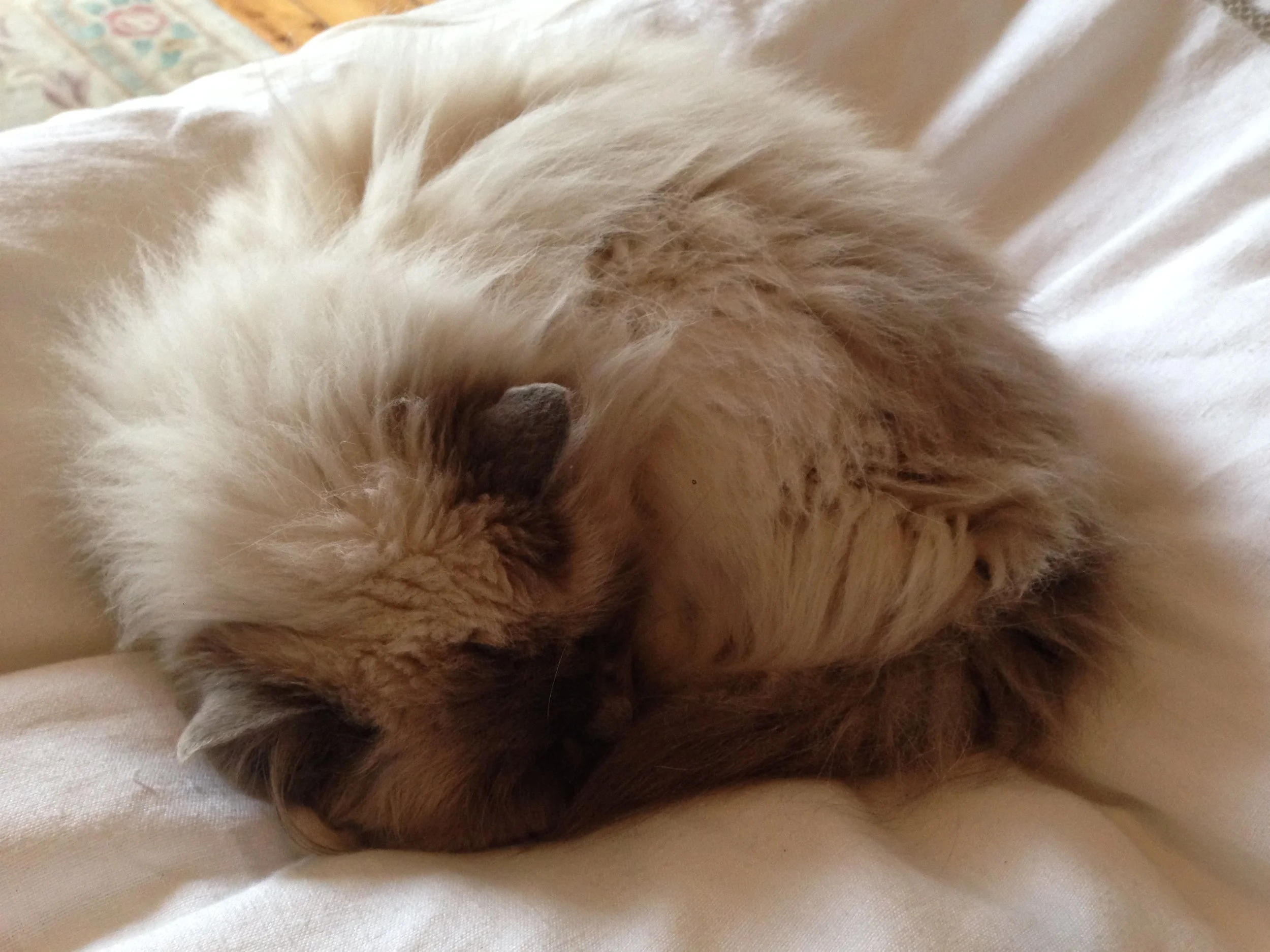
(Above is a picture of my cat – or possibly a cushion someone abandoned on my bed. Her name is Sophie Afternoon. When I’ve got a moment, I’m going to change it to Artemis. Serena always said her name should be Artemis, and Serena is usually right.

I just can’t quite remember how a cat changes her name.

Her relevance to today’s post? I can’t quite remember that, either.

Perhaps it is her attitude to tragedy. She is quite philosophical in her approach, as you see. Sophie Afternoon, aka Artemis, has had three pregnancies, that we know of. She has only raised one live kitten. Her response when she lost the last one – after spending twenty-four hours looking for the fluffy little grey body I’d already disposed of, through my tears, while she was still warm – was to catch a moth. And eat it.

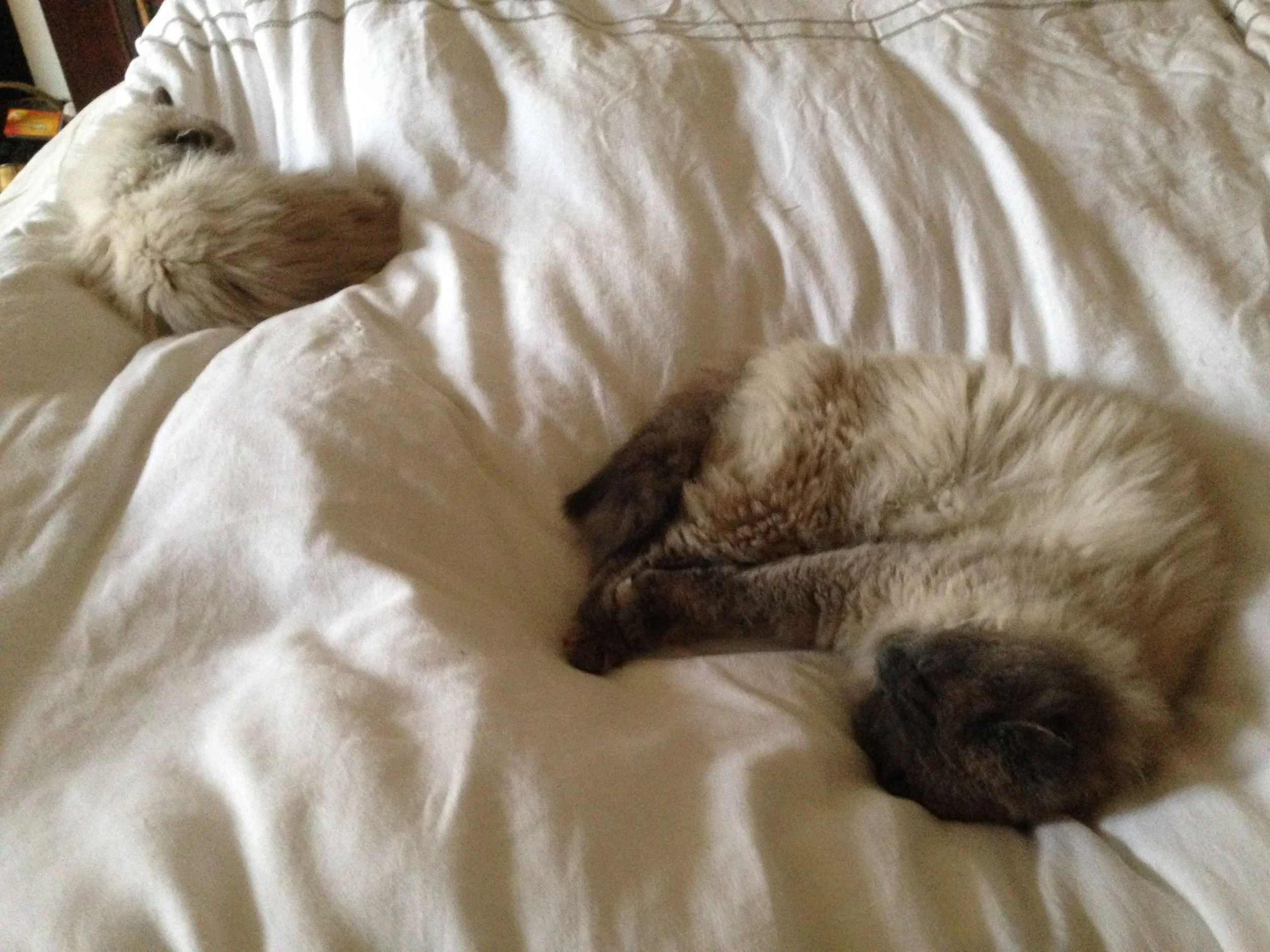
Oh look, and here’s my other cushion, which Serena gave me at her wedding. Aloysius. Almost as much of a workaholic as Sophie Afternoon Artemis. Here they are franetically competing as to which can be more productive...)

IMG_3098.JPG
January 13, 2019 /Anne Atkins
Comment

Neuro-Linguistic Programming.

January 12, 2019 by Anne Atkins

Early summer 2008.

The other two teachers on the NLP course Bink and I attended together, apart from the utterly charismatic and inspirational Paul McKenna himself, were Michael Neill and Richard Bandler. (I notice Paul and Richard still work together.)

Michael was kindness itself. 

Richard Bandler, I quickly deduced, was one of the nastiest and most manipulative bull*******s I’d ever come across. Like Paul, he had impressive stage presence and the audience eating out of his hands.

Unlike Paul, who explained everything he did and how it worked, Richard made numerous and sweeping claims about being able to cure any and every ill imaginable, from demon possession to stage fright; conversely, he also claimed to be able to impose ills, again such as stage fright (or other neuroses), on those who challenged him.

Everyone seemed to consider him a genius.

Undoubtedly, if his claims were true he could help Bink as soon as lay hands on her.

There were over five hundred delegates on that conference. It had cost a fortune. The chance of Bink being called up on stage, if left to chance alone, was small.

So I did what I’d been advised when booking our places, and on my feedback slip at the end of Day One, begged Richard Bandler to invite Bink onto the stage and heal her. I also spoke to one of his assistants and told her how very, very much it would mean to us if he could help.

The next morning I sought her out again and asked how he had received my request.

“He doesn’t like being told what to do,” she said. “I’m afraid he won’t see her, now. It would have been better if you hadn’t asked.”

Compared with the generosity of spirit of both Michael and Paul, such brutality and arrogance took my breath away.

If he really could help a young woman with a terrible illness that was blighting her life and stealing her youth, and actively chose not to – simply because her mother was pushy – it amounted to the most staggering cruelty imaginable.

I didn’t believe it for a moment. His momentous claims were bravado. He couldn’t conquer her OCD any more than she – or half a dozen shrinks so far – could. He didn’t want to risk being shown up in front of his adoring crowd of five hundred devotees.

I was very sorely tempted to challenge him, openly, to give me stage fright. He had thrilled the entire audience the previous day by claiming to have paralysed someone who had crossed him once before.

He could no more have given me stage fright than enabled me to fly.

But I was too broken-hearted to prove my point.

Michael Neill, by contrast, did invite Bink onto the stage. The exercise he tried on her didn’t work particularly successfully, but his kindness meant much.

Perhaps, if Paul had done so too, it might have changed the course of her life? I saw him have remarkable impact on other volunteers. He is a very powerful hypnotist.

It is possible that he alone, of all the healers she has encountered, could have enabled her to believe…

His techniques were astonishingly effective.

Bink had always been terrified of spiders. By the end of a session spent on arachnophobia, to her astonishment and proud delight she held a huge tarantula in her bare hands.

His exercises worked on me, too. Ever since we’d been made homeless by Shaun’s employing Oxford church, I’d been unable to go anywhere near it. I could barely face going into the city I had loved so much for so long, and never visited my college where I was entitled to eat on High Table every term.

After learning the techniques for overcoming trauma and abuse, however, I was able to invite a friend to hear Shaun preach, take her to the church which had hurt us so profoundly and get through the entire service without a wobble.

This was followed by an equally fascinating incident a week later.

One theory about Houdini’s death is that it was caused by unexpected blows to the abdomen, in his dressing room, for which he hadn’t had a chance to brace himself. I had prepared myself for that service very carefully, using all the skills Paul McKenna had taught and explained so well.

The following Saturday, at family supper, Shaun chanced to say, “Now you’ve been to church once, you’ll be able to come with me every week.”

Unprepared as I was, I ran from the room, out into the night and up into the woods above our little cottage, heaving sobs of panic for half the evening before I could return.

(While poor Shaun had no idea what he could have said so wrong…)

By the time we finished the course, on the Sunday evening, Bink was dancing on air. Never before, she said, had she felt such joy. She wanted to sign up immediately for the next, advanced, course... but it was another two thousand pounds.

Besides, she had a place in the Royal Bethlem Hospital waiting for her.

For that brief summer, Bink came off all her medication. She went into the Bethlem free of it, and stayed off it for weeks.

One lunchtime, during that week in London, she and I met up with my literary agent, and the editor from a leading publisher very interested in the book Bink and I were working on together, about her OCD.

Bink looked, as she can when she chooses, a proposition to stun any publisher: blonde, wavy hair half way down her back; slinky red top; figure to stop the crowds; flawless features in her fine face.

The publisher was bowled over – hook, line and all – and went away to consider how generous she could make the advance.

And the high Bink experienced after that NLP course lasted a bare fortnight...

January 12, 2019 /Anne Atkins
Paul McKenna's treatment, Neuro-Linguistic Programming
Comment
thunderstorm-3625405_1920.jpg

Therapies and treatments

January 11, 2019 by Anne Atkins

Summer 2008.

Bink was to be readmitted to the Bethlem again, in early summer.

She was still following alternative therapies too. Still being treated by Neuro-Developmental Consultant David Mulhall, all those years later, still completely free. She had always sworn that as soon as Rosie turned five (the youngest David will treat anyone) she would take her to him for pre-emptive treatment, against her beloved sister ever going through the pain she has endured. They started going together, that summer, and for several years Bink paid for Rosie’s treatment, using her Disability Benefits.

Also at Easter she tried the Lightning Process, a three day course in Neuro-Linguistic Programming, which Alex and I had both attended a few months earlier. Phil Parker, its originator, teaches psychological exercises for overcoming anger or illness or even simply lack of motivation, and his techniques have proved astonishingly effective in overcoming ME. I had gone, partly to write it up in an article and see if it helped Alex whose place at Cambridge was at risk. But also because, despite my extreme frustration, I still couldn’t write.

It didn’t help my fiction writing, alas. I suppose nothing could have done, given the circumstances we were living in.

But after that week I believed I probably had the tools never to be depressed again. I now felt equipped with skills to overcome the dragging, weeping helplessness of being trapped in such a dismal place: so inadequately housed; and Shaun working for a boss who had made his children homeless.

The week, which I wouldn’t have anticipated could do anything other than good, had a bizarre effect on Bink. Phil’s techniques, which should have been liberating, became a prison of horrifying detail to her: when he suggested so-and-so, she had to perform so-and-so to the very jot and tittle, to the last iota over and over.

Two or three days after completing the course she was going round in ever decreasing circles, becoming more and more stressed.

After several telephone calls Phil advised her to forget his teaching. It wasn’t helping her.

And then in May, just before she was due to go back into the Bethlem, I signed us up for seven days of NLP with Paul McKenna. It was frighteningly expensive, but I managed to procure a commission to write it up in the press, which covered my place. And a very generous friend had asked if there was anything he could do for Bink. He put the details of this course to the trustees of his charity and they agreed...

I look back on Bink, that summer, as being astonishingly well and blooming. So stunning and charismatic was she, that she was offered an amazing advance on a book about her story.

And yet here we still are now, Shaun and I, ten years on, on our way to a meeting at the Priory at ten o’clock to find out whether there is any treatment on God’s earth which can ever help Bink be well...

January 11, 2019 /Anne Atkins
Trying the Lightning Process, Neuro-developmental consultant, Trying Neuro Linguistic Programming, Paul McKenna's treatment
3 Comments

Girls' ski clinic

January 10, 2019 by Anne Atkins

Late spring 2008

For at least the previous decade, every holiday we had been on as a family (other than at my parents’ holiday house in Norfolk) had been because I’d been writing a travel article for some publication or other. For obvious reasons these have to be unusual, interesting and not written about by all the other journos wanting to go on a similar jaunt. Suits me. Since I get to do the work, I get to make the suggestions... and have lost count of the whacky and gruelling ridings junkets I’ve put my family through just because I love being on the back of a horse.

Generally speaking therefore, for obvious reasons, skiing trips are off limits. Unless you happen to be the ed-in-chief and bag one for yourself.

By extreme good fortune – sorry: my utterly stunning genius – however, I had successfully pitched an article about a Girls’ Only Ski Clinic in Morzine. With Serena as photographer.

The two of us taking Bink as our guest.

Years earlier, I had prayed that one day Bink would be well enough to ride and ski again. She had been competent at both as a child. Both had been lost as she entered adolescence. Though whether because she had grown out of other people’s tastes, or because she was too ill to enjoy anything at all, was hard to say.

Now, I told myself, she was surely well enough again. Look at her.

We prepared for the trip with excitement. Dusted off ski suits. Went to be fitted with new boots. Dug old skis out of storage.

And when we arrived, were greeted by our hosts, briefed round the roaring fire, toasted our half-week away with pink champagne.

(And that first evening, as it happens, Bink got the vile and vicious text from the other side of the world saying she wasn’t fit to be among Christians, given everything she’d been accused of as victim of such sordid sexual allegations in court. Serena and I were shocked; even more when she told us this was only one of a string of similar such. Some of whom from a man who, months earlier, had wanted to marry her. We urged her to ignore it as best she could: the next day we would be on the sunny slopes...)

The skiing tuition was based on the principles of Neuro-Linguistic Programming (positive thinking, to you and me) and the construct of my newspaper article was whether this might help Bink’s mental heath.

It would be a miracle indeed if our instructor could give me positive thinking about my amplitude and edging, my schussing and traversing, my snowploughing and steezing. I’m rubbish at skiing, always have been, and only do it to spend time with my family. I think the last time we’d been on the slopes together, before that Girls’ Ski Clinic, was when Serena had been chalet-girling in the Italian Alps and I’d been eight months pregnant with Rose, and took Alex and Ben out to spend a week with her… and then completely lost my nerve, and stood at the top of what, I swear, was a completely vertical red run, sobbing in utter terror for ten minutes after the three of them had all zoomed to the bottom in moments; and then watched dear Alex walk painstakingly all the way back up, presumably on sideways skis, to comfort me and spend half an hour gently guiding me all the way down.

That’s when Serena told my ski instructor, who’d had me in his group all week, that I was pregnant (she didn’t confess by how much) and he had a very vocal and extremely Italian panic attack all of his own…

In those four days of the Girls’ Ski Clinic, Serena and I saw Bink skiing like a wild thing.

Enthusiastic, reckless, utterly fearless. We watched with amazement as she bounced madly over moguls. Laughed with astonishment as she skidded into the air and swished inches between ragged boulders. One evening, she told us over the Après ski that she has skied all day with her boots unbuckled and hadn’t even realised until she came to take them off.

Wot larks.

What joyous abandon. We all laughed together.

And yes, by the end of it even I was dropping down sheer, cliff-like – I tell you, completely vertical – red runs with near-confidence. Even almost enjoying myself.

Never mind Bink: it certainly helped my mental health.

It was much later – several years, I believe – before Bink told us the truth.

We were having a conversation about anti-depressants. How is it possible that one of the side effects can be suicide risk, when the whole idea is to cheer you up?

Easy, Bink said. She had sailed within a hair’s breadth of suicide herself, she told us, as a result of anti-depressants. They dull you to reality, she explained. You lose touch with the consequences of your actions. You could kill easily yourself, without even understanding that’s what you’re doing.

Take that time, she said, when the three of us went skiing together. I was taking insane risks. I had no idea.

We stared at her. We assumed it was joie de vivre.

“Not at all. I was simply out of it. I could have had a terrible accident: don’t you remember my missing rocks by a whisker? Even, yes, killed myself. I had no concept of the dangers.

“They’re extremely hazardous, some of those drugs. I simply didn’t have a clue what I was doing...”

January 10, 2019 /Anne Atkins
Girls' Ski Clinic, Living with mental illness, Risks of anti-depressants
1 Comment
Court scene

Accusations

January 09, 2019 by Anne Atkins

Late spring 2008

It was several more months before the (alleged) sexual assault came to court. Some three-quarters of a year after the event itself.

Even then, Bink didn’t trouble us with it. She didn’t want us distressed or upset on her behalf.

Fleet St had no such qualms. Every newspaper knew whose daughter she was. Several editors rang me asking for a comment or an article.

Indeed, anyone who recognised Bink’s clothing would have known her. As a token nod in the direction of the law – that victims of a sexual attack are entitled to anonymity – her face had been pixilated. Big deal. Not her trousers or hoodie or shoes. Nor indeed her parents’ occupations.

It was a miserable affair.

If he had been found guilty: his academic career (not to mention freedom, for the time being) would have been over.

If innocent – or rather, “not guilty” – then Bink herself was obviously (to the Daily Mail, anyway) guilty of all sorts of vile and jealous motives; malicious and evil accusations; and most hurtfully of all to someone so precise, lying and inaccuracy.

This, of a witness who could cite exactly what was said and who was wearing what and when, the previous summer. As against someone just out of his last exam and off his face with more celebratory units than he could possibly remember...

I understand why we have an adversarial judicial system, and in general I admire it. Indeed, I’ve often thought how, in another world and time, Bink’s formidable talents and energy and intellectual precision could be put to devastating effect as my learned friend for the defence. Probably defence of some utterly disreputable otherwise-no-hoper.

But in this instance, it seemed wholly and completely inappropriate.

Not for the first time – as Bink’s friend who had urged her to report the case could also have testified – her assailant had acted inappropriately, offensively and in Bink’s case, pretty devastatingly damagingly.

Nobody, however, thought he had acted with deliberate or malevolent intent. He was drunk. And he had rather too good an opinion of himself and his attractions to the opposite sex. But he hadn’t particularly wanted Bink hurt: his gracious words after the trial made that clear.

So why not an old-fashioned and discreet – and prompt – visit from the cops immediately afterwards to give him a nasty shock, tell him such behaviour was a serious breach of what was acceptable let alone legal, and warn him never to do it again? A caution perhaps, if that would have been right and appropriate?

And a similarly old-fashioned apology from him to Bink, also immediately afterwards, to say he now realised he’d overstepped the mark, he was sorry he’d distressed and disrespected her and he would treat women with more care and attention in future?

Mightn’t that have been just as effective, and a lot less damaging and expensive, than nine months of investigation, several days of trial, a very great deal of legal and police time, his face and name recognisable all over the national news and Bink – albeit anonymously – deemed a slut and a liar, and at least one ex-boyfriend and quite a few complete strangers sending her very unpleasant and revolting messages and texts afterwards. One of which was from the other side of the world. Telling her she had let down Christians everywhere. Thanks.

Not to mention a group of previously close friends polarised into taking sides without even, in some cases, bothering to hear the evidence.

And Bink too traumatised to return to the university and city she loved.

January 09, 2019 /Anne Atkins
Living with mental illness, Surviving sexual assault
2 Comments

Quitting...

January 08, 2019 by Anne Atkins

January 2008

It was shortly after the start of the Lent Term of Bink’s second year at Cambridge, January 2008.

We were in bed, asleep, in the sweet and tiny cottage Shaun’s employing church had bought for us, which we all squeezed uncomfortably into, tucked in among dozens and dozens of piled-high boxes which I knew we’d never be able to unpack until we moved out again.

Shaun and I slept with our heads under the low Western window in our dear little higgledy-piggledy beamed bedroom, which was a thoroughfare to Serena’s room and Bink’s, which (I’d forgotten this, but there weren’t any others) she must have shared with Rose. There were windows behind and before, church bells through the one and birdsong through both, and an early woodpecker which used to rat-tat-tat-tat at dawn, delight us and drive our neighbours nuts.

It was long before dawn, though, when the telephone rang. Between about one and two, from memory.

I’ve taken so many distraught telephone calls from Bink over the years that I’m probably amalgamating other memories as much as distinguishing this particular one. Sobbing, beside herself, out of control with grief and distress. Help me. Come and get me. I can’t keep going any longer.

One sentence, however, I recall very clearly. Over and over again.

“Don’t make me stay. Please, please, don’t make me stay.” Begging, desperate, entreating.

I was surprised, thinking it never would have occurred to us to persuade her to stay in such wretchedness. But I wonder now, remembering her anguished words as I still do so clearly over a decade later, imploring us not to divert her course: why was she so insistent...?

We calmed her as best we could, and assured her we would be there as soon as it was day.

Shaun went over to Cambridge to pick her up, and was with her for three days. I’ve no idea where he stayed but that’s how long it took for her to be able to leave.

At some stage he accompanied her to her tutor’s study, signing her off to degrade from Cambridge, which in theory means you can resume your place again, when – if – your health improves enough. The tutor, Shaun told me, was deeply shocked at Bink’s appearance. There was no question as to whether she was ill enough to warrant leave of absence.

What we didn’t know at the time (nor the tutor either, I presume) was that the CPS had deemed there was sufficient evidence against the friend she’d reported as assaulting her, so the court case was now pending…

Thus Bink left her course at Cambridge, half-done, half-way through, and came back home to the little cottage.

And for years afterwards bemoaned her departure. What a waste of so many years of her life! Why didn’t she stay on? Surely she would have felt better again soon…

I am reminded, in some ways, of a choice Alex made some years later. I knew immediately that it was a bad one – it was obvious, glaring, idiotic – and he and I were an hour on the telephone, talking of its ramifications.

At one point he implored me, as if longing, “Just tell me I’m not allowed to go.”

“Alex, I can’t do that,” I said. “You’re an adult. I know you’re making a mistake. I can advise you as strongly as I can. But I can’t tell you you’re not allowed to.”

So he went, and learnt for himself.

For a long time afterwards I wondered whether he really had been asking me to prevent him. When I relayed the conversation to him a year or two later, when he’d had to reverse his decision, having lost a year of the career he could have embarked on and the deposit for a house he could have had, I asked whether I should have put my foot down and told him he couldn’t do it? Was that what he was asking me to do?

“Surely not,” he said, not even remembering his request. “I wouldn’t have wanted that.”

Really?

Perhaps Bink, too, was begging us to make her keep going?

January 08, 2019 /Anne Atkins
Experiencing breakdown, Living with mental illness
Comment
face-1618921_1920.jpg

Trauma

January 07, 2019 by Anne Atkins

Summer and autumn 2007.

We left Bink, exactly a month ago, in midsummer at the end of her first year at Cambridge, 2007. 

(That was before I took you on an early-December diversion to that first, terrifying, indication of her illness, twenty-one years before almost to the day: 7th December 1997.)

Twenty-two, lovely and at her first May Ball with her sister. Trinity College, surely the most iconic May Ball in Cambridge.

How happy I was to wave them off, looking so gorgeous, both of them. So excited that Bink might enjoy her life at last, still stretching out before her. Could start her youth now in earnest, having lost half of her life till then to illness suffered since she was eleven.

To be honest I don’t remember much of significance to Bink’s story for the rest of that summer. We had plenty of other issues to worry about, in our other children’s lives and Shaun’s employment. The move to Oxford – which had turned out to be such a terrible mistake, resulting as it had in our family’s homelessness – had presented us with multiple challenges and changes of career, most of them devastating but none of them strictly relevant here.

The next marker in Bink’s life was settling her in for the Michaelmas of her second year at Cambridge. She had been allocated the same two rooms, so she wouldn’t have to share a bathroom nor have the upheaval of moving. (Those same two rooms on the ground floor which Alex and Serena had found so much more convenient to enter by the window from the college gardens than bother with the cumbersome security at the Porters’ Lodge...)

I drove her there, helped her unpack, retrieved her larger belongings from college storage, put her mugs and kitchen things around her sink and her scatter cushions on the bed... and at some stage during our busy afternoon together she was visited by a woman police officer.

It was the first I heard anything about it.

She had been sexually assaulted the previous summer. By someone well known to her. Two extremely sensible (female) friends in the same social circle had urged her to report it.

One of them had experienced similar sleazy pestering from the same person. Critically, unlike Bink, she had been equipped to deal with it.

Yet again, sorrows coming not in single spies but in battalions. Like stacked-up dominoes…

Because of Bink’s anxiety disorder, she didn’t learn how to repel men at an age when the rest of us do. Because of this, she was far more vulnerable to unwanted advances. Because of which, she has suffered a number of sexual assaults. Which she presumably experiences as even more traumatic than the rest of us. Because of her anxiety disorder.

It had taken place over three months previously.

I asked the officer why nothing had been followed up in all that time. I found the ensuing conversation so bizarre I copied the dialogue virtually verbatim, after a character suffers a similar attack in my most recent novel.

“We were told your daughter had left Cambridge, so we couldn’t contact her.”

“Of course she had.” I was genuinely stumped by such incompetence. “It was the long vac. Couldn’t you have contacted her at home? You could have got her address from her college, surely?”

“We didn’t have that information.”

What information?

You didn’t know which college she was at? You didn’t realise her college would know where she lived? Or do you mean you don’t know how to use a telephone, to contact her if she isn’t in Cambridge?

The great British Police force. Showing less initiative that an unpaid journalism intern on a gap year...

It turned out to be significant, that three months’ silence. Certainly to the Daily Mail. Whose journalist claimed – several times, even after the first mention had been corrected – that Bink hadn’t reported anything for three months.

So she must have spent those three months making the allegation up. For same bizarre, twisted, man-hating reason so self-evident it was never explained or elaborated on.

I’ve said Bink probably finds such experiences even more devastating than the rest of us, because of her underlying anxiety. The truth is that the longer I live, the more I see the dreadfully damaging effects of abuse in anyone it touches.

Often decades afterwards.

January 07, 2019 /Anne Atkins
Suffering sexual abuse, Living with anxiety disorder
Comment
  • Newer
  • Older

Powered by Squarespace