Anne Atkins

  • Home
  • Bink Bonkers
  • Non-Fiction
  • Novels
  • Journalism
  • Speaking
  • Broadcasting
  • Biography
  • An Elegant Solution
  • Thoughts for the Day
  • Anthem for Mary and David Briggs
  • Love Strong as Death
  • Contact
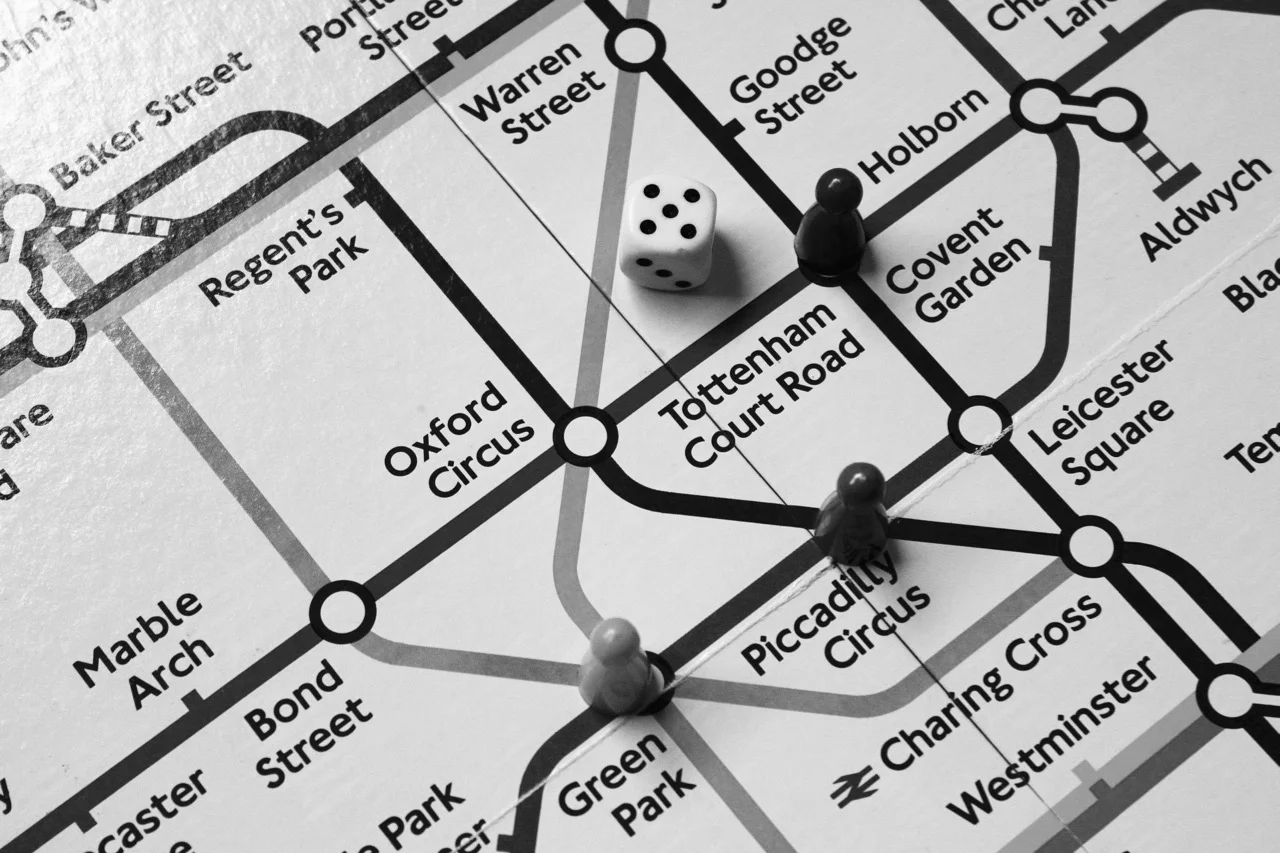
underground-2725336_1920.jpg

Journey

November 27, 2018 by Anne Atkins

May 2006

From another prayer-email-round-robin, that early summer of healing:

‘Bink has just been to a concert. Initially, she opted out because she couldn’t afford it. This was not because we hadn’t given her money. We had. Plenty. In truth, it is impossible to give Bink enough though, for luxuries like concerts, or pretty clothes, or simply enjoying herself with friends, because she never knows how much she might need for necessities. She lives in too much fear.

‘Suppose she spent money going out for the evening, and then tomorrow needed more wet wipes, loo paper, mouth wash... it would be like spending on lipstick and then watching your children starve. This is why she has never had a bank account or even an allowance. She always said it would be meaningless, because if she ran out she would have to ask us for more anyway.

‘So Bink said she wouldn’t be able to go. But her therapist said the outing would be of therapeutic value and ensured she had a ticket. Kindnesses like this mean a great deal to her.’

[It was much later that we discovered such expenses were part of her treatment, would have been funded as such, and she need never have worried about it.]

‘There they were then, three inmates – patients, freaks, what you will – trying to cross London together to reach the concert. Andrew and John (real names disguised, obviously)... and Bink.

‘“You know what it's like,” Bink said, “going out anywhere with me. I have to avoid litter bins. And dogs. And bits of the pavement. And I'm dodging all over the place trying not to let people get near me.

‘“Imagine three of us doing that, but all with different phobias...”

‘John is scared of buildings. Including the hospital they are staying in. So he has an issue with going into them.

‘But of course three loonies going out together were bound to forget all sorts of things they absolutely couldn’t leave without, so they had to keep going back... And every time they came out of the building again, John had to enact all his rituals all over again, to get over having gone into the building again. (We never discovered why he didn’t stay outside while the other two fetched things for him...)

‘Andrew, however, has performances that involve going round lampposts.

‘So every lamppost they passed was a major operation. Round and round and round, while the other two waited patiently, knowing there but for the grace of God...

‘Bink, meanwhile, is carrying her rucksack full of loo rolls.

‘(On her actual 21st birthday some previous, Serena and Alex took her out partying all night in Cambridge. At three a.m. she forgot her bag in a bar when they went on to a club, so some opportunistic thief, having noticed how carefully she nursed her treasure full of valuables, thought he’d hit the jackpot... until he got home, emptied it greedily and found it contained nothing but 24 rolls of Andrex-with-Aloe-Vera. He must be puzzling over it even now. Who knows, perhaps still there, in his thieves’ den, tearing open every square of loo roll looking for the crack cocaine which he’s convinced must be hidden in there for Bink to have stuck to it so carefully all evening... Gradually going mad himself.)

‘Naturally, they also had to find a route that avoided King’s Cross, because John (or Andrew) has a thing about King’s Cross, allegedly because of the bomb.

‘So their progress – avoiding buildings, alternately giving a wide berth to lampposts or circling endlessly around them, carrying industrial quantities of loo rolls and having to take an eccentric route three-quarters of the way around the wrong bits of London so they wouldn’t have to transverse King’s Cross – was not only circuitous but pretty tortured.

‘“Weren’t you terribly late?” Serena asked, somewhat naïvely.

‘“That didn’t matter. The person we were meeting also has OCD, so he was even later.”

‘(And of course, once they got there, because Bink can't use loos, every time she needed the loo Andrew, or possibly John, had to accompany her outside to help find a patch of grass’ while John, or possibly, kept guard so she wasn’t overlooked...)

‘Bunch of nutters.

‘Well, yes.’ 

November 27, 2018 /Anne Atkins
Treatment for OCD, Royal Bethlem Hospital Anxiety Disorders Unit
Comment
suitcase-1412996_1920.jpg

Please pray for me

November 26, 2018 by Anne Atkins

I have just found this email, the first of many I sent from that tiny little study in that sweet little cottage, twelve years ago:


‘April 2006

‘Dear Friends

‘Shaun and I have just dropped Bink off at the Bethlem Hospital, where she is due to stay for twelve weeks. The last thing she said as we said goodbye (having somehow managed to give me a hug for the first time since the last – disastrous – stay in hospital five years ago) was “please ask everyone to pray for me”, so this is what I am doing. Please forgive the round robin: I never send these things because they're so impersonal, but I hope you’ll allow it on this occasion.

‘This is what she has asked us to pray for: 

  1. That she gets better! It is possible to get 100% better from OCD. Rare, yes; unlikely, for someone who suffers from such a severe form of the disorder, perhaps... but still possible. A week ago (the weekend we moved into this cottage) Serena organised a 21st birthday dinner for Bink and a small handful of her few best friends (all men, naturally...); I had spent the day getting new clothes and a makeup lesson for her, and she looked absolutely stunning... just, I thought, as she would have looked if she had grown up never having got ill ten years ago. She was sparkling and funny and exuberant and joyful, and we laughed till our sides ached until the clocks sprang forward and way beyond, and perhaps for the first time since her childhood I could imagine what her life would be like if she really could get better. We will never redeem her childhood or recover anything from her wretched adolescence, but it is possible that she could enjoy her twenties and more. Please pray for this.

  2. That she doesn't “freak out”. I think what she means by this is that the treatment is terrifying: a question of setting the most ghastly challenges possible (the equivalent, for the rest of us, of daily bungee jumps, eating live maggots and cockroaches, leaping into scalding water or frozen seas, being shouted at by Alan Sugar in front of a million viewers... imagine whatever you're most frightened of and would cause you most pain, and having to do it every day for 12 weeks) and she wants us to pray that she doesn't suffer awful panic attacks, or fail to cope without us there to catch the pieces.

‘I would like to add three prayers of my own, though they are much more trivial.

  1. She has been offered a job to start in two and a half weeks, working in her old prep school. After the first two weeks, you are allowed to combine the hospital treatment with outside activities if you can. Obviously it's much more important to get better, but it is a super job: giving her responsibility, self-esteem and experience in the only career she's ever expressed an interest in, and a nest egg for university.

  2. There is as yet no way forward for her to be able to take up her place at Cambridge next October (her college hasn't got appropriate accommodation for her). She had her disability assessment last week, and the Admissions Tutor, Disability Resource Centre and I are trying every avenue we can think of... but we've been doing this since January and we haven't yet found an answer. Please pray for a solution so she can take up the place.

  3. Very distressingly (and inexplicably) the vendor of the church-owned cottage we are now in ignored all Bink's instructions and all the details they'd spent hours agreeing together, and her bathroom has been fitted up completely wrong and may be no use to her at all. At its worst, what this means is that if she doesn't get better she won't be able to live with us; at best (again assuming less than total recovery) she will find it very stressful and miserable. (If she does get better we won’t care what the bathroom is like! – though it will be useless because it’s only a shower and there’s a shower elsewhere in the house.) Having discovered recently that we’ve missed five years’ entitlement to Disability Living Allowance for Bink (and probably Alex too) and Carer’s Allowance for me, I’m going to see whether the council has any disability grants available to redo the bathroom.


’Thank you for caring enough to read this. Her address until the beginning of July will be: c/o The Inpatient Cognitive Behavioural Therapy Unit, Alexandra House, Bethlem Royal Hospital, Monks Orchard Road, Beckenham, Kent, BR3 3BX. [Here followed her telephone number and email address of the time.]


‘Thank you all,


’Anne’

valentine-2343828_1920.jpg

I have felt so much, over the years, that it takes me a while to work out what I feel now.

It is a salutary lesson, reading one’s prayers from over a decade earlier. Perhaps it’s as well that we don’t often write them down.

She got to Cambridge, yes. And managed to use her shower.

I had forgotten how much worry there was about these two issues at the time. It’s true (I remember now) that I spent many months looking for suitable accommodation for her, so she could take up her university place. In the end her college gave her two rooms instead of one, so she didn’t have to share a bathroom.

And she told me the other day that the benefits from her treatment in the Bethlem are still with her today. She no longer eats all her meals wearing Marigolds, for instance.

But as for her twenties being less painful than her childhood and adolescence… oh! why did I have to read such a prayer, written at such a hopeful time?

Still, we can pray for her thirties, can’t we?

It’s not that old, for your life to start…

November 26, 2018 /Anne Atkins
Royal Bethlem Hospital, Treatment for OCD, Prayer letter
Comment
Fireworks

Bedford pre-Christmas fireworks, November 2018

Celebrations

November 25, 2018 by Anne Atkins

Sunday

Despite our time – in that pretty cottage, in that pretty village, opposite that pretty church – being very challenging all the time we lived there, we have lots of lovely memories.

Our neighbours were the best in the world.

2nd April, 2006

On that very first Sunday, the day after Bink’s 21st birthday, I tipped everyone out of bed and said from now on we’d be supporting our new tiny village church, barely a hundred yards from our door.

The one with the glorious bells.

There were a few grumbles and some extra snores. But we all made it.

Apart from Shaun, of course, who was employed to be at a different church altogether. (A church which, incidentally, still expected us to be attending it. I had told the vicar before we even left London that if we were housed outside Oxford I would attend our parish church, wherever that might be. And the children would probably follow me. He hadn’t believed me, perhaps because it didn’t occur to him that some people do what they say they will. Far less important was that we only had one car, that church was seven miles away and Shaun would need to be there an hour or two earlier than anyone else.)

The Atkins family soon swelled the electoral roll of the village church by nearly 50%. Within eighteen months Radio 4’s Sunday Worship programme was broadcast from it.

That very first morning we were warmly befriended by Muriel and Bob, retired farmers, who invited Rosie to play at their house any time she liked. They were only a couple of minutes away, and she quickly learnt the lane to their cottage.

9th April 2006.

Soon, too, we were invited to the Manor House: ours was the humble Manor Cottage, in the once Manor grounds. Would we like coffee on Sunday morning? I said we’d be at church – a very slight, “oh!” – but we’d love to call in afterwards.

The lady of the Manor would obviously be gracious and elderly, with grey hair and perhaps a bun. A sort of friendly Miss Haversham.

I dressed carefully.

And, wow! Met one of my now bestest friends. Blonde and gorgeous and vivacious and full to the brim and overflowing with love. That very first morning together we started organising a joint fête, to span our two gardens and raise money for the struggling church. Soon, there was a hole in the wall between our tiny patch and their spacious grounds, making the gardens one.

Rose told me last night that she went through it, as we often did, tripped down the stone steps to their barbecue and had an egg on her forehead for Easter.

Joanna and her adorable (slightly quieter, more academic) husband filled our spirits all the time we lived there. With spirits, mostly.

Gin when the going was bad. Champagne when it was good.

We got through a lot of gin.

But actually, a fair bit of champagne, too. Joanna can turn anything to celebration.

And tomorrow, they are hosting a party at their Manor House to launch my new novel, not even (quite) out yet – though beginning to garner some interest.

I am expecting a lot of bubbly...

Bink will not be at the party. She is still on the Priory’s bootcamp, and not allowed out.

Am I sad? Yes and no.

Mostly no.

Of course I’m sad that she won’t be popping the corks with us. Of course I’m sad because she herself is sad to be missing two of our dearest friends and their very dear home, which meant so much to us and kept us cheerful for so long.

But am I sad she is getting treatment? Am I sad she is on a strict programme to enable her to overcome her OCD?

Was I sad to hear these words: “Oh well. I probably shouldn’t be partying for a while yet anyway.”

Is the Chief Rabbi circumcised?

jonathan-daniels-385121-unsplash.jpg

(To be honest, I’ve never asked him.)

November 25, 2018 /Anne Atkins
Living with OCD, Addiction Treatment Programme, Priory Hospital
1 Comment
buddha-452028_1920.jpg

And a birthday

November 24, 2018 by Anne Atkins

All Fools’ Day, 2006.

That day, Saturday 1st April, was the day we moved in.

And that evening, we celebrated Bink’s 21st birthday.

If you’ve ever had a party on the very day you move into a new home... well, I was going to say you’ll know what it’s like. But you won’t really. Because either it was your first ever student pad and you had nothing to move into it other than a few mugs, a kettle and some books.

Or you’re completely barmy.

Or, I suppose, your life has become so surreal that nothing conforms to anything any more.

So there we were, marking Bink’s most significant milestone into adulthood, with a dinner party around our dear familiar kitchen table from the Vicarage which we’d had specially made, out of hundred-year-old pine, in the days when we had a home.

Boxes to left of us, boxes to right of us, boxes in front of us. Over, under and all around. Boxed in by cardboard… as wallpaper, and carpeting, and almost on the ceiling. Only a fraction of our possessions, mind you, from fourteen years in a six-bedroom Victorian Vicarage. (The rest, a kind new friend from the Oxford church had put in a barn on his farm. The garage was full of them too.)

Most of which were to remain unpacked all the time we lived in that dear little cottage. They took up less space that way, stacked eight or ten high against the wall in the hall. And the landing upstairs. And our bedroom. And the bathroom.

Shaun was never given the few weeks off to unpack which clergy are normally allocated between posts. And I never had the heart. Even if we’d had room.

After all, it would have suggested we might be staying...

Bink invited her A-level tutors, including the aforementioned Mad Richard who’d taught her maths. And another, who’d taught her Latin, also still a good friend all these years on. And her best friend from junior school, by now a medic at Oxford: the two had become inseparable as children, long before either was ill with painfully similar ailments, in their teens. The friend’s mother, still close and dear to us, believed they must have recognised one another, seen their mirrored futures, long before any of us had any idea.

And Bink’s new boyfriend… Wow! Where did that come from? I can’t remember where he came from, to be honest. But Bink now had a boyfriend. Training to be a vicar, as far as I recall. Celebrating his 30th birthday, more or less.

After a drink or two Ben told him, if he wanted to date his sister, he had to endure trial by arm-wrestle. Well now, this boyfriend had a gym membership, and body-building pretensions, and all that guff. So he could hardly say no to Bink’s baby brother. He rolled up his sleeve and furrowed his brow and gripped Ben’s arm... and sweated a lot... and concentrated a lot more... and grunted much.

While Ben continued drinking and chatting and joshing with the rest of us. Then suddenly turned, as if he’d forgotten all about it, said, “Oh, sorry,” and flattened the boyfriend’s arm on the table.

Someone’s telephone rang. For Bink. Some manic, babbling Chinaman, with terrible English, completely incomprehensible, extremely distorted.

After a number of Bink’s “Sorry?”s and “What?”s and “Could you say that again?”s, and us wondering how on earth this call had come from half way round the world (or had somebody ordered a takeaway round the corner?) someone, probably Alex, went out into the hall and started opening cupboard doors. And there, crouched on the floor, was Mad Richard on the other end of the line.

It was the last place in the world I wanted to be. (Well, except the house with the windowless room in the middle of it.) But I was with the people I most wanted to be with. Which is a bit better than a poke in the eye with a burnt stick, without the people you most want to be with. Isn’t it?

On this morning’s Thought for the Day (which I can’t link you to yet because it was only half an hour ago) on Radio 4’s Today programme, Brian Draper quoted a Pole, exiled to Siberia, who lost all his possessions. “I have life. I have breath. I have shelter. I am here.”

I had my own mantra. It’s possible I originally penned it in the Vicarage, when Bink became ill and I first experienced depression, but it became much more important to me in that tiny little cottage. I stuck it on the wall in my new study, too minuscule to turn around in:

I have not committed suicide.

I have not committed adultery.

I have not been found out by the tax man.

I am a success!

(As Serena said, it was the “not found out” that was slightly disturbing.)

We still had a lot to laugh about.

[And the picture? This was the nearest I could get to Mad Richard hiding in the cupboard.

Probably something to do with politically correct squeamishness, but if you search on all the free photograph sites for “Mad Chinaman hiding in cupboard on telephone” – or even, “Mad mathematician posing as mad Chinaman… &c.” – there’s less choice there than you might think.

Besides, this is a pretty good likeness anyway.]

November 24, 2018 /Anne Atkins
Comment
bell-97784_1920.jpg

Benefits, birdsong and bells.

November 23, 2018 by Anne Atkins

Lent 2006

Those three months spent living with my parents, like so much before and afterwards, were just a matter of survival.

I kept trying to write. I kept failing.

My memory is of sitting in the neighbours’ new, clean house, Rosie playing at my feet, Bink no doubt washing in the background, writing endless long emails to my cousin Fleur. Feeling endlessly guilty.

Strictly speaking it wasn’t that I couldn’t write. In truth, I couldn’t stop. Words poured out of me like tears, all the day long. I just couldn’t write anything constructive or disciplined or book-shaped.

I found a little house for sale in Newnham, near Rosie’s – and my – nursery school, and desperately wanted to buy it and settle there. I’d have to borrow money from my family, though. And no one could see the sense in it: Shaun’s job was in Oxford.

There was a vacancy for a vicar, just round the corner, near where I was brought up. I dreamt and dreamt of Rosie waking to the birdsong I’d heard as a child, my mother lying on my bed beside me in the barely lightening morning, teaching me to listen to the Dawn Chorus.

Shaun applied for it… and wasn’t even called for interview. It was three years before we learnt the bizarre and sinister reason why. (And no, it was nothing to do with Shaun himself.)

Meanwhile, I arranged for someone to come and assist Bink in applying for the Disability Benefits she’d been entitled to for years. Page after page after dozens of them. How many minutes in the night she needed help. Whether she could make a cup of tea.

Even after several hours, with professional help, the process had barely started. It was to take many months and several visits, even with a trained member of staff.

A year or two later, such help was discontinued.

The brutal truth was that if you were half-ill enough to qualify, you’d be far too ill to apply. I couldn’t help wondering who managed to make any money out of it…

The neighbours came back from Australia and needed their house back. Bink’s place in the Bethlem wasn’t yet ready. And Shaun’s employing Oxford church had at last bought the sweet little cottage for us.

The last thing I wanted was to go back to Oxfordshire. But there was no sensible alternative.

Just as we were about to leave, Alex’s college finally thought to inform us that he’d been told to step down for the rest of the year. Because he’d missed too much of the course. Because they’d appointed the wrong kind of mentor for him. Because (you may remember) when a mother tells the (expert) professionals the kind of mentor her (technically adult) son needs, she’s being an interfering fusspot and must be politely (or not) ignored.

So... obviously they’d learnt from that mistake and kept his family in the loop this time, right?

You think?

And the condition of Alex’s leaving was that he was barred from living in Cambridge.

So he and Shaun moved into the little cottage first, the rest of us to follow in a few days. 

(And if you want to read more about Alex, you might be interested in this article in today’s Mail.)

Saturday. Mid-morning. Shaun rang.

“Listen!”

So I listened. I heard chirrups and trills and the chuck-chuck-chuck of diligent and energetic birdsong. And then I heard something else.

Bells. Peal after peal after peal. Merry and laughing and dancing. Singing in the air.

“Where?”

“Through our bedroom window.”

I knew we were right to choose the little cottage, just up from the tiny church.

November 23, 2018 /Anne Atkins
2 Comments
andrew-neel-98872-unsplash.jpg

Shame

November 22, 2018 by Anne Atkins

January 2006

Living on the edge of Cambridge, Bink and I were able to see Serena (at Trinity) and Alex (at Peterhouse) often, for tea in the Grad Pad or a drink in the Eagle. Though without a car or child seat on my parents’ bikes, not easily and only when we could leave Rosie behind or she was attending nursery school.

It was late January. Serena rang me, early afternoon. “Can you come immediately?” All she could tell me was that Bink was with her in her rooms, extremely distressed. She had begged Serena not to tell me but she had somehow gently persuaded her it would be ok.

I had to promise though, absolutely, not to breathe a word to Shaun. 

Shaun is hardly the fierce pater familias. What could Bink possibly be so frightened of?

Pregnancy. Must be. There is nothing else that scary.

It was twenty minutes by bike, leaving immediately and pedalling as hard as I could.

Bink was in a dreadful state, sobbing uncontrollably.

Poor child! How long she had coped without telling any of us...?

When the children were much younger, my dear mother had given each of them two hundred pounds. I had taken all four to the Post Office, so they could each open an account. A couple of years later she gave them all the same again.

So Bink, like the others, had four hundred pounds carefully saved over ten years, with interest, waiting for something important enough to spend it on. Serena had been allowed to invest half of her nest-egg buying chickens, when she was twelve and had first expressed an interest in becoming a farmer. She had to keep accounts, and sell the eggs, and kill any surplus cocks herself... and discover, by doing everything herself, what a very expensive hobby farming can be.

The other three had not touched their precious pots. As far as I knew.

What I didn’t know was that for years, Bink had needed up to a hundred pounds’ worth of toiletries every single week. Her savings had disappeared very quickly. And then the rest of Serena’s, with Serena sworn to secrecy.

And then what? She knew we couldn’t afford that kind of expenditure. What else was left to her to do?

So she had no option but to help herself. Without paying. For years. Until that fateful day when she was caught.

First in Boots. And then, because she had unpaid-for goods from the previous shop and she was searched, Sainsbury’s too. She had been told she wouldn’t be arrested and charged on this occasion, but banned from both shops indefinitely. 

The shame couldn’t have been greater if she had been an unmarried teenager in Catholic Ireland half a century earlier.

And poor little Bink did it out of concern for her parents. Knowing we couldn’t afford to pay for her habit. Her addiction. To cleanliness.

Serena and I reassured her, and loved her, and calmed her, and somehow persuaded her that Shaun would understand. Then I rang both shops and explained.

They were lovely. Both managers very understanding. Both assured me they wouldn’t take it any further.

Neither offered to lift the bans.

What was Bink to do? She couldn’t survive without toiletries! Without ever going into Boots...

She would have to rely on the rest of us.

It wasn’t until she was about to start at Cambridge University six months later that I rang both shops again and she was allowed to use them once more.

Years later, Serena commented on the way it was handled.

Bink had been beside herself, scared out of her wits. I, in my naïvety, assumed the shops were being generous and charitable in not pressing charges. I was almost as relieved as she was.

Serena thought otherwise. Bink had a registered and very severe disability. She was about to be hospitalised for several months. Any attempt at prosecution wouldn’t have survived five minutes’ scrutiny.

“I doubt it was even legal, to frighten her like that...”

November 22, 2018 /Anne Atkins
Living with OCD
Comment
mammal-3128440_1920.jpg

Information underload

November 21, 2018 by Anne Atkins

January 2006

Bink had accepted her place at Cambridge to start in the Michaelmas term. And had been accepted for treatment for OCD in the Bethlem Hospital as soon as there was a bed available.

The second surely even more miraculous than the first.

On the downside, we still had nowhere to live...

Amazing parents though I’ve had the privilege to have, they were nearly ninety now. And like most nearly-ninety-year-olds, their house was… hmmm… well, a bit old, and unmodernised, and not as spic-and-span as it might have been, nor their cleaner as diligent as she could have been. And Bink has a bit of a problem with all of this kind of rough and tumble of a house’s hygiene.

But their extraordinarily kind next-door neighbours, whose cleaner was a lot more conscientious, were going to Australia for five weeks and they lent us theirs. Which made Bink very happy. She kept going round it saying what a lovely clean house it was…

I was in constant communication with the Bethlem about when they could take her, and how to help her get ready for admission. She needed to be clean, and have all her clothes clean, and be in a clean environment. And all that OCD stuff. Before she could be treated for her OCD.

“Don’t enable her illness!” I was told repeatedly.

Not for the first time, I wondered if any of these therapists had ever tried living with OCD.

If I don’t enable her, she’ll never ruddy get there, will she? If she doesn’t manage to do all these loopy things she has to achieve before she can get into hospital, we’ll still be here in ten years’ time waiting for her to get into hospital.

Isn’t that your job, to fix her OCD?

(We had to do the same before she could go into the Priory, a few weeks ago. We’ve promised no one will touch her room. Which is a bit of a bummer, really, because our house is now our only source of income; and Bink’s bedroom is the only room with en suite facilities; and every weekend we fill our house with a hen party of gezillions of hens wanting to shower all day, and we only have one shower between all of us.

Still, what’s a few poor reviews on Airbnb – and another source of income gone – if it means Bink can get well, eh…?)

Meanwhile, because she’d had to turn down a well-paid job in order to accept treatment, it occurred to me that perhaps she might be able to claim Job Seeker’s Allowance to go some small way towards making up for it. And it was then that I discovered what we should have been told years before: ever since she’d got ill she’d been entitled to Disability Benefit, and I to Carer’s Allowance.

What a difference this could have made! I lost about two thirds of my income since Bink became ill.

And if we’d also been told – by any of the many mental health professionals we’d been in touch with over six years – that we could have claimed a Disability Grant for her to have her own shower at the Vicarage when she first got ill, she never need have ended up in the Florence Nightingale Unit and might hardly now be ill at all.

You’d think, if you work in something as vague and amorphous as mental health, you might at the very least do the one thing you know will be helpful, right? At least telling you you’re entitled to benefits can’t ever actually damage you…

When our children were much younger and one of them had a very traumatic time in hospital, we were offered a few sessions of family therapy. In the very first session the psychologist did the single most helpful and important thing it was possible to do: she said Alex was unhappy at his school; advised that we should move him to another; and procured for him a virtually free place in the one and only school where he was truly and blissfully happy: Finton House, in South London, with an integration policy on Special Needs.

That’s what I call a shrink being seriously useful.

The other person I needed to look after was Rose, now two and a half and surely, after our beautiful isolation in Scotland, ready to benefit from other children to play with. I went to look round a nursery school in Newnham, the other side of Cambridge... and as I did so, realised with a wave of astonishment and joy that I was standing in my own nursery school! And with it all the happy years, going to school on the back of my mother’s bicycle, when any ailment could be solved by her warm and lovely embrace and ready reassurances, came flooding back to me.

And here was the very same room I hadn’t daren’t enter… I had been offered the choice but no one thought to tell me what they actually did in there, so for all I knew, there might have been a wild ravening lion eating up all the little children. And I discovered too late and to my devastating disappointment that I could have learnt to read earlier than I did. How I regretted my foolish cowardice! (It never occurred to me that the grown-ups could have been to blame.)

It was as wonderful as it had been. The owner had a policy of children playing in the garden every single day, come rain or snow or hurricane. Gumboots, sou’westers and a healthy attitude to jumping in puddles.

I took the form home and Bink helped Rosie fill it in. “Is there anything you don’t like to eat?” it asked. “Chairs,” Bink wrote to Rosie’s dictation.

Alas, it didn’t prove quite so easy to step back into the happiness of my own nursery years. Far less move my family back to the friendly city I longed to stay in now…

November 21, 2018 /Anne Atkins
5 Comments
Dominos

Not single spies but in battalions

November 20, 2018 by Anne Atkins

Don’t you love today’s news story?

Pretend doctor practises for 23 years without the appropriate qualifications, no one noticing anything untoward. Not her patients: not her colleagues.

You can’t imagine a brain surgeon faking it in the operating theatre, can you? Or a cardiologist pretending to know how to fit a pacemaker? Any more than you could pretend to be a violinist when you don’t know an A string from an E: because that is a real, measurable skill.

There is only one medical discipline, of all of them, which you could make up as you go along. And nobody notice.

(And as Ben said, quite possibly do a lot less damage than the real thing...)


But back to

January 2006

and how was Bink coping with all we were going though?

I estimated at the time that it set her back five years of her previous recovery. Which turned out to be a lot more than five years of her future development, in the effect it had.

I learnt, over and over again during that dismal time, why sorrows come not single spies. One knocking another knocking another in a long and overwhelming line throughout our family.

She was absolutely right that losing her medication had lost her a place at the college she had applied to. Nevertheless, she was pooled and offered a place at another Cambridge college. 

She wanted to turn it down and apply again the following year.

It sounds absurd, I know – and everyone told her it was – but I understood her reasoning. It was at a single sex college, for mature students: she would be 21 by the time she started. She should have got into the college she’d applied to; and if she hadn’t lost her medication just before her interviews, probably would have done. And she would have been really happy there.

Bink was not one of those who socialised more naturally with her own sex: she hated being at a girls’ senior school, after a mixed prep school where all her friends were boys. (Like me at her age, she was a tomboy. Like me too, if we’d both lived in a later age, she would almost certainly have identified as a boy. Either of us quite possibly opting for transition. Thank goodness we lived when we did: what a scary thought…)

And a mature college more or less shuts down at the weekends.

But everyone told her it would be irresponsible. So she gave in and agreed to start at Cambridge the following Michaelmas.

She went to London for an interview at her old school and was offered a smashing job: an extremely well-paid post as a teacher’s assistant. It would have covered a substantial proportion of her expenses at university. And spring-boarded her into work afterwards.

But she also went for an OCD assessment at the Bethlem Hospital and was told yes, she was easily ill enough to bypass a GP’s referral and be admitted as soon as they had a bed, probably in April.

She couldn’t do both. She chose hospital.

It was wise – and remained, until this year, almost the only effective treatment she has ever been offered for her OCD, giving lasting help.

But the other side of it was is that, to this day, she has never done a day’s paid work. Having that on her CV would have enabled her a number of times since. She offered herself for voluntary work in a church primary school, for instance, but was turned down when the head discovered she had no experience.

So being homeless, by robbing her of the recovery which she, and we, had worked so hard for since the Florence Nightingale Unit, also robbed her of any work she could have done for many years to come.

Domino effect.

November 20, 2018 /Anne Atkins
Living with OCD, Living with homelessness, Florence Nightingale Hospital
Comment
haley-powers-370168-unsplash.jpg

Clean socks or a Bible?

November 19, 2018 by Anne Atkins

January 2006

That meeting, between the vicar and me in Oxford, spelt the end of the peace and tranquility I’d experienced at our friend Louis’s beautiful house in Scotland. From then on I was overwhelmed by a raging, roaring vortex of drowning depression.

(Warning: never interfere with quick-fix simplistic panacea for complex ongoing issue. Particularly pertinent on subject of mental health.)

I longed to stay in Cambridge, the city of my so-happy childhood and teen years. Near my children (Serena and Alex were at the university) after their recent experiences. And my parents, now nearly ninety and increasingly frail. But our only chance would be for Shaun to find another post with accommodation…

Meanwhile we needed somewhere, anywhere, to live. The Oxford church was still determined to buy, not rent for us. Over the New Year, Shaun had taken us to view a new-build some miles out of the city.

Almost immediately I’d had to run out of the house again and sit in the car. There was a room right in the middle of it with no windows at all. Even if I never entered it, simply knowing it was there – like Bink’s illness, a black hole at the centre of our family – would suck all the light from our lives. 

I said nothing to the others. How could I? But as we drove away, Shaun pointed out a sweet little thatched cottage, right on the pavement, also within the budget but not yet available to view.

“Stop the car!”

“Please,” I asked the woman at the door. “Will you let us see round?”

“Not now. It’s a terrible mess.”

“Please.”

It was a terrible mess. Cat food on the carpet; dirty laundry sprawling off the sofa; teenagers in bed; filthy plates everywhere. About a quarter the size we needed.

“This one,” I told Shaun. It was far, far too small. And miles from his parish. But oh-so pretty. Next to the gracious Manor House and just up the lane from the little church.

I don’t consider myself particularly fragile in other ways, so I wonder how unusual this is: my mental health being so dependent on place and environment? (I’d be interested to know if any readers are the same.) When I first bicycled past our Parson’s Green Vicarage, long before Shaun was vicar there, I’d experienced a falling in love, just as with a person…

The meeting was some time after this. And a disaster.

The friend who’d so fiercely promised justice for us suddenly shifted ground without warning, and simply asked the vicar and me to tell each other what we’d done wrong and say we forgave each other. I had no difficulty with the forgiveness: I didn’t wish him harm, nor any evil on his head.

I just wanted us to escape. Since we now knew the church wouldn’t house us in any way that would enable Shaun to do the job properly.

And meanwhile, urgently, somewhere for my children to live. 

I didn’t care about his forgiveness one way or the other, not knowing any way I’d wronged him. It was our children we’d sinned against, by being so recklessly trusting, and leaving their previous home.

He asked if the cottage we’d suggested was right for us. It had come back with the kind of survey you’d expect of a thatched seventeenth-century cottage, and was no use to the church for anything else.

What could I say? I’d made all my much more sensible suggestions a year earlier, when I’d found two large Oxford vicarages, one already empty and with a peppercorn rent. I knew buying the cottage would spell the end of Shaun’s employment with the church: gorgeous though it was, it was miles out the parish, and tiny. But the last time we’d said a house wasn’t appropriate we’d been put out on the streets.

So I said nothing.

And that was the end of the meeting. All I heard afterwards was that they were all shocked at how wrecked I looked. The most useless insult I’ve had in my life was the vicar (who had apparently expected to breeze in, all charm and bonhomie, and give me a kiss) advising Shaun that I didn’t seem at all well and should see a doctor.

I went back to my parents’ in Cambridge. Rose and Bink and I. And the dogs, to live in the car.

Sometime later my clergyman friend, who had called the meeting, sent me a Biblical verse to be helpful.

“Can’t look it up,” I replied. “Lost my Bible many moves ago.”

He told me to do myself a kindness and get another.

Well, yes… Up to a point, Lord C.

But believe me, when you’ve lost all your socks apart from the ones on your feet, which you wash in your bath every night so you can leave them to dry for the morning, it’s not a Bible you need.

One lasting blessing to come out of that Christmas was our friendship with the doctors from Malawi who’d lent us their new home. She, too, had suffered years of debilitating depression and spotted it immediately. I barely knew her, but every day she sent me a text, from her home in Oxford, asking how I was, in Cambridge.

Her kindnesses became unbelievably precious.

As, however, did my sleep. When you’re depressed, it’s one of the first things to go. You might, if you’re lucky, fall asleep at the beginning of the night. Then wake at one. Or two. Or three. Or all of them... if you’re fortunate enough to sleep in between. Or you might be awake for hours... and, again if you’re blessed, fall asleep around breakfast time.

The telephone I had at the time would bleep when it got a text. And go on bleeping. Every few minutes. Until it was attended to. Something which is quite challenging – depressed or not – is sleeping through chronic, persistent, continual bleeping.

“How are you?” came another solicitous message.

“Well, I was a little better... Until a text message woke me up.”

On one of Shaun’s weekly visits we walked past David’s Bookshop (secondhand). I nipped in and asked for the cheapest Authorised Version he had.

Sadly, he didn’t sell socks.

November 19, 2018 /Anne Atkins
Living with homelessness, Living with depression
4 Comments
Apple

Owning up

November 18, 2018 by Anne Atkins

Sunday

On Friday, reader Helen asked a pertinent question on Guilt. How can Christians demand forgiveness of a wrong that is still ongoing? (Apologies: this has turned into enough for two posts. I should have started yesterday. Sunday is always good news, and today’s news.)

I gave much thought to forgiveness over those years – what it involves; how it feels; whether it wipes everything out – and we may return to it.

But Helen’s question is particularly timely this week.

In principle, we can be called to unconditional forgiveness. African slaves on American cotton plantations had little enough alternative, and no hope of redress… in this life.

Our Lord forgave on the cross… an ill that was very much ongoing.

But Helen asked how we could be required to forgive by those allowing the wrong to continue? It would stick in the gullet, wouldn’t it, if the slave-owners or executioners themselves preached the need for forgiveness?

(I’ve asked myself a related question in the writing of fiction. And am speaking on this in Cambridge on the evening of 5th December. How to portray evil? Do we create the cunning Iago, with no redeeming features at all? Or the far more murderous Othello and Shylock, whom we sympathise with much more?)

The fundamental challenge, as I see it, is this:

When I do wrong, I still have to live with myself. If I can’t, the game is over. And the longer, deeper and more devastating the wrong I have done, the harder this is to do.

1. The easiest way is to argue the evil away. How did the Nazis do what they did? By telling themselves Jews are not really human, so it wasn’t wrong. The same with Negro slaves. Or the disabled or homeless or mentally ill, or any abused group. (Some might even say, unborn children.)

We are on the same spectrum when we argue anything from our own point of view. Last time you had an quarrel, did it go:

“I was really unkind to you last night.”

“Well actually it was my fault, for being rude.”

“Yes but that’s because I belittled your mother first”?

Much more likely the other way around.

So bear in mind, regarding our homelessness, I am giving my side of the story. To many in the church, I don’t suppose there was a wrong at all.

a) The vast majority probably didn’t know. I’ve said before that in a church of many hundred you become a customer, to be served; not a family member, to own.

Shaun was allocated half a vestry as his study. After August 2005 this also had to house the clothes, books and musical instruments we’d brought from London for our few months in rented accommodation... before that ran out. A member of the church called to see him, and found him eventually, at his hidden-away desk, through a narrow path between cardboard boxes piled seven foot high and far more deep.

“Gosh,” his visitor said, astonished. “This is real, isn’t it?” 

b) The minority with responsibility on the (far-too-big) PCC presumably thought someone else was solving it. They must be. They couldn’t just have voted for us to be actually homeless, could they? One went home to her husband – a truly kind couple, who helped us hugely later – who asked her, “But where are the Atkinses going to live?”

“I don’t know,” she said. “I wondered that...”

c) And the tiny few who knew exactly what they were doing? They told themselves it wasn’t wrong. We were to blame.

If you remember, we were persuaded – our hearts in our mouths – to tell the PCC, if they bought the house I knew I couldn’t cope with (so much so, that all I could think of was to leave my family and go home to my parents’), that Shaun would look for other work. Anything less was irresponsible. So the purchase was aborted.

Which was interpreted as our refusing accommodation, and choosing to be homeless.

And that’s how it was (eventually) told to the many.

So from one point of view, there was no wrong ongoing. It was my fault for being difficult. I reaped my deserts.

(Jumping ahead a bit, my response – avoiding the vicar, the church, even the city I once loved as much as my home town of Cambridge, where Shaun and I met and fell in love; which I even now stay away from as much as I can – must have seemed the result of resentment or anger: the remedy, forgiveness. It wasn’t at all: it was the result of trauma; the only way I knew to keep going.)

I never quite worked out how my children deserved it too.

But this I did know. The vicar was a sportsman. He liked to win. I wasn’t doing as I was told. I could see as well as the next man that by far the most effective way to beat me was through my children.

2. There is another way, however, to live with the wrongs we have done. Much tougher, more painful and daunting.

Bink is currently on the Priory’s Addiction Treatment Programme. 

Last Wednesday she was allowed two guests for the Families’ Day, and invited Shaun and me.

I can’t tell you about the sessions, because they were confidential. I can tell you the procedure, because we were told this in advance. We were each required to write our own “Consequences Letter” telling our loved one what effect her addiction has had on us.

We were to pull no punches and spare no feelings.

This would be read out to the addressee, face to face, in a circle of others.

We were allowed one page, and twenty minutes to write. I described Bink’s addiction to destructive thinking, mostly around washing, and what it has done to us. I pulled no punches.

I can also tell you Bink’s reaction, because she has given me permission to write anything about her treatment.

She was devastated. Distraught. So much that I cry now, thinking of her, broken and wretched at what she has done. Or her illness has done through her.

The addict is allowed to respond. She couldn’t. For minutes she had no words, she was sobbing so, until coaxed by the therapist.

It hurt to have hurt her so much, and I feared she’d wish she hadn’t invited us. At tea afterwards I asked if the session had been helpful.

“Oh yes,” she said. “Very.”

That is courage. That is facing up to wrongs done. That is the honest way to live with our true selves.

To say: “I’ve done it. I own it.” And eventually, “I repent of it.”

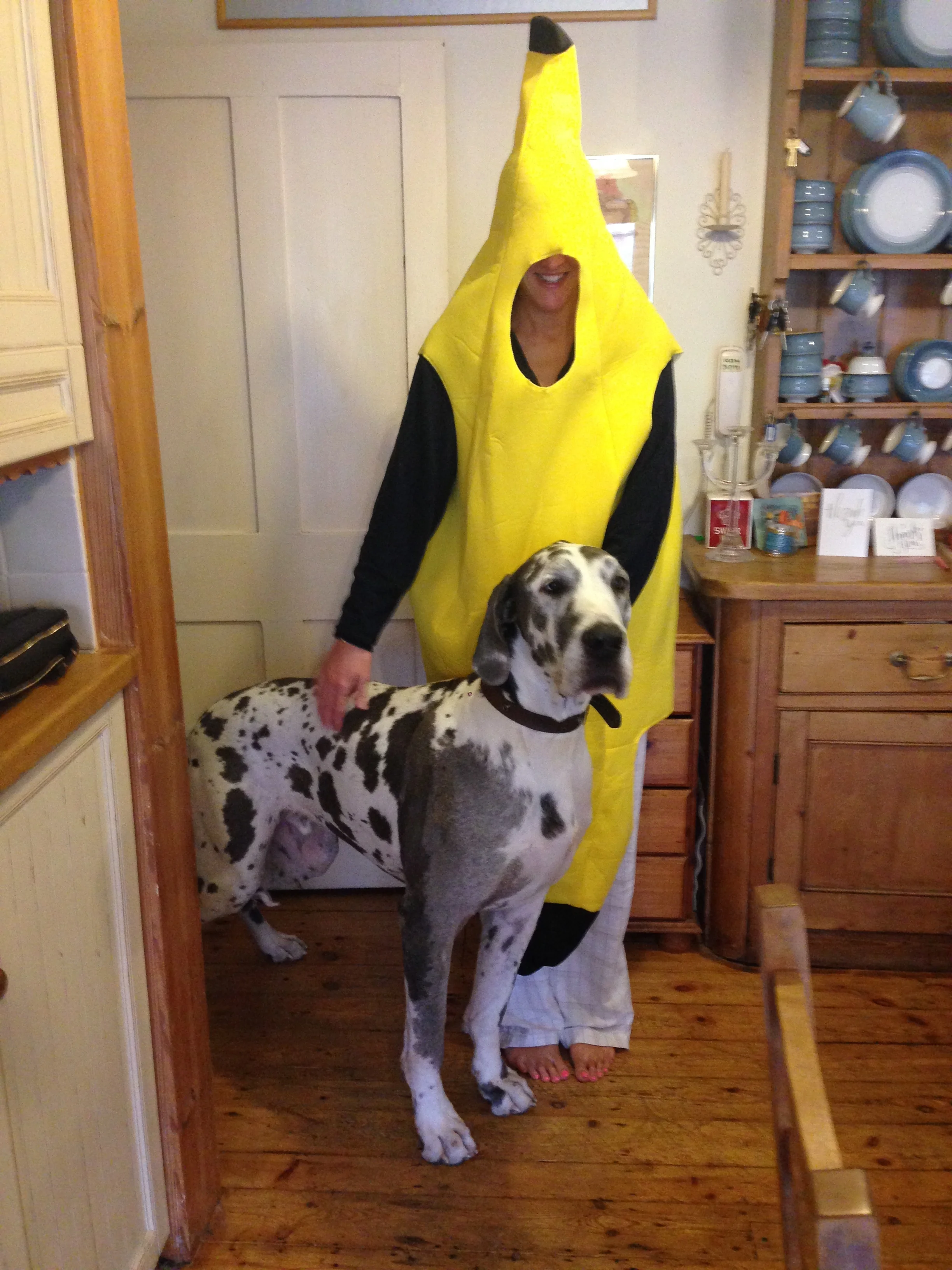
Now, its being Sunday, here is Horatio with a banana.

IMG_2857.JPG

Every Sunday I give you colour photographs I’ve taken myself. There had to come a time when the link would be tenuous...

Now that Shaun has left his job and until he has another, our only income is letting out our home. We are very popular with hen parties. Horatio loves them, and flirts with all the girls.

One bride (a six foot doctor) was a yellow duck all weekend. This morning, Shaun came back from his shower having just bumped into a banana.

Facing her dæmons as she is, why shouldn’t Bink be well? Once well, why shouldn’t she fall in love? In love, why shouldn’t she have a hen party all of her own?

And dress as a banana…

November 18, 2018 /Anne Atkins
Christian forgiveness, Living with mental illness, Priory Hospital, Addiction Treatment Programme
5 Comments
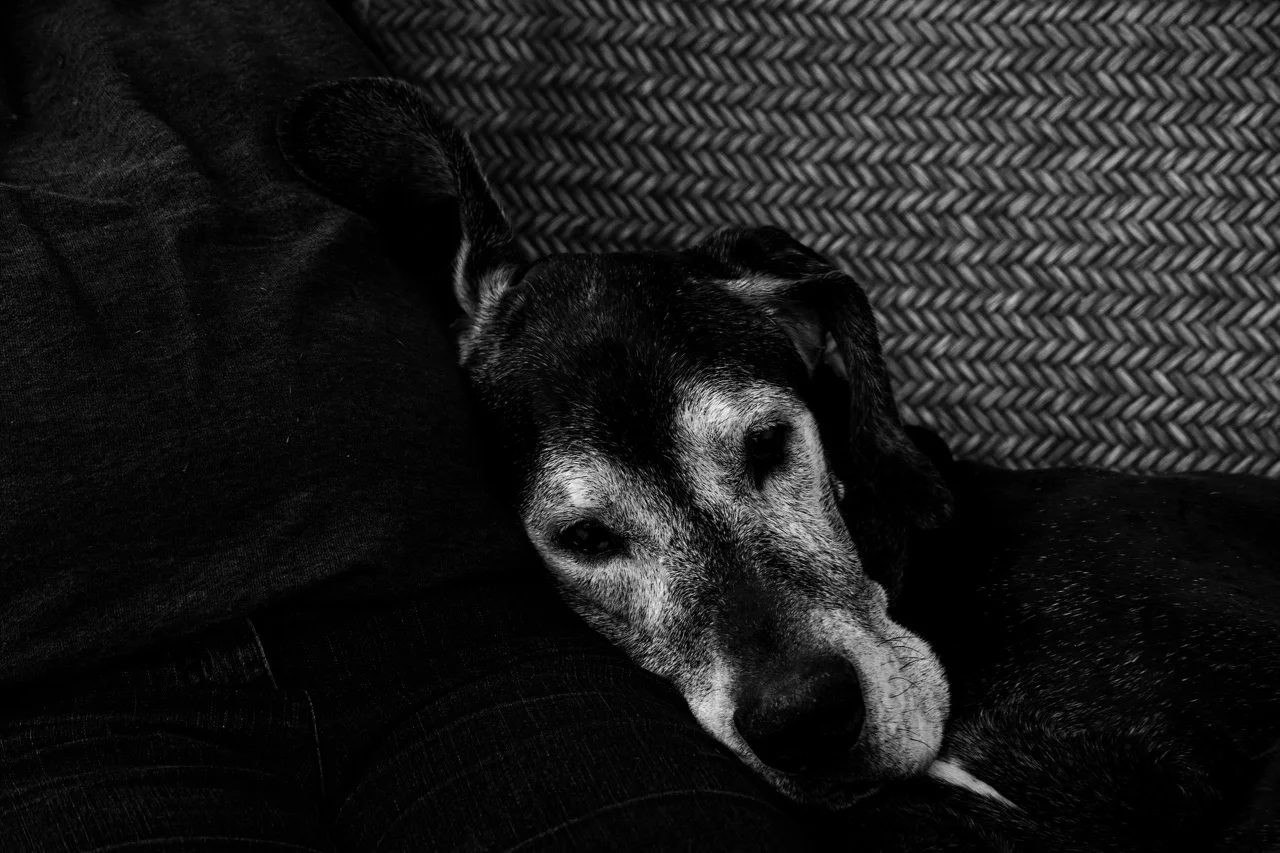
old-dog-3303296_1920.jpg

Losing it

November 17, 2018 by Anne Atkins

New Year 2006.

After Christmas, the three homes we’d borrowed had all run out of time, the people who’d so kindly lent them needing them back.

One of the many blessings God gave me was wonderful parents. Their house wasn’t big, but we were more than welcome. Bink and Rose and I, none of us having anywhere else. And, of course, our two dogs.

At Rosie’s baptism two years earlier, Serena’s Great Dane had knocked my mother over, galloping into the garden after Serena finished bathing him for the occasion. He didn’t even know. He put my mother in a wheelchair for six weeks. We obviously couldn’t risk this again. So poor Hamlet had to live in the boot of our car.

For three long months.

It was too low for him to stand. I would watch him, from my bedroom window, trying to turn around to get more comfortable, at a crouch. It was pitiful. And yes, of course I explored alternatives. I’d done so a year earlier, when he wasn’t wanted in our rented accommodation, and the church suggested getting rid of him. Several Great Dane charities told me you can’t lend your Dane to a foster home: it wouldn’t be fair on him. You have to give him away permanently.

I couldn’t do that to Serena. Not her dog as well as her home.

Besides, I couldn’t have parted with him either. We don’t “get rid of” members of our family. (If we did, wouldn’t we have “got rid of” Bink? I’ve known families do this with the mentally ill, to protect the others… I can’t find the smallest iota of myself that could.)

Small wonder the experience changed him too. He’d always been extremely well-trained and obedient, though of course far stronger than me. Afterwards, I was never entirely sure he wouldn’t take his frustration out on another dog. Animals, too, suffer mental trauma. Once, after our homeless period, he dragged me on my belly through the woods for ten or twenty feet. The other dog-walker shouted that he knew where we lived and was coming after us with his shotgun.

The police did nothing. And I never took Hamlet for a walk again.

Members of our previous church at Parson’s Green had bought a large house near Wycombe, and most generously took Shaun in. He appreciated it greatly – if not the commute forty minutes to the flock he was called to live among. And being apart from his family again.

Once a week, on his day off, he drove to Cambridge to spend the night with us.

Three years earlier, when I’d told him I was pregnant with Rosie, his first thought had been of the broken nights. When the gods hate us they give us our desires… and God’s love can show most when He overrules our fears.

What kept Shaun going through that dreadful time was knowing he would see Rose’s sweet smile of pure joy at the end of each week.

The friend, mentioned earlier, who’d promised to get justice for us, wanted me to attend a meeting with Shaun’s boss, the vicar who had made us homeless.

Shaun said I needn’t. I wasn’t well enough.

No good has ever come of my going against Shaun’s word. But I considered this cowardice. The friend had known me since I was a teenager, and had been praying for my family for twenty years. Surely I owed it to him? (Er, no... God tells us to submit to those we’re married to. Not random friends who pray for us.)

My friend repeatedly told me there was nothing to worry about. What did he know, I wondered?

“I might forgive a rapist,” I tried to explain. “But that wouldn’t make it wise to meet up with him.”

Six months earlier he’d rebuked me for being tearful at having no home. Now, for using over-dramatic and emotive language.

(And he was a clergyman...)

It was easy to say no, living eighty miles away in Cambridge. But that January I was due to speak at a women’s breakfast near Oxford. It was hard not to agree to a meeting straight afterwards.

The night before, for a treat – not something clergy can often afford – Shaun took me out for a meal.

Poor Shaun! I wept, and wept, and wept. I could barely speak. Except “Sorry”, repeatedly. The Indian waiters were attentive and kind, and showed no embarrassment. Eventually they packed my untouched meal in boxes to take away. That night, although with Shaun – another too-rare treat – I barely slept.

I have no idea how I got through that talk... about the love of God.

Except that my style tends to openness. I probably told them what we were going through.

At the hands of God’s people.

November 17, 2018 /Anne Atkins
Living with depression
Comment
justice-2060093_1920.jpg

Guilt

November 16, 2018 by Anne Atkins

2003... and 2006

I’ve just remembered another go I gave to counselling, for the struggles I’d had since my entire family imploded into Bink’s illness.

Talk about hope over experience...

I’ve indicated already that the kind of “mental illness” I’ve experienced, on and off for the worst part of twenty years, is so different from what Bink suffers that the two are barely on the same spectrum.

Mine was a disease of malnourishment, starving from without. Bink’s, one of cancer, devouring from within. Both make you feel pretty lousy. But their diagnoses and treatments, properly miles apart.

Nevertheless this is a blog about being nuts. And for a long time, thanks to our circumstances, I qualified.

Our Parson’s Green GP’s surgery would fund up to six counselling sessions. Given what I’d discovered when researching psychotherapy a few years earlier – after our devastating experience of marriage counselling, when I learnt what scant hard proof there is of its effectiveness – I found this curious. Doctors are scientists, used to assessing evidence. After all our surgery wouldn’t pay for the osteopathy, or indeed hypnotherapy, I was advised to procure for myself.

In the interests of fairness I should say Shaun found his six sessions very helpful, being able to offload what we were going through onto someone who had nothing to do with our parish.

Mine were dismal.

Many years earlier I’d been pronounced 100% resistant to hypnosis. (This was because I didn’t like the hypnotist: he told me a fork was hot when it was very obviously not. Now, if he’d asked me to imagine it was hot I would have done, probably better than most.) I seem to be equally impervious to counselling. I find reiterating sorrows usually makes them worse.

The first session, naturally, was spent filling my counsellor in on Bink’s illness.

“Do you feel guilty?”

“I’m sorry?”

“Do you feel very guilty?”

I was shocked. “Do you think I should feel guilty?”

“Your daughter has a severe mental illness. As her mother, you might be expected to feel this is your fault in some way.”

Know what? Until you put the idea in my head, it had never occurred to me.

I expect I will now, though…

New Year 2006

So by the time we became homeless in the summer of 2005, the Black Dog and I had become old sparring partners.

What was curious was that all the time I was living in Louis’s beautiful house on the Findhorn Estuary, I seemed mercifully free of symptoms. Looking back, I strongly suspect I should have been diagnosed as depressed: I was barely functioning, except to get my children through each day.

But I felt almost nothing.

That was the mercy of it. No joy, true. But no wild despair either. No helpless hours of sobbing.

Just a numbness, in the beauty of my surroundings.

All that was to change, at the beginning of 2006.

What tipped me over the cliff was do-good-interfering.

From the moment Shaun’s employing church put my children out onto the streets for us to fend for ourselves, various members of the congregation had been exhorting me to forgive.

Reader, I know as well as the next sinner what Jesus taught on the subject. Why would there be any place for me in God’s wide and bountiful mercy, given all my transgressions, if I can’t find a place in my heart for those who have done far less to me?

I have no issue with this. I can’t afford to.

What I did have considerable issue with, was a cheap and simplistic form of Christianity: painted by numbers just for the look of the thing. 

You forgive me. I forgive you. Hunky-dory.

No repentance. No justice. No addressing of the wrongs.

Far less putting any of them right.

November 16, 2018 /Anne Atkins
Living with mental illness, Living with depression, Effectiveness of counselling, Living with homelessness, Christian forgiveness
3 Comments
pie-chart-1569175_1920.jpg

Sharing the blame

November 15, 2018 by Anne Atkins

2002… and early 2006

Since Bink had got ill at the turn of the century, my own mental health – for want of a better phrase – had been in pretty rough shape.

Every year or two, when seeing my GP anyway, I would say, “I don’t suppose there’s much you can do about this, but I do have symptoms of depression.”

I would then be offered pills. Say no thanks. And that would be that. 

On one such occasion in the early years of the millennium, the GP offered me, instead, a luxurious choice: happy pills or talk therapy. There was, she said, nothing else. Since pills remained a useless suggestion (my taking them wouldn’t make Bink well, would it?) and I reasoned not much damage could ensue from simply talking (how little I still knew!) I was referred to a psychologist. Who was about fifteen.

So I told her the story of Bink’s illness.

When she asked why I seemed so distressed (no, I’m not sure why she chose that profession either) I illustrated our daily struggles by describing the previous evening.

“Having children is hard work,” I explained patiently (yes, to this mental health professional). “You put a lot of effort and self-sacrifice into raising these small people. The family meal at the end of the day is payback time. When it all becomes worth it.”

I can’t remember how Bink’s illness had ruined that particular family supper the night before: it was such a common occurrence. Perhaps because she had the wrong marigolds on. Or needed the loo just when the food was ready so we all had to hide for half an hour. Or couldn’t eat the food.

One way or the other, family supper had been sabotaged. Yet again.

“Ok,” said the therapist. “Let’s make a pie chart.”

Look on the bright side: she didn’t suggest we made a model out of cardboard egg boxes, empty loo rolls and finger paints.

“So, if this is your evening together,” she draw a circle on paper, “how much of the meal being spoilt was your responsibility, and how much was it Bink’s?”

Eh??

None of it was Bink’s, obviously. She was ill. And a child.

(Whatever the Florence Nightingale Unit had claimed about our having no parental rights. Everyone knows sixteen is still a child.)

Sigh.

“I suppose if it has to be one or the other, you’ll have to put it all down as my fault.”

“Well,” she said (as if I were five to her fifteen years). “Let’s say this much is your responsibility,” and she drew a segment of about 100º or so. “And this much is your husband’s,” ditto. “And other members of the family,” another segment. “Shall we say this much is Bink’s?” Final segment.

“Um... No. Not really. I don’t consider any of it her fault. Like I said, she’s ill.”

“Well then, how about this much?” And she reduced Bink’s share a little.

Which part of Not Bink’s Fault didn’t she understand?

By the end of the hour I was wrung out. It’s a pretty punishing process, talking about something so painful. I had spend most of it in tears. From which I had to argue with her about an ill child’s contribution to a ruddy pie chart. So I was very much hoping the sessions would eventually prove worth it. Because this one had left me a lot more battered than I went in.

As she wrapped up she suggested, if I would like another session, I should give her a ring.

“I would,” I said. I hadn’t gone through all that for nothing.

“Here’s my number. You can give me a ring when you’ve thought about it.”

“I don’t need to think about it. I would like more sessions please.”

Why would it help to go home and have to add making a telephone call to my to-do list?

“Well,” she said as if completely deaf – not conventionally on the list of qualities you hope your therapist has – “when you’ve decided, ring me on that number.”

I never did. Of course.

If her aim was to get rid of an argumentative patient, as it presumably was (unless she has also learnt in the Mickey Mouse School for Psychologists, along with Pie-Chart-Making-For-Cheering-Up, a lesson on Patients-Taking-Ownership-By-Showing-Initiative) she had succeeded.

So when it came to the beginning of 2006 – still homeless; still with more family-needing-help than I had help-to-go-round – I wasn’t at all surprised to find my mental health crumbling considerably further.

November 15, 2018 /Anne Atkins
Living with mental illness
Comment
John_Everett_Millais_-_Ophelia_-_Google_Art_Project (1).jpg

Without a boat

November 14, 2018 by Anne Atkins

Christmas 2005

Soon we had to move on again. Our good friends (now, they were!) were back from Malawi, and needed their home themselves.

Next we borrowed a housemaster’s flat in Radley College while he went away. We didn’t know him either: we simply met his girlfriend at a party. After Christmas we’d be able to borrow the Chaplain’s house for a few days.

We made what Christmas we could from our borrowed rags, begging the school Christmas tree after the last service in Chapel on Christmas Day.

Bink was wretched at, she was sure, having lost her Cambridge place because of mislaid medication. Alex was looking as if he could lose his too, for lack of disability support.

Worst of all, a member of the very church which had made us homeless wanted to fight for justice for us, and asked me to write down everything that had happened, over a year and a half. This took three so-valuable days of our scant time together... only for him to decide that all Christians need, for justice to be done, is to apologise and forgive.

When you stretched that thin, one more demand can become fatal. And it becomes a lot harder to forgive then, I tell you…

One of the most heartbreaking aspects of illness and disability is how it cares nothing for other members of the family. How neglected our other children have been! That was the holiday when Serena said something which, in any other context, should have brought her family to a stunned halt, to attend to her needs. Instead, I merely suggested asking her tutor for advice. It was a year before I realised she was so short of money, in her third year in Cambridge, that she became severely malnourished, and that same kind tutor offered to lend her £1,000.

I simply did not have attention enough to take it all in.

To know Ben, is to laugh.

When we first tumbled into the lovely flat we’d borrowed, and gathered round the friendly kitchen table that wasn’t ours, Ben cracked a comment to double us all up. I laughed, as one does when Ben is in the room.

But underneath there was always sadness now. I laughed with my face, but my soul sagged with sorrow.

It was then – at that kitchen table; on that first evening together; in that housemaster’s flat which seemed so luxurious to us now – that I realised what I was nostalgic for: the Christmas when Bink came out of hospital for three days, and went berserk from chemical withdrawal, and Shaun and I thought she had schizophrenia.

How is that possible? That it can be worse to lose a home – that was never even yours – than your own daughter’s mind?

Because then, in that wild sea of insanity, we had a raft to cling onto in the storm.

So, yes: we have been through worse even than Bink’s madness.

A few days before Christmas I took Rosie up for her bath, in this spacious home which was ours for a brief precious week. She was, by now and very frighteningly, the best behaved two-year-old I’ve ever come across. She never put a foot wrong or did a naughty thing in all those years after we left our Vicarage. I often feared what needs she was suppressing, this toddler so careful of her troubled family.

She got happily in her bath to play, as she often did. And I left the room with the door open, as I often must have.

The water was lovely and warm. The child was tired at the end of the day. Worse, the mother was bone-brain-weary... and utterly distracted by the disaster her family had become. I nipped downstairs for something; somebody asked me something; my help was needed for something; as it often was... and twenty minutes later I remembered Rosie in her bath.

I ran the wide steps, three at a time.

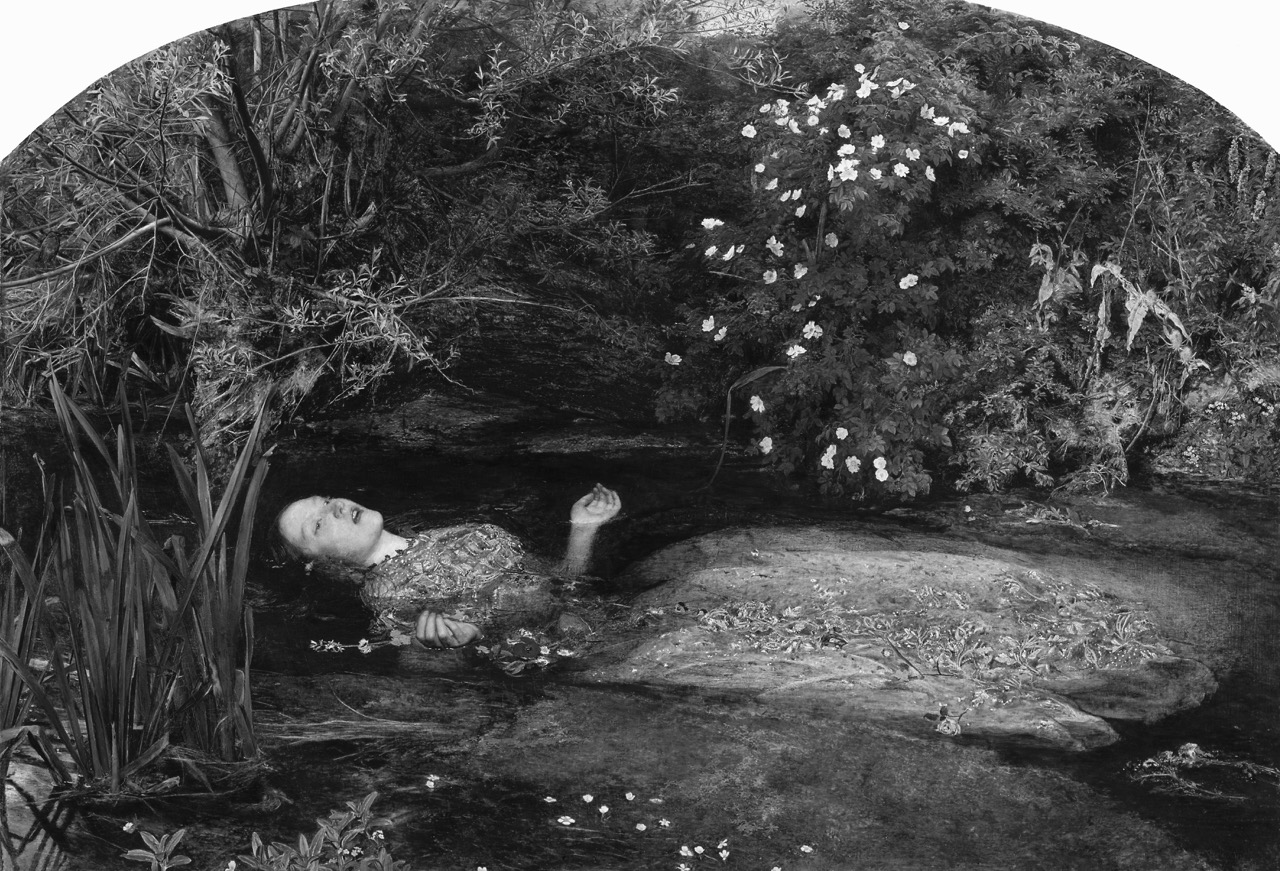
And there, in the vast great bathtub, in the deep warm water, floated an infant Millais’s Ophelia, hair spreading in the water, consciousness completely gone.

We had lost our home. Bink had lost her mind.

But my blood runs dry every time I picture what we could have lost that terrible Christmas.

Perhaps God still loved us a little after all. Rosie’s nose was above the water...

November 14, 2018 /Anne Atkins
Living with homelessness, Living with disability
2 Comments
park-1590553_1920 (1).jpg

On the move again

November 13, 2018 by Anne Atkins

December 2005

It would soon be the end of term and we still had nowhere to live.

My brother had friends returning from Malawi – doctor couple, Christians – who had just bought a house in Oxford for their young family and kindly agreed we could have it till they got back.

Then wrote to cancel, having realised it would be bare of furniture.

I didn’t know these people at all. Please, I said. A roof over our heads, being together for a few days is all. Floor, fine. Just, please.

Well of course they understood. They’d been ten years in Malawi.

In which case could we do them a favour, and direct the removal men where to put everything? At the last minute, another email. “Make sure they put the piano in the room near the front door!”

I can’t now remember what gave me insight into this surgeon I’d never met, who had founded several orthopaedic hospitals.

“Too late,” I replied. “They said it would look better on the third floor. I thought it best to be guided by the professionals. Don’t worry,” I added kindly. “it’s lovely for parties up there.”

He was thrown into enough panic to go in search of an e-café in the middle of the Malawian night... His wife was overjoyed. “For once,” she said, “the butt of a joke, not its instigator!”

They are good friends still, he one of the funniest people we know, and is interviewing Alex and me for the Oxford launch of my new novel.

A member of Shaun’s employing church, a musician, rang and asked me for help. I had no idea what we could find left in common, but I invited her for tea. (She had once given us dinner with the bishop...)

While the church had been providing accommodation for us at the beginning of the year, I had been asked to take over the music for the eleven o’clock service. Known as the “graveyard slot”: mostly grey-haired members of the flock; no children screaming through the aisles; no endlessly repeated choruses. Shaun told me I raised eyebrows by choosing this service to attend, when all the trendy people went to the early family or evening young people’s services.

But it proved handy when they wanted help with the music.

Within weeks we had a four-part choir and a chamber group. Bink had made a number of musical friends; she Alex contributed to both; while Rosie sat quietly listening, in a pretty frock and straw hat, charming the old ladies. Causing wonder by not screaming down the aisle herself, pushing a truck, never having had this example set her.

When our accommodation ran out, so did my help. I don’t know what happened after I left. But now we were back in Oxford, presumably I could help again.

To my shame, my memory is that, very rudely, I spent most of the time on the telephone: almost certainly, something to do with the increasingly pressing and many needs of my children. By now I had so many demands on me, so much more life-saving that this was going to be, I had little enough time for good manners.

It is no excuse for discourtesy but it happened that, a few months earlier, my visitor’s husband had acted extremely unprofessionally towards Bink, severely compromising one of her A levels. I was learning quickly that, when you are treated badly by one, it soon catches on for others.

Eventually I must have hung up and apologised.

Could we help with the various carol services, she asked?

“How?”

“By playing.” Obviously.

“What?”

“Your instruments!” What was the matter with me?

“What, specifically, did you have in mind?”

She was clearly stumped. “Well... harp, ’cello, violin...”

I stared at her. This woman was on the PCC. The body which had made us homeless.

I still, all these years later, have no words with which to answer her.

When we lived in our Vicarage in Parson’s Green, a man lived in a red car opposite. (Until he had to go into hospital, and some cruel and unfeeling authority towed his home away.) Chatting, Shaun discovered he had once been a concert pianist, and invited him to play the church piano any time. Which he did. Superbly.

In all the time he lived over the road from us – when we gave him mugs of tea, or hot filled baked potatoes, or just the time of day – it never once occurred to any of us to ask whether he had his concert piano about his person.

However mad Bink is, she is nowhere near as mad as many of the sane people out there.

November 13, 2018 /Anne Atkins
Living with OCD, Living with homelessness, Living with mental illness
Comment
syringe-1884784_1920.jpg

Withdrawal

November 12, 2018 by Anne Atkins

December 2005

Over those few months between late summer and mid-autumn, Bink calculated that we had fifteen addresses in a hundred days.

Somewhere between around the dozenth and the last, and a couple of weeks before her Cambridge interviews, she lost her medication. Perhaps travelling salesmen and soldiers get the hang of this, but I certainly never did: packing up and moving on every few days meant I eventually lost almost everything I needed for day-to-day living.

So for several days she wasn’t able to take any pills: you also have to register with a GP every time you need a prescription, which is hard to do on the move too. After a week without, she asked my advice. Should she find a doctor and get more?

More than anything else – more even than the gene lottery which made her susceptible in the first place – it is prescription medication that has wrecked Bink’s life. I don’t say this out of knee-jerk Ludditery: Bink would have died as an infant (of infected adenoids) without modern medicine; my father is 101, and you don’t get there without some pretty skilful doctoring (and a family to care for you); and I have witnessed first-hand the benefit of mind-pills in at least containing, if not curing, mental ailments from depression to schizophrenia. 

In Bink’s case, however, medication – mostly given in place of treatment – has proved utterly devastating. She was forced onto pills in the Florence Nightingale Unit, aged 16, and we had to witness the dreadful dulling and disturbing effect drugs had on her previously sharp and lucid mind. I weaned her off them as soon as she came home, though some of the confusion remained.

But with treatment still not forthcoming, after six months our GP persuaded her back onto them.

In the long term, quitting medication was more important even than her Cambridge interview. I had sometimes made the mistake, in the past, of putting my children’s immediate academic welfare above what would last them a lifetime. When Rosie was born, I didn’t recall Ben immediately from boarding school to welcome his new sister and celebrate with the rest of us, because he was about to sit Latin GSCE: an error of judgement I regret still. He won’t remember his Latin GCSE grade on his deathbed, will he?

I knew Bink would never be fully well while on medication. And no doctor we’d ever found – all so happy to get her addicted to the stuff – would help her come off it.

She had already gone a week without. If I went to a chemist and got another bottle just to get her through her interviews, it could be years, it could be half her life, before she tried to survive without again.

“No,” I advised. “Stay off them.”

I just wouldn’t have chosen the timing.

I knew nothing about the shelf-life, and how long it would be for withdrawal to take effect.

(As I was to discover next time she stopped, neither does anyone, really. A GP friend told me that what Bink experienced – unbearable symptoms of withdrawal months after she seemed to have got through – was impossible.)

The day before her interview she was shaking like a pneumatic drill. She was very obviously not well.

I rang the child psychologist she had seen as an outpatient at the Maudsley a few years earlier who, although firmly espoused to chemical cures, had seemed sympathetic.

Not any more.

“Well yes, the medication has a long half-life. There will have been traces in her system until now, so she’s only just feeling the effects of withdrawal.”

Should I get her an emergency supply?

“Bit late now,” she said sharply. There was no mistaking her annoyance. “I can’t help her, if she goes on and off medication without medical supervision.” And she hung up.

Thanks. You have no idea, have you?

She got through the morning interviews, despite being now very ill indeed, by spending fifteen minutes beforehand breathing deeply, and ruthlessly calming herself down.

I took her off for lunch, and got her back punctually for the afternoon interviews, but with no time to spare. She was called straight into the room with no opportunity of performing the same ritual.

“It was a disaster.” She was distraught. “I couldn’t even hear what they were saying.” The room was a fog of confusion. She had intelligent answers to all the questions, but couldn’t drag herself from her place of panic and jangling agitation, into the same space as her interviewers.

Everyone wants to make excuses after a bad interview. There was nothing worth saying to the college. How could they understand what even close friends couldn’t: that as well as her disability, Bink had nowhere to live?

Definitely the wrong time to come off the meds.

November 12, 2018 /Anne Atkins
Damaging effect of SSRIs, Living with mental illness, Living with OCD
Comment
Poppies

No news

November 11, 2018 by Anne Atkins

Sunday

When our daughter Rose, now fifteen, was baptised my father gave her a present of the silver christening mug he was given over 100 years ago. 

(Sadly, I can’t post a photograph of it here because it was pinched, last year, by someone who was working for us; the police refused to interview him even though we knew who’d nicked it because they said someone else might have taken it; and the insurance company refused to pay for a replica to be made because there hadn’t been a break-in. Hey ho. Extremely trivial by comparison with what follows...)

It was from the churchwardens of my father’s father’s church, St Andrew’s in Norwich. And it was given him by his godmother, Lady Morse.

Anne Morse was a widow. Some consolation for the loss of her husband was that she had three fine young sons.

All of whom proved their worth by winning the Victoria Cross.

And all of whom – all – were killed in action.

I need two minutes’ silence to take this in. 

All my pretty ones?
Did you say all? O hell-kite! All?
What, all my pretty chickens and their dam
At one fell swoop?

Imagine. The bells ring out. The joy, the celebration, the relief. He will come home, safe and sound, to live again.

And then you see the Post Office boy coming up the path with a telegram for you...

How they must have prayed against news, in that fell and dreadful time.

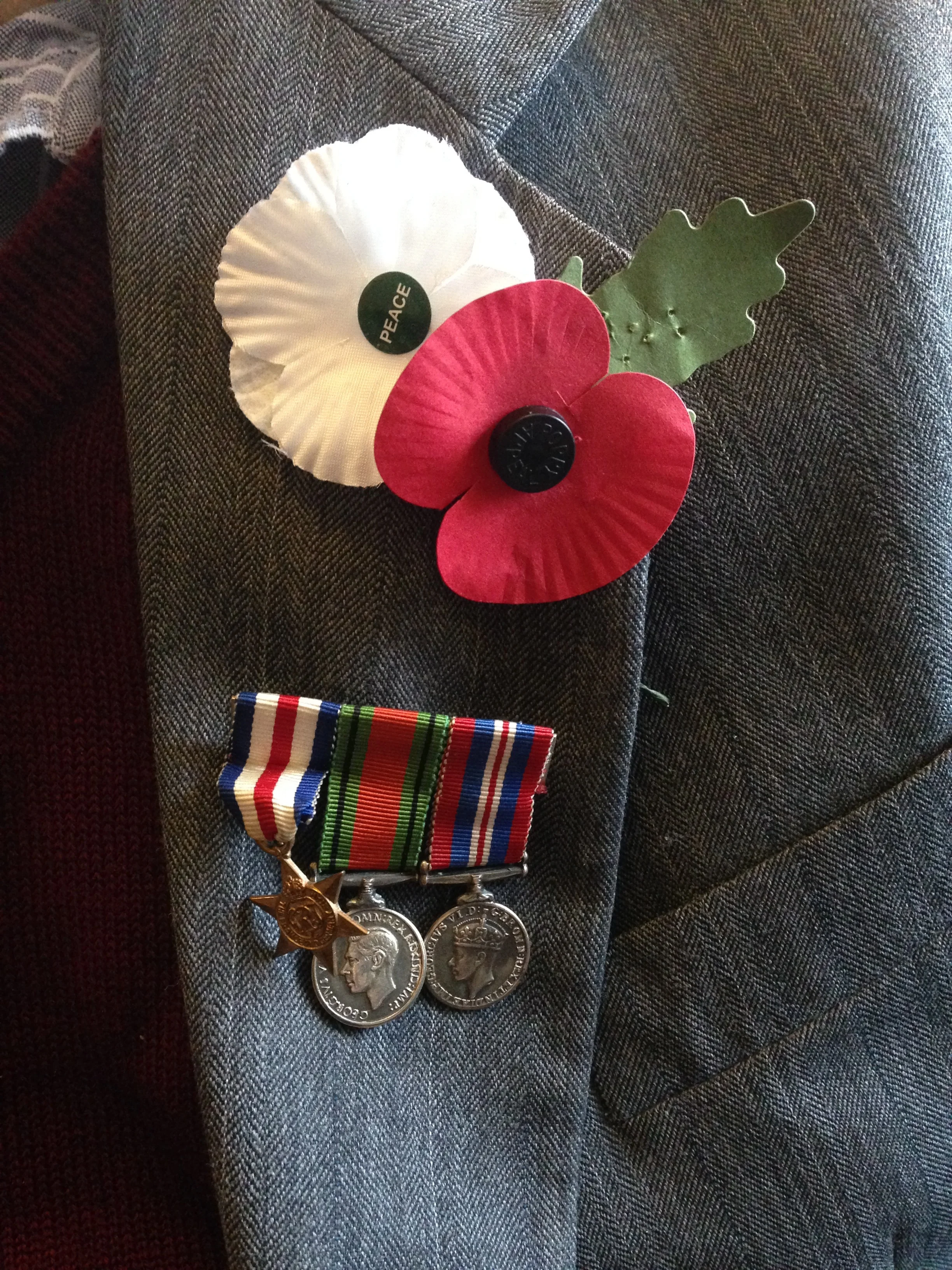
Bink was the first in our family to wear the white peace poppy. Now even my father wears one, alongside his traditional red and the only medals he is entitled to: for being there.

Despite courage that made me swell with pride as a little child at school, when my class all said what their daddies did in the war and I was laughed at. Despite braving shame from society and even his own family, his sister still resenting his stance over half a century later. Despite insisting on a rôle in the front line when he was posted to a safe office job in London, so he saw D-Day as an orderly in the Medical Corps. Despite standing his ground under threat of the firing squad when he refused to bear arms, till reprieve came the next day from the Geneva Convention.

Despite all this, as Conscientious Objector he is allowed no other recognition for his bravery.

He is now deeply moved – and vindicated – that more people than ever wear the peace poppy alongside the red.

Starting with his own mad granddaughter: our own Cassandra.

If you’d told me a few years ago that there would come a time when I’d be glad to have no news of one of my children, I’d be intrigued. If you had gone on to say I’d prefer to have no news of Bink, frankly astonished.

Ten days ago, Bink embarked on the Priory’s Addiction Treatment Programme. A tough regime, nearly fourteen hours a day; for the first week, no contact with the outside world.

Every day that went by with no news left me more buoyed up and happy. She is lasting the course! She has not rung home! And the hospital has not rung to say she has disappeared...

(Her therapist has most considerately been in touch three times; told us Bink has impressed them all by her commitment to the course; most recently, that she was preparing a presentation for the morrow and might not have time to ring.) 

Even now when she is allowed contact, she has not. I’m longing to hear her voice, of course I am. But even more, I would prefer her to be too busy to talk to me.

How good it is, sometimes, to have no news.

November 11, 2018 /Anne Atkins
Comment

Storm

November 10, 2018 by Anne Atkins

Late November 2005

My memory is of peace and tranquility during those months on the Findhorn Estuary. It would be hard for it to be otherwise.

My beautiful environment held me safe in a quiet cocoon of sanity.

Has this been properly taken into account, in the treatment of mental health? Do we consider, when designing psychiatric hospitals, the importance of beautifully laid out gardens, lovingly draped curtains, dancing open fires? Do we train psychiatric nurses in the courtesy and kindness so crucial to psychological welfare?

Bink has often said, if only she could live somewhere quiet and peaceful, by the edge of the sea or side of a lake, with none of the pollution of modern life drumming in her ears, she might be whole.

And yet there was a curious end to my stay in that loveliest place on the edge of the world.

A friend from university days – then archdeacon: now bishop – had booked me as the after-dinner speaker for some diocesan event, hundreds of miles away in the South. I rang, explained we were homeless, said I was at the top of Scotland. He didn’t even comment on our situation, or what the church had done to us. It was a reaction I often encountered: our circumstances were so unbelievable, it was as if friends hadn’t heard.

He was obviously expecting me to be there. He didn’t offer to pay for flights so I could return to Scotland afterwards. I would have to go back. To what, I knew not.

Oh well. Louis needed his house for Christmas. And Bink – who had rejoined Rosie and me – needed to be back for Cambridge interviews.

After-dinner speeches must be two things. Short. And funny.

We have always been able to find humour in the blackest of circumstances. Alex’s Asperger’s syndrome. Bink’s madness. There’s always something to laugh about.

“Tell me,” I rang Shaun. “What is amusing about our situation? I’m giving a talk,” I mentioned our friend, “and need some jokes.”

I’d never heard him say this before. I hope never to again.

“There is absolutely nothing funny about it. At all. Whatsoever.”

Shortly before we had to leave, there was a storm.

Wind tore the trees. Rain shook the windows. Darkness raged around the house as an evil force, while the black sky bore down on the wild treetops. We were as safe as houses in Louis solid, spacious mansion that has stood for hundreds of years.

And I was terrified. I knew it was utterly illogical. My emotions were simply worn out.

Suddenly, I was glad to be leaving.

The next day I booked our train tickets.

We had ten large cardboard boxes. All the books I had bought during our three month stay, so that Bink could study for Cambridge. The toys Rosie had been given by the little church. The few clothes we arrived with. Most of it, simply books.

How do you travel by train, with a two-year-old and ten boxes? And two dogs. And a couple of shotguns, in canvass bags slung over your suitcase.

Every time we had to change trains – which was several, between Forres and King’s Cross – I would ask half a dozen people in the carriage if they could kindly each take a box or two off the train and place them on the platform for me, please? And the same again, of different strangers, from the platform onto the next train. People are kind, when you don’t know them.

While Bink held Rosie’s hand for safety.

After twelve hours or so we pulled into London. Whilst I organised more passengers to help me get the boxes off the train and shouldered the shotguns off the rack, Bink must have lifted two-year-old Rosie out of the carriage.

She saw her Daddy at the other end of the platform, and ran the entire length of it into his so willing and wide embrace.

Even now, well over a decade later, I often lie my face on Shaun’s shoulder, when he is fast asleep, and reiterate the promise I made myself that autumn 2005, which I have not quite managed to keep.

That I will never again have to sleep alone, without his shoulder beneath my head.

November 10, 2018 /Anne Atkins
Living with mental illness
Comment
cambridge-116005_1920.jpg

The pointlessness of parents

November 09, 2018 by Anne Atkins

Autumn 2005

This blog is about Bink, and her mental illness. Not primarily about mine. Or anyone else’s in the family. Nor any of our other challenges, including our homelessness.

But no disease happens independently of circumstance. This is not only true of mental ailments; I know someone who dates the adolescent onset of type 1 diabetes to parental divorce. And how often have you heard of the occurrence of cancer, hard on the heels of other stress?

So this will inevitably be even more true of mental disease. What we were going through eventually had a devastating impact on Bink’s psychological welfare.

As well as everyone else’s in the family…

Alexander had started at Cambridge University that Michaelmas, 2005.

He wasn’t formally diagnosed with Asperger’s syndrome till his mid-twenties, but he (and we) had known for some time that AS was the simplest label with which to announce his differences. It also entitled him to help from the university’s Disability Resource Centre.

Which I had been attempting to engage with for over six months, about the support he would need.

I shouldn’t worry. It was in hand. He would be fine.

Well yes. He might have been.

Had the DRC, and more particularly his college, been willing to work with his family in meeting his needs.

For those of you who don’t have the advantage of living with Alex or someone like him (there are others like him?!) here is a brief summary. Being Aspergic often means:

  1. You have enough to distinguish you from the herd already. Not that Alex minds being different – it’s who he is, after all – as long as it doesn’t result in bullying. (Which, for most of his schooling, it had. From teachers, anyway.)

  2. You may be more straightforward than neurotypicals. You don’t talk in code. If you say something, you probably mean it. 

  3. And it’s fairly a safe bet that life has been considerably more challenging for you than for most. You will almost certainly have struggled, and suffered, far more than a neurotypical with comparable talents and abilities, to achieve the same goal.

Getting into Cambridge had taken Alex years of unhappiness and pain. And me, years of worry. Now at last he had been recognised, would feel at home, could meet others like himself.

So I don’t even want to imagine the distress he must have felt, when he received an email advising that every fresher must report to the college office with the relevant A level certificates.

Obviously – to Alex – this meant what it said. A level certificates were not an optional extra. If they were, why would you be told you needed them?

And Alex’s A level certificates, like almost everything else we owned, were now buried deep in several storage containers somewhere in the Heathrow area and hadn’t been seen since we last had a home, the previous year.

Alex, therefore, did what any truly logical, rational person would do. He presented himself at the college office to relinquish his Cambridge place.

I don’t know, nor do I want to, what he went through to arrive at this decision.

Alex had taken up residence in college a month before term, because of having nowhere else to live. This didn’t matter as much as the fact that he only had the clothes he stood up in. Well, he had a spare T-shirt and no doubt more than one pair of boxers and socks, but everything else was in the same place as his A level certificates.

He was a member of the Chapel choir. And the dress code for Chapel was formal.

My father very kindly lent him a suit. My father being an inch or two taller, a few stone heavier and seven decades older than Alex. And had probably owned his suit for most of that time.

Alex needed a suit several sizes too big for him and half a century out-of-date about as much as he needed... well, actually, he did need it, didn’t he? Because otherwise he couldn’t have fulfilled his duties as a tenor in the choir.

But Alex would have found adjustment to university challenging enough anyway, without falling over his trousers every time he processed into Chapel.

Nevertheless, all this, Alex would have coped with.

What tripped him up was the DRC’s refusal to engage with his family.

It is the same old story. Just like Bink, in the Florence Nightingale Unit several years earlier.

Parents are amateur idiots who know nothing. Mothers in particular are interfering fusspots who make nuisances of themselves.

Since early the previous spring, I had been advising the DRC that Alex’s first and most pressing need would for a mentor to guide him through university. He would need someone approximately his age; preferably his sex; and most critically, someone who understood his subject.

Crucially, this relationship would need to be in place several months before he started his course.

Day after day, up in the North of Scotland, after the start of his course, I wrote email after email. To the university; the DRC; Alex’s college. Sitting half inside the airing cupboard, where I could plug my laptop into the telephone socket. Or down on the howling beach, where there was occasionally signal.

Week after week, I was ignored. Told it was under control. Most devastatingly, that Alex was an adult and it was confidential.

Interesting, that, isn’t it: that a student isn’t an adult financially until the age of 25?

Several agonising weeks into his first – very intensive – eight-week term, his mentor was appointed.

A middle-aged woman with no academic background.

“She can be a shoulder for him to cry on,” the DRC told me comfortingly.

A shoulder to cry on? Alex didn’t need a shoulder to cry on! (He had mine, if he did.) He needed someone who understood the Cambridge Maths and CompSci course.

By the time both DRC and his college admitted their mistake, Alex had missed a very great deal of the first six months of his course, and was required to step down for the rest of the year. (They needed time to find a suitable mentor for him.)

Without, of course, his parents being told.

At which point, I grant you, he could have done with a shoulder to cry on.

statues-2291148_1920.jpg


(And if you are interested in learning more about what makes Alex different, he inspired this book, here. Every sold copy of which helps support this charity here, so future Alexanders don’t have to step down from Cambridge University.)

November 09, 2018 /Anne Atkins
Living with Asperger's syndrome, Coping with homelessness
Comment
IMG_2814.jpg

The power of beauty

November 08, 2018 by Anne Atkins

Autumn 2005

Thinking back to those months when I lived in the farthest Highlands, it feels an eerily peaceful time.

I was in one of the loveliest places on God’s earth. Our friend Louis is perhaps the most generous we have... and has much to be generous with.

His drive sweeps round to its gracious mansion: sea sparkling through the trees to the left; forest soaring golden in slanting sun to the right; river straight ahead.

Every morning I am woken, in the triple aspect bedroom, by the dark Northern dawn glinting off the water. Wisteria and old roses tap at the window. Blackbirds flit, chucking, through the avenue of old yews beckoning down to the lapping estuary.

We have seen badgers there, and an otter. Red squirrels scampering in the Scots pines. The air so clear, lichen velvets every twig and branch, and gaudy toadstools flame the paths through the woods. I saw a strange creature, crawling hunchbacked across the kitchen floor by daylight... and for the first time understood all the bat-stories of weird horror and fascinated disgust.

The beauty of the place proved more powerful than any mental disorder.

Some of the time I was there alone with two-year-old Rosie: Bink must have had to go back to Oxford. I had the use of Louis’s Landrover, and took Rosie to the church in the nearest village, several miles away. I put her in a pretty dress, and made a boiled eggs for our Sunday breakfast, and promised myself, “One day, we will live in a Vicarage again, and all go to church together, as we did in Parson’s Green.”

It was a mere smattering of a congregation and we were immediately befriended. When I told our brief story they put together a box of old toys from the Sunday School for Rose to keep.

In the afternoons I would build roaring fires for the two of us, and sit in the window seat looking out across Louis’s beautiful knot garden, and roses, and espalier apple trees.

I was content never to see anybody at all. Apart from Rosie herself, and the few at the small church we said hello to on a Sunday morning. 

One afternoon, in the soft autumn sunshine, as I was filling a basket of logs from edge of the wood, it sounded like God’s voice I could have heard, telling me Shaun would soon be given a different job, in my beloved Cambridge. Perhaps by Christmas…

And all the time I was there I never once burst into tears, or found myself unable to get up in the morning, or felt aware of anything like the savage black dog snapping at my ankles to bring me down.

I needed nothing and no one. Just the sea and sky and sun, and Louis’s beautiful surroundings.

And yet this doesn’t tell the full story.

When the next house which had been lined up for us to move into in Oxford fell through – the vicar, Shaun’s boss, didn’t sign the lease – I felt no surprise. It almost seemed right, it was so inevitable. I had come to expect catastrophe. Life was supposed to turn on us.

There was a kind of safety in the now-familiarity of it.

I didn’t protest, or ring up and insist we were moved into the Vicarage which I’d found before, still sitting empty, so we could all have a home by Christmas. If we were treated badly enough, someone, somewhere would rescue us.

My parents. Or our friends. Or God.

So I now understand how you can sink into a defeatist torpor, and almost want disaster to continue, even if what you have got used to is full of dread and despair.

I also learnt – eventually, not yet – that there comes a time when, if you don’t help yourself, there is no one else. Understanding this proved crucial a few years later, when I was the only one left standing…

I was, however, completely paralysed and unable to write. It distressed me greatly, and I constantly beat myself against it. Again I understand it now, I believe... but at the time it seemed a pointless torment and waste of life. And the loveliness all around.

Well, it was.

Ben came up to stay for two weeks of half term, and we had several afternoons of clay shooting together. I missed, and missed, and missed; clay after clay after clay, falling on the dull earth.

It was more than a loss of confidence. It was a complete loss of ability, at something I’d been able to do with ease.

I rang my dear friend and cousin Fleur Lloyd, creative writing tutor, and pleaded with her to teach me to write again.

“I teach amateurs,” she objected. “You’re an established writer: there’s nothing I can teach you.”

“Fleur, I’ve lost it,” I begged her, desperately. “I could employ someone to teach me to shoot again, couldn’t I? I need the same for my writing.”

The clearest sign that that my mental health was not as robust as it felt came when someone – perhaps it was Ben – was travelling back to Oxford. I sent Rosie back too, to live with Shaun.

It seemed obvious that she would be better off with him.

One of the two families who had displaced their children to take us in was that of my dear schoolfriend, Anne. She is extremely smart.

“Something’s very wrong,” she commented to Shaun. “Why wouldn’t a mother want her own child with her?”

Shaun relayed the conversation to me.

I saw it. With the clarity of the sun bursting through Louis’s copper leaves: Anne was right.

The loveliness of my surroundings and largesse of his hospitality had kept me feeling fine. And thank goodness: the alternative would have been terrible.

But I was not in good mental health at all.

The next person who came up to Scotland – was it Bink? – brought Rosie back to me.

November 08, 2018 /Anne Atkins
Comment
  • Newer
  • Older

Powered by Squarespace