Anne Atkins

  • Home
  • Bink Bonkers
  • Non-Fiction
  • Novels
  • Journalism
  • Speaking
  • Broadcasting
  • Biography
  • An Elegant Solution
  • Thoughts for the Day
  • Anthem for Mary and David Briggs
  • Love Strong as Death
  • Contact
book-863418_1920.jpg

Application

November 07, 2018 by Anne Atkins

Autumn 2005.

Bink was studying for her Cambridge interview.

I ordered dozens of books, costing hundreds of pounds, though I had them all, every single one, back in England: stored in boxes with all our other belongings, or those which hadn’t been destroyed by ecclesiastical mismanagement and deliberate cost-cutting neglect. It echoed the time a few years earlier, when I’d had to buy duplicate copies of numerous texts I had already; though for a different reason.

Anglo-Saxon prose and poetry. Victorian verse. Children’s fairy tales. All laid out on the long dark antique dining table, overlooking the garden leading down to the Findhorn Estuary, so Bink could study and read and write.

I couldn’t do any of work of my own. Every so often I would start a poem. Or outline a children’s story… in which a little girl called Rosie come across a hidden door in Louis’s exquisite garden, which she opens to find all her siblings, and a home for them all to share together again – and her Daddy back! But soon my mind drifted over the mist to the sea and I thought of what we’d loved and lost, and tried not to think of our bleak future.

It was enough to be there for Bink, and help her to the place at Cambridge she was so obviously worthy of.

She needed to talk to the Admissions Tutor of the college she’d applied to. But she hadn’t been able to touch a telephone for years. And this was before hands-free.

I can solve this: of course I can!

Hmm.

I rang the college and left a message. He needn’t know she hadn’t done this herself. Asking the Admissions Tutor to return the call.

Then I set to, cleaning the telephone. Try it. You can do this at home. Imagine... ok, let’s say... your telephone has to perform a surgical operation and needs to be completely sterile. Or maybe you’ve committed a murder with it, and need to remove all forensic evidence. It’s amazing how many packets of wet wipes you can get through, just cleaning one handset. All the nooks and crannies you’ve never had to notice before. The lines in the plastic where earpiece joins handle joins mouthpiece. Right down inside that tiny little crack there. The little holes you speak into, twisting a wet wipe into a tiny screw to clean down inside.

And then you have to dry it. Reams and reams and miles of loo paper. An entire roll, piling up into an enormous snowman in front of you in discarded lengths. Though you can then gather it all up and put it in the loo to be used there in the normal way. As long as it’s not Bink’s loo, obviously.

Half a day’s work, easily.

Parts of a telephone you don’t know exist, until you have OCD. Or someone you love has.

It is arguably the most infectious of mental illnesses. After this, you wouldn’t touch the telephone again, would you? You’d contaminate it, and have to start all over again...

I then had to insist Bink spent the entire day within arm’s reach of the room where the telephone was plugged in.

I mean, suppose she wandered off, and the Admissions Tutor chose that moment to get in touch?

Ring ring. Ring ring.

“Bink! BINK! BINNNKKKK!!!!”

Ring ring.

“What?”

Ring ring.

“Come! Quickly!!”

Ring ring.

“I’m on the loo.”

Ring ring. Ring ring.

Rising panic.

If I ignore it, he might not ring again for another day, and we’ll be stuck in this room for yet another twenty four hours, not knowing when he might ring back... or even whether it was him.

If I answer it... I’d have to start the cleaning process all over again. Bink won’t be able to take the call once I’ve touched the telephone, will she?

What’s that you say? Why not just be straightforward, and tell the Tutor the truth?

Oh yeah. That’s a good idea.

“Um. Right. You see. It’s like this…

“Ok, my daughter – who is hoping to be given a place at your extremely competitive college in an extremely competitive subject in your extremely competitive university – is too loony to touch a telephone. As one is. You know. Doesn’t mean she’s stupid. Just means she’s. Well, there we are. Anyway, may I take a message for her, please?”

Or shall I just take that as a ‘No’?

To everything?

bible-1868070_1920.jpg


November 07, 2018 /Anne Atkins
Living with OCD
Comment
sunrise-3744418_1920.jpg

The Sun King

November 06, 2018 by Anne Atkins

August 2005

We were now homeless.

Fortunately, we had some very kind friends. Technically, therefore, we should be described (I know this now) as “middle-class homeless”. This means that instead of sleeping on the streets (very much not recommended) you sleep on other people’s sofas, in their spare rooms, or – our immediate port of call – in their children’s rooms while their children sleep in a tent in the garden. Or indeed anywhere.

(Also not recommended, actually. Certainly not for longer than a night or two... But very, very much better than the street option: I know this too, because we had a number friends with only this latter, when we lived in Vicarage; your life expectancy is not good out there under Putney Bridge. We will be forever grateful to the two families who took us in straight away, both displacing their children for us. Specially as Serena’s lovely, gentle, extremely well-trained Great Dane, who had never before hurt a fly but who was by now as distressed and traumatised as the rest of us, responded by ripping our hosts’ dog’s stomach.)

You think fast, when you have to. I asked Serena’s and Alex’s Cambridge colleges if each could take up residence a month early. Ben was soon due back to school. Shaun would have to remain in Oxford, where his work was. He didn’t have anywhere to live either, but sofa-surfing (whilst also not recommended when combined with a job which requires books and a study and space to think) is very much more manageable if you are on your own with no dependents to break your heart.

Leaving Rose, aged two; Bink, who was not at all well; and me. And two dogs and a cat.

I gave my cat, which Serena had given me in a happier year, to my brother’s family: I’d always thought they needed a proper pet to look after them.

Oh yes, and I sent the au pair home to Holland. She wanted to stick with us, wherever we went. I considered the dogs enough to worry about.

Then I asked a dear, kind, generous friend from university if we could borrow his house on the Findhorn Estuary. I knew he didn’t do dogs... but I also knew his magnanimous heart.

It was at this point that Shaun’s sister rang to say their father wasn’t well. Shaun was due to see the vicar, his boss, that evening: relations between us now so strained he didn’t consider it wise to postpone.

He left to see his father the next morning. Half a day too late.

How low had we sunk, that Shaun’s last goodbye to his father had become an unaffordable luxury?

So we set off one evening, dogs in the boot, with what few possessions we could fit in.

The remote and ravishing North our home for the foreseeable.

I must have been so concerned for two-year-old Rosie to repay this so-kind liberality by caring for such a beautiful home, that the last leg of the journey, through the Highlands, was spent explaining over and over again that she mustn’t put anything on Louis’s antique tables, or spill anything on Louis’s heirloom carpets, or scrape chairs across Louis’s parquet floors... or even pick Louis’s flowers or the fruit from his garden.

Yes, these trees are Louis’s too, sweetheart, so be appreciative. And the woods, yes. And this long drive along the water. And the little cottage before the house and the fields. All Louis’s, and we must care for it all much better than if it were ours.

The yellow dawn was just beginning to warm the backs of the osprey gliding over the sparkling estuary, gilding the tops of the almost-turning trees.

“Look!” I said. Gold just starting to nudge the day.

“Is the sun Louis’s?” Rose asked.

It is axiomatic that writers find manifestations of mental illness, even their own, fascinating.

Rape survivor Jill Saward, an old friend of ours, attracted criticism in 1997 when she called for different degrees of assault to be recognised: a date which goes awry, she argued, being very different from a brutal, violent, gang-rape effected with the use of a knife. Unfortunately, she would know.

Perhaps a similar distinction should be made about degrees of mental illness, which category now includes any form of depression.

In which case I’ve been round the bend for much of the last twenty years.

Only, I haven’t.

The searing, furious grief which overwhelmed my father when my mother died nine years ago no doubt classifies as a mental illness now. It’s not, though, is it? If you knew my mother, you’d consider it the only sane way to respond.

Similarly if you don’t go a bit loopy at finding all your children homeless, you must have been pretty darned loopy to begin with.

November 06, 2018 /Anne Atkins
Coping with depression, Middle class homeless, Living with mental illness
3 Comments
Homeless

Homelessness...

November 05, 2018 by Anne Atkins

Summer 2005

The church continued negotiations to buy the house I knew I could never live in. I continued with the only alternative I could think of, to go home to my parents’.

Driving back to the city I once loved so much, with Alex – who, because of his Asperger’s syndrome, can be much more attuned to mood than many neurotypicals, having taught himself the language of emotions as we analyse the grammar of a foreign tongue at school – as we neared the environs of Oxford, he commented on how tense and miserable I had become, without noticing it myself.

One or two members of the church PCC knew of my reaction to the house they were buying for us. (And of course, thanks to Bink, the vicar and churchwardens had known all along.) But it wasn’t the kind of church where it was easy to speak out.

In our church in Parson’s Green, with an electoral roll of 150, what happened next would have been impossible. But once numbers reach five or six hundred, an institution starts to behave more like a business serving a clientele, than a family run by its members.

We went to the seaside that July, to my parents’ holiday house, as we always do.

The Mail on Sunday, knowing of Bink’s OCD, asked if I would watch the two-part series, The House of Obsessive Compulsives, and write about it for the paper. (I had to buy a video player especially. It proved well worth it, eventually.)

Bink and I watched the two programmes together.

Since the devastating damage done to her by the Florence Nightingale Unit two and a half years earlier, Bink had eschewed all conventional treatment. Who could blame her? Not I.

We observed the protagonist of the series, Professor Paul Salkovskis: psychologist not psychiatrist; curing his patients not drugging them. Sufferers with the same symptoms as Bink’s were experiencing near miraculous cures, thanks to good treatment.

“Would you agree to that?” I asked tentatively, after the second episode.

To my astonishment, “If it works, yes,” she said.

Important though this was, it wasn’t as urgent as impending homelessness.

The church would soon be exchanging contracts on a house I knew I couldn’t live in.

Two people we hugely respected – my mother; and the extremely generous Christian financier mentioned already – both told us we must somehow tell the whole PCC. The congregation was about to make the significant purchase of a house for a minister and his family, which very purchase would drive that minister and his family away. We had a duty to let them know.

Fearful of the consequences but feeling the force of this, we wrote to the PCC, scrupulously not asking them to pull out of the sale: it was their money not ours. But of course, it was difficult to explain that if they bought this house for us Shaun would be looking for a post elsewhere, without such a construction being put on it.

It was also impossible to hide the fact that some people had known all along…

Within days the imminent purchase was aborted. Several thousand pounds wasted. Instead of a few hundred thousand.

Within hours I had found somewhere within the budget that we could move into immediately. And a number of us had found the same permanent solution: an ideal house for rent coming up nearby.

The vicar had other ideas. Our current accommodation was now at an end.

“You’re camping out,” he said.

Laughing. And meaning it.

November 05, 2018 /Anne Atkins
Being homeless., Living with OCD
2 Comments
Horatio in his bed

Miracles

November 04, 2018 by Anne Atkins

Sunday

Imagine, you are bounded in a nutshell. 

Suppose, for the last fifteen years or so – or half your life, if that’s easier – you have been confined in one of those cage things which people who have an Aga and old boots in their kitchen have for their dogs to escape into, to keep them safe from un-doggy guests.

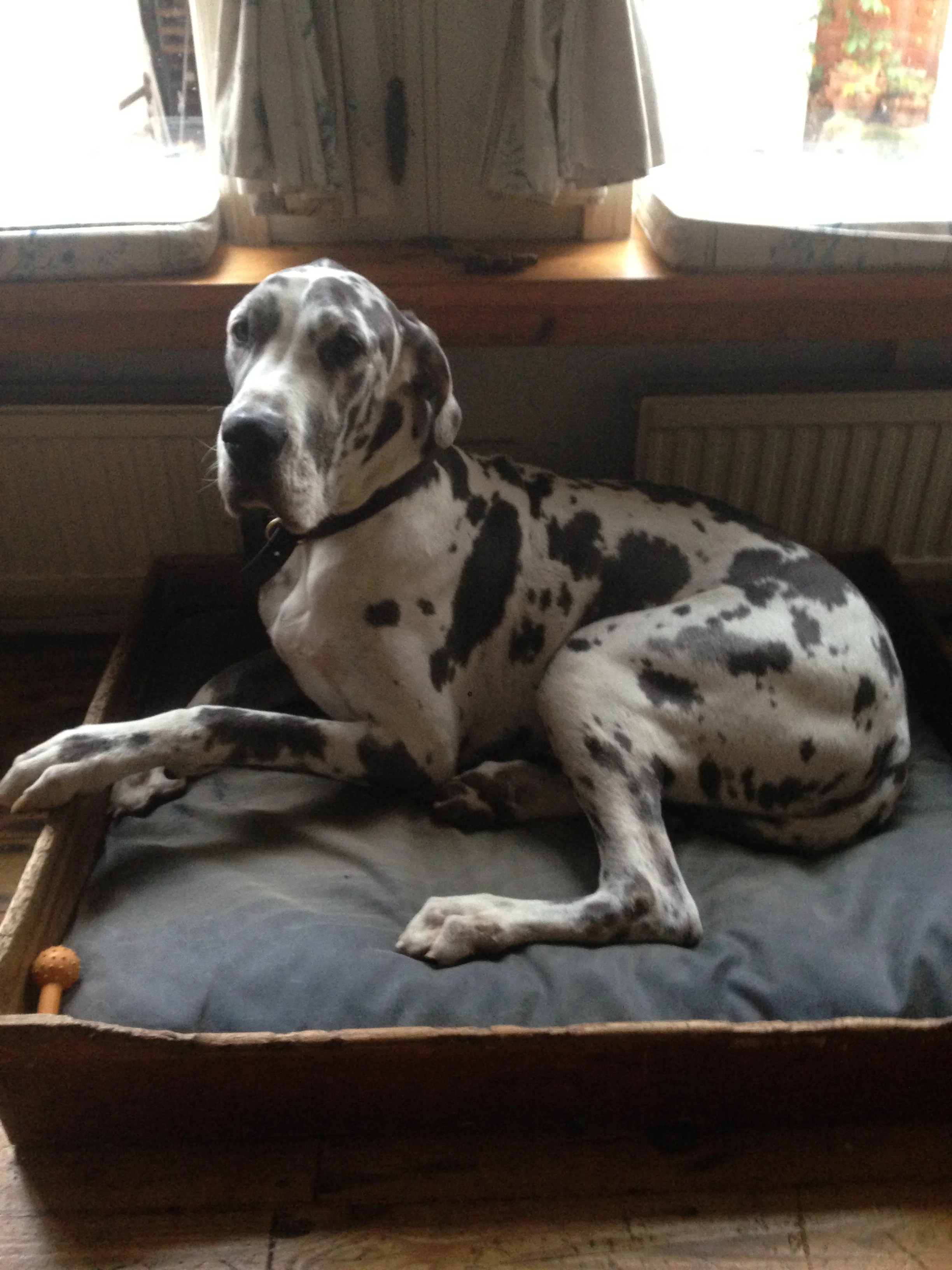
A bit like Horatio’s comfy bed (above) only with bars around it. The size of Wandsworth Prison, in Horatio’s case, obviously, because Shaun’s dog is about ten foot high when he stands up. Except that this cage we’re talking about, unlike a friendly doggy-cage, is one you can’t stand up in.

And it hasn’t made you feel safe, because you’ve been locked in it. Asking, for as long as you can remember, for someone, anyone, to help you escape.

At last, someone with a key comes to help you. The cage is unlocked and you are eased out, to stand on your feet for the first time in half a lifetime.

What do you feel? A sense of exhilarating freedom? Or howling, excruciating pain? The agony of muscles unused for years…

Perhaps also terror and apprehension, at learning to walk again. Very likely a terrible sense of loss.

Last Sunday our eldest, Serena, went to visit Bink in the Priory. Also Serena’s Viking husband, and little rampaging, amok-running, chaos-making and general-reorganising-of-the-world, fruit of the six-foot-something-Viking’s-loins, Serena’s one-year-old mini Viking. Who apparently left the hospital intact, on this occasion. Mysteriously. Must have been plotting the overthrow of something else I suppose.

They had a lovely, long and leisurely day together.

But Serena also said Bink was tearful. She has lost so much of her life; so many opportunities have passed her by; so many snows of yesteryear have melted leaving nothing on the bare, beaten grass beneath.

Bink has no little Vikings, of any nationality, to run amok at her childless feet.

At Bink’s age, I had four. (Five, if you count my first book.)

Every day, I wake grateful that Bink is getting treatment at last. But that doesn’t mean it won’t hurt. Probably a very great deal.

Mind you, staying ill hurts a lot too.

Five years ago we didn’t know where Bink was. We didn’t know she had just been in a psychiatric hospital for a month, having been found with ligatures round her neck. We didn’t know where she spent that Christmas. Nor that she eventually, very deliberately, made herself homeless, in a desperate and very dangerous – and unsuccessful – bid for treatment.

By the time I asked a handful of friends if they would pray with me, a few years ago, and started sending them regular email updates, she hadn’t been in touch with home for longer than I can remember.

Last week she rang every day. Until Wednesday, when she rang just to “sign off”, and tell me what I knew already: that she was starting the Priory’s ATP bootcamp the next day and wouldn’t be allowed any contact for a week.

And to wish her grandfather a happy 101st birthday this coming Wednesday, because she won’t be allowed to ring on the day.

How’s that for a turn up for the books? God does sometimes answer prayer.

Miracles do happen. 

Just… sometimes you have to wait a while…

dog-1539523_1920.jpg

PS Many apologies. I was in Cambridge this morning, recording some scenes from my forthcoming book, so I scheduled today’s post in advance – for 10pm by mistake. (You can’t be good at everything, can you? Or indeed, anything perhaps… As I said, sometimes miracles take a while.)

November 04, 2018 /Anne Atkins
Living with OCD
Comment
boat-1378635_1920.jpg

Brave Bink

November 03, 2018 by Anne Atkins

Summer 2005

By midsummer Shaun’s employing church was no nearer solving its legal requirement to house us. And our rented accommodation was almost at the end of its term.

Unusually for the CofE there was no shortage of money. But the will wasn’t there. The vicar was right to have recognised his need for Shaun on his team. But he had failed to explain this need to his congregation. And as he had considerably less brain (which was why he needed Shaun) and a very great deal less money (he was only the vicar) than a number of powerful personalities in his flock, he wasn’t in charge of much. Neither church nor budget.

One way to cope with feelings of inadequacy is to bully those under you. And one of those under him now, was me: we had given up our home on the assurance that we would be provided with another. By trusting, we had put ourselves at the mercy of others.

All the affordable suggestions I put forward – if the church invested differently and rented instead of buying, we could be housed easily – were ruled out. Partly on principle, see above. And partly because the vicar couldn’t understand the arithmetic. See above.

So Shaun himself was tasked with the impossible: to find a house, within the budget and the city, large enough for his family.

After months of viewings – he was visiting houses most days, as well as fulfilling his work commitments – each emphasising more than the last the inadequacy of the sum agreed, he found a house with the specified number of bedrooms. 

I was too demoralised to view it. If we had no choice, what was the point? I was teetering on the abyss already. Adequate unto the day would be the evil thereof: I knew I’d cope better if I faced it when we had to move, not before.

With more cunning than compassion, the church’s administrator tricked me into seeing it. I went up into the bedroom that was to be ours – windows just below the ceiling, as in a prison – and sat on the bed heaving in despair. The kind old lady selling stayed tactfully downstairs. Shaun came up, put his arms around the wreck that was now his wife and promised me we needn’t live there.

But what alternative?

I could only think of one thing. I would have to move back to my parents’. I could not hold onto my increasingly struggling sanity, continuing to care for my family, if I stayed where I was, feeling so bullied and manipulated.

I could bear the burdens God Himself put on me. Not more.

Better leave, than drown in the deep despair opening up beneath me. Shaun would have to find work elsewhere. We would be together again when he could.

It was Bink who had the moral courage to write to the Parochial Church Council.

“If you buy this house, you will split my parents,” she told them. “My baby sister Rosie will lose either her mother or her father.”

You think this might ring alarm bells? One of the first requirements on a church minister is to model family life.

The letter never reached its intended recipients. The vicar shared it with his churchwardens. All three agreed to ignore it.

I draw two lessons.

However the dæmons torment her, Bink is still the dear, true, indomitable Bink. Sometimes she can do nothing but scream – as you would, stretched on a rack. But she is not destroyed. Injustice, unkindness, most of all harm to a child, all rouse her to fight for others.

When dementia crept into my dearest mother’s finest brain, she was still my mother: she loved us as much as ever; smiled at the sun in happiest gratitude as she ever had.

And when Bink is healed and whole again, she will emerge. You read it here first.

She will stun the world.

The other concerns discrimination.

In a few days’ time, my father will be 101. Some time ago I employed a mother-and-daughter team to clean his rooms. After they left he couldn’t find the Victorian casserole pot which had been his mother’s, which he and my mother had used for potato peelings throughout their thirty years’ retirement together. It should have been full of vegetable parings, under his sink, needing cleaning.

First the claimed they had never seen it… and when pressed, that he had told them to throw it away.

Far more infuriating even than the loss of the pot (I found a replacement on eBay) was the insult. My father’s brain is as sharp as a pen. Every evening he puts me through Virgil or Sophocles, incisive as a laser.

But, “She can’t challenge what her dotty old father might have said,” I could hear them thinking.

The same towards Bink. “She’s nuts. We needn’t listen to her.”

The next day, however, the vicar called round with a present for her.

trojan-horse-277525_1920.jpg

A trout he had caught himself (he might have done better tending his sheep) and a bottle of Liebfraumilch.

I grilled the trout for supper but Bink wouldn’t touch it. 

lunch-2148346_1920 (1).jpg

And Bink, of course, was right.

If they had listened to her, the church could have saved itself years of pain, a six-figure loss on a house which plummeted in value, much more again on another employment expense and one of the finest members of staff they ever had.

She was right about the trout, too.

I never throw an apple core away. But when the he turned up again, much later, with a brace of pheasant he had shot himself (time better spent preparing his sermons, perhaps?) I didn’t expend energy plucking or gutting it.

retrieve-1753023_1920.jpg

It went straight in the bin.

November 03, 2018 /Anne Atkins
Living with OCD
Comment
alice-in-wonderland-276452_1280.png

Madnesses

November 02, 2018 by Anne Atkins

2005

Mad Richard – as we still call him, with great affection – was Bink’s maths tutor.

He is strictly teetotal. Which is just as well. Given that he behaves more superlatively sotted when completely stone-cold sober than anyone who’s ever been sober is liable to when blitheringly blind besozzled.

He was always late. But always. (Both eccentricities, his abstinence and his unpunctuality, possibly deriving from his Northern Irish heritage.) Probably because he was overrunning by several hours from his previous pupil, on account of being not just the best maths teacher we’ve ever come across – apart from my mother, who will always be unsurpassable – but also the most dedicated – see previous exclusion, above.

After a while he started bringing cake, by way of making up for it. Only, unfortunately, he would sometimes be further delayed by pulling into a lay-by to eat said cake, in the manner of Pooh on his way to Eeyore’s birthday. So he got into the habit of bringing two cakes. One for being late, for tea. And a spare to eat on the way, by mistake.

Not that it mattered. Bink was always in bed, whenever he turned up. So his first job was to get her out of bed. Once, she begged to be allowed her lesson in bed. Richard was a proper Protestant Ulsterman: it was about the only time he put his foot down.

He didn’t need to put his foot down over maths: he just enthused about it. Maniacally.

On an early spring evening, Bink and Richard were having their usual maths lesson, running around the garden screaming deliriously at each other, in the way of things. I’m not sure we ever quite ascertained why this was an essential aspect of every maths lesson, but there are many things in heaven and earth not dreamt of in anyone’s philosophy. Having completed this wholesome and invigorating routine so conducive to the sympathetic exercise of the little grey mathematical cells, they bounced through a window back into the house still yodelling at each other... and straight into the first – and last; and only – church meeting Shaun ever hosted in that house, which was being rented for us.

It was all right, though, because Shaun explained it to the assembled ecclesiastical committee. “That was Bink, having her maths lesson with her tutor,” he explained.

See? 

Bink never hung onto possessions.

In early adolescence this appeared to be the impressively efficient organisation of a teenager who kept her room excessively tidy. It was only later – several passports and birth certificates and almost all the presents she’d ever been given, later – that I realised it might be a manifestation of her illness.

Richard was teaching her something from a new text book. He took a break to go to the loo, and when he returned asked her to refer back to her notes.

“Refer back?”

“To what you wrote ten minutes ago.”

“You mean read it again?”

“I want you to look at what you jotted down just before I left the room.”

“I tore it out of my exercise book.”

“Why?”

“It was dirty.”

“Well, let’s have a look at it anyway.”

“It’s in the fire.”

After he’d got over this – or resigned to it: I’m not sure he ever got over it; he had his methods, Richard – he asked to see her text book.

He couldn’t find the chapter he wanted. “Where’s the contents page? Should be at the beginning...” He didn’t even ask where the front cover was.

“That was dirty too.”

“I was only out of the room for a moment! How much more have you burnt?”

Alex was due to start in Cambridge at Michaelmas, to read maths. I asked Richard if he would give him some refresher lessons. Rather rashly and to my astonishment, he agreed.

We tried to warn him.

Really, we did.

“Ach, nobody can be as bad as Bink,” he said cheerfully. (Or did he say, “as mad as Bink”?)

Um...

Richard turned up, late naturally, sometime around early-evening late-teatime. Ish. With or without cake. Half-eaten or not.

He gave Bink her lesson first, to allow Alex time to get ready.

Unusually – well... not necessarily unusually for Alex, but unusually for a human being – Alex was still in his pyjamas. From the night before. Even after Bink’s lesson. In the early evening.

Richard decided to let that one go, and asked Alex if he had his books to hand, as requested. Given that Richard had been late as usual, and had since taught Bink, I suppose there was a teeny, weeny, tiny, sporting chance that Alex might have had time to do this.

Richard let that go, too.

He embarked on the lesson. For the first ten minutes or so, he gave Alex an introduction to the work they were going to be doing, and how they would go about it.

Then he suggested Alex might want to get some paper and a pen.

“I’m sorry,” Alex said, coming to. “What?” From whatever planet it is where he spends most of his time. “Did you say something?” As yet unexplored by humankind. “Was I supposed to be listening to any of that?”

Richard never attempted to teach Alex again.

Even Richard had his limits.

So you see, there are other forms of madnesses. Besides Bink’s.

Obviously, there’s Richard’s. And... erm... Alex’s.

Thing is, not all forms of madness disable, do they? They don’t necessarily hurt. They don’t all cause terrible, screaming pain.

Which is when it matters.

(And if you want to know more about Alex’s creative, autistic kind of madness, you might be interested in this book he inspired.)

November 02, 2018 /Anne Atkins
An Elegant Solution
1 Comment
house-557297_1920.jpg

Misplaced trust

November 01, 2018 by Anne Atkins

First half of 2005

No illness takes place in a vacuum, certainly not a mental illness. I was soon to estimate that Bink lost five years of recovery as a result of that move at the end of 2004.

The – very serious – mistake we made was to trust. Where no trust was due.

The most fundamental aspect of a Church of England minister’s remuneration is housing. Even more fundamental to what is known as a priest’s “living” than the stipend designed to be just enough to live on, is the housing in which the priest’s family is to live. So fundamental is it, that many positions of employment within the CofE now offer only housing, no more: known as “house” [in exchange] “for duty”.

So when Shaun was told that, although the new church employing him didn’t have a house for us yet it would soon, he trusted. ’Specially as the person doing the telling and offering him the post was not just a Christian but a member of the clergy himself; and not just a clergyman but a very old friend, going back decades.

And naturally, when Shaun told me all would be well (even though all looked very far from well indeed) I chose to trust him, as I always had.

And at first all did seem well; with Bink at least, if not with our situation. We moved into rented accommodation for the first eight months, with the idea that the church would buy a house for us before it ran out. (We had stipulated a house with two bathrooms, so Bink could have her own.)

Being in a very large (and rich) church in the centre of Oxford, our children soon made lots of new friends. Bink in particular: in place of a tutorial college for the last two terms of her A level course, I found tutors for her from within the congregation. Two of whom have remained close.

(This wreaked havoc with her disability benefits for about the next ten years. Despite her being registered to sit A levels that summer, someone somewhere refused to recognise that she was still pursuing the same course of education. This is neither here nor there except to demonstrate how utterly ball-crushing the benefits system is made to be. Shaun and I accompanied her to several tribunals, and even after it had been conclusively demonstrated and agreed in more than one of these that she was indeed still studying the same subjects with the same syllabus, it proved impossible to reinstate what she had been receiving and was entitled to.)

When the challenges in a family become tough, the emotional wellbeing of the whole often derives from the mother. How often have you read biographies in which she was the glue which held everyone together?

Two of our five children were now diagnosed disabled. We had a toddler. We were also responsible for two dogs, a cat and an au pair. (Our poultry had all been taken by a fox in the muddle which constituted our move.)

We were standing on a shrinking island with nowhere to live from the summer onwards.

We had brought clothes and books with us to our temporary accommodation. Everything else we owned, our new church had agreed to move and put in storage till we had permanent housing. Until it dawned on the treasurer that it would be cheaper to do nothing. So all our furniture and everything else we loved and treasured was still in our old Vicarage, waiting for our new church to move it all.

After a while, the London Diocese threw a considerable amount of it on a skip.

I rang a lawyer friend, crying too much for him to work out what I was asking. We did indeed have grounds for a claim… And by the time I had the resources to follow it up, it had timed out by several years.

More and more of Shaun’s working time was being spent viewing houses. Every suggestion I made – almost immediately, for instance, I’d found a large Vicarage with a peppercorn rent sitting empty in the centre of Oxford, considerably cheaper and more suitable than the house we were in – was dismissed.

Why? I truly believe, because I’m a women. That’s the kind of church it was.

A committee asked Shaun if he was enjoying the work. “The work, yes,” he replied. “I love it. But would you enjoy waking every morning to find your wife in tears?”

Initially it had seemed that the move could do Bink good. And if we’d had a suitable house to move into, I’m sure it would have done. But a looming fear of homelessness isn’t good for anyone’s mental health.

I was falling apart at the seams. And Bink’s seams were a lot more loosely sewn together than mine were.

I am not one to be coy about my daughter’s illness. But even I draw the line at details which compromise her dignity.

She had exciting and interesting new friends. She was doing very well at her studies. She was playing in the chamber orchestra, and singing in the choir, I had put together when asked to take over the music for the 11 o’clock service.

But privately, behind closed doors, she was reverting to the sanitary recourses of a trapped, desperate and very frightened feral animal.

November 01, 2018 /Anne Atkins
Living with OCD
Comment
magnolia-1314398_1920.jpg

Leaving home...

October 31, 2018 by Anne Atkins

2004

It is a truism that loving a child does not mean you give it everything it asks for. We all know that.

Nevertheless if you did, the damage would usually be fairly limited. How much harm can you do by giving a three-year-old enough sweets to be sick; or a six-year-old, a pony? (Or our current one: a fifteen-year-old a pierced cartilage?) Not a lot, really.

The call is far harder when that child is not a child at all but a grown-up, so ill she needs looking after as if she were.

Much of the time, fortunately, Bink does seem to know what is good for her. Which makes it all the harder when she doesn’t. (Particularly when Data Protection emerges as considerably more obsessive than the patient, so you find yourself legally barred from helping the one you love and care for. In fact, it can be agonising... but I pre-empt.)

By 2004 Bink wanted us to move from our Vicarage.

I am not a moving-house kind of person. Serena is like me, I suspect. Indeed, in general Bink may be, too.

I become attached to a place, a city, a home, so much that I never, ever want to leave. When Shaun went on placement for a few weeks to Yorkshire soon after we were married, I became so acutely homesick in the first few days I had to go back down South again. It was pathetic. The people, the scenery, both utterly lovely; and they offered Shaun a permanent post. But I would have found it easier to relocate to Pokhara or Lusaka than to the beautiful Dales.

Our Parson’s Green Vicarage was not ours – in any way recognised by the Land Registry – but I loved it like another member of our family. So when Mrs Thatcher introduced a law against ageism and ruled out a compulsory age of retirement, I truly dreamt we might live there for the rest of our lives – or Shaun’s life, at any rate. Time was when vicars never retired...

In truth, Shaun had been itching to leave for some years. He – and we, with him – had rescued a dying church and filled it with children and young families, a Sunday School and music group, prayer meetings and home-groups and a choir, and much more besides. That very church for which the Bishop had instructed Shaun to “manage the decline” was now many times the size and thriving, and had been for some time. Shaun felt he had done his job. For a while now he had been staying on for the family, because we all loved it so much: the church particularly, but also Parson’s Green and the house itself.

And now, suddenly, Bink wanted to move.

She had been getting slowly, steadily better ever since she left the Unit. She was now attending MPW regularly, and doing well at her A levels. And she wanted a fresh start, in a new place.

It happened that year, that Shaun was offered his “dream” job, in our beloved city of Oxford: a post almost certainly designed around him. They hadn’t got accommodation for us yet, but it was a large and very rich church, easily able to buy a house for us and promising it would.

Bink’s desire to move wasn’t the only factor. But it may have swung it for me.

I’m not sure I ever sat down with her and ask exactly why she wanted to move. If I had, I would have discovered it was because she now considered the Vicarage “contaminated”. Not exactly the thinking of a well person, is it? Nor a very good reason for leaving...

So at the end of 2004, we left.

The worst decision we ever made. Bar none. For Bink herself as much as anyone. Even including the decision to let Bink go into the Florence Nightingale Unit.

(Though many years later even more harm was done to Bink, by giving her what she asked for.)

October 31, 2018 /Anne Atkins
Living with OCD
Comment
jason-leung-478507-unsplash.jpg

Telling the story

October 30, 2018 by Anne Atkins

Spring 2002

Our church AGM was not long after that church weekend away.

Normally I would prefer to have my toenails gouged slowly out with a blunt teaspoon to the accompaniment of the entire Ring Cycle played on rusty bedsprings, than attend an AGM. But our church AGMs went against the trend. Indeed, they were not to be missed. Shaun would whizz through the obligatory brief biography of the roof guttering at whistling speed, and then give a beefy Bible reading.

After which, refreshments.

It was the social highlight of the church year. Everyone came.

Except me. That year. The only time I ever missed it.

Although our much-loved friends (mentioned yesterday) had apologised and there was no rancour whatsoever, I simply didn’t feel up to it. It wasn’t that I consciously feared further criticism. I just felt too fragile, I suppose.

Which, as it turned out, was a pity. I lost count of the number of people who said to me afterwards, “Such a shame you weren’t there.”

When you first meet Shaun you tend to assume you’ve been introduced to a typical reserved type of up-tight Englishman. Possibly one who has been putting in extra practice on the fortification of his loftier lip since early childhood.

After about a decade and a half it will suddenly dawn on you, with the shock of a dénouement at the end of a gripping page-turner specialising in the most unlikely possible final twist, that this apparently conservative Anglo-Saxon exterior is merely a front for about as wild and poetic a rebel Celtic Irishman as it is possible to get. He is no more British than Swift, Sheridan or Shaw, Oscar Wilde or CS Lewis.

You will realise this because he has just said something astonishing. Which, on balance, was probably worth the wait.

It wrong-footed me so much – when this least likely of all my contemporaries at Oxford, who showed absolutely no interest in women and hadn’t had a girlfriend since he was at nursery school (and whom, moreover, I barely knew), told me one Monday morning in late Lent that he was madly and passionately in love with me... and of course that we must never see each other again – that I lost my balance and agreed to marry him.

That AGM was one of those. 

After the riveting narrative of how much quota the C of E was fleecing us for and when the alto pipes on the organ were due for their next bicentennial de-mousing, he swept away all business and, in place of the usual in-depth look at the Book of Esther, said to the assembled throng, “Let me tell you what it’s like, living with a daughter who is out of her mind.”

He thanked all those kind members of the church who had said to us, comfortingly, “We all know what it is to have rebellious teenagers,” and patiently explained that you don’t get hospitalised for normal adolescent defiance. Or even pretty hard core mutiny.

Bink was ill.

He then described sitting down to play a game of chess with one of your children... and realising way down the line that all along she has been playing draughts. And you have no idea of the rules, what the moves are or how to engage with or understand what she is doing.

I don’t know what else he said because, sadly, I was next door in the Vicarage, spending the evening alone: the one member of the church not there. I just know that people came out stunned, profoundly moved... and realising that our boat was sailing on a different sea altogether.

It is the same old challenge.

There is such a taboo around insanity, still now, that often your friends can’t bear to acknowledge your child isn’t there any more. Just as the bereaved experience the crossing-the-road-to-avoid-you syndrome because people don’t know what to say, so those blighted with lunacy encounter denial as if it were kindness.

“She’s just being a teenager,” they console.

Would that she were!

When I’m asked my about my children I’ve stopped saying our middle daughter is mad, because people think it’s a joke and titter politely. Or say proudly, “Yes, my daughter’s completely mad too!”

If I say she has OCD, though, they’re likely to respond, “Tell me about it! You should see my sock drawer...” In which case how are you here, behaving as if you can function?

If, Heaven forbid, you had to tell your friends your child had leukaemia... Well, I realise it’s absolutely no consolation whatsoever, but you probably wouldn’t receive these pat responses.

We need to tell the story. The story starts here.

October 30, 2018 /Anne Atkins
Living with OCD
Comment
music-notes-3221097_1920.jpg

Bink's birthday

October 29, 2018 by Anne Atkins

Present day.

Oh, no no no no NO! Please no. The £2bn allocated by Mr Hammond in today’s budget for mental healthcare is to be spent in A&E! Have we got nowhere?

It is not in A&E that we need the money! It is when a 15-year-old first goes to her GP, with a worried mother in tow, because she is dieting more than her friends and fears she is losing control.

Not two years later when she has dropped three stone and taken an overdose, because no help has been forthcoming. Because she “wasn’t thin enough.”

Well, let us wait and see. I am reacting to the early snippets…

March 2002

Bink’s 17th birthday fell at around the time of our church weekend away.

(Forgive the latitude with chronology. Memories come when they will.)

If you have never been on one of these, you won’t know how much fun they are. It is a mega-mini-break: a beautiful venue booked; all your favourite people there; meals cooked for you; no responsibilities; holiday atmosphere; games and entertainment; and with Shaun is organising it, intellectually exhilarating talks.

When it is a proper parish church as ours was, a completely eclectic mix of people too. All ages, from teetering tots to doddery nonagenarians. 

Bink said the only part of her personality not destroyed by her illness was her love of children. She wanted to do something for the church children that weekend.

So for her birthday I bought the score and all the instruments for Haydn’s (or possibly Leopold Mozart’s) Toy Symphony. The music group Bink herself had led in church had a handful of strings and a flute. The cuckoo, rattle and toy trumpet &c. were easily allocated. Which left no one else left to conduct: I don’t play a useful instrument. We even managed a scratch rehearsal the previous Sunday.

The idea was to perform it for all the children before their Saturday tea and bed.

Friday afternoon, and Bink wasn’t yet ready to leave. She had always been the organised one, ready before anyone. But now her rituals could imprison her for hours… or days. Shaun was in charge of the weekend so he couldn’t delay departure. And we only had one car. 

So we all set off without her, arranging that I would return and collect her when she was ready. She said it might be ten or eleven that evening. It was a two hour drive. I stayed for supper with the others then turned round again.

Midnight. Bink still not ready. Nor by two am. Nor three. Nor four.

It was long after breakfast before she could leave. I hadn’t slept, I had driven several hours and I had missed the first evening and morning of the weekend.

But I got her there!

I longed for a bed but there was a complication with our accommodation and the person with the key nowhere to be found. Nor had I managed to make arrangements for our dog – there is only so much one human being can do – and found myself entangled in ugly nastiness with the management.

My head felt as if it was being held twenty thousand leagues under the sea, but all I had to do was keep going till the afternoon and I would feel I had swum the Channel.

We did it. Bink played her fiddle. I’d even found myself an old tailcoat in the attic. We performed. I was too zonked to notice whether the children enjoyed it… but I had succeeded at Bink’s birthday present!

That evening there were party games in the huge drawing room. I wanted to take part but couldn’t get myself off the sofa in the hall adjoining. I sat, numbed and listless, listening to the laughter and longing to join it.

For some reason long forgotten, at lunch the next day someone announced Serena’s recent exam results and there was a round of applause. I felt the uncomplicated relief of joy at an offspring’s normal achievements.

A few days later, dear friends called at the Vicarage. There is absolutely no blame attached to what follows: none whatsoever. I have done far more hurtful things myself, with far less excuse. They are much better people than I am.

None of us understands, until we have walked in someone’s shoes.

It transpired that we had long been hoiked onto a false pedestal. We were the Vicar’s family. They looked up to us as their model. I was the Vicar’s wife. They had always admired me. And now I had let them all down. 

I had attended nothing over the weekend. I hadn’t taken part in anything. I had missed all the talks, and only shown interest in one thing: my own children. They told me as kindly as they could. They were deeply disappointed in me.

When Shaun came home I was still howling, alone, at the table.

Shaun is professional to a fault. He never criticises colleagues and never, ever upsets parishioners. I have never known him do anything like this before or since but he went straight round to see our friends and told them how much their visit had distressed me.

Very sad to say, shortly afterwards one of them had a child diagnosed disabled herself. A year later she referred to the incident again, distraught at what she had said to me. She had long since apologised and was long, long forgiven. But now she understood.

How dearly I would have preferred it if she never had! She used to bubble over with such mischievous joy and uncomplicated zestful irresponsibility. As did I once, I suppose.

We are both now wiser people than I wish we were...

music-1283851_1920.jpg

Last year my father was 100 so I threw a party for him.

The toy symphony had another outing, the piece conducted – far better and hilariously – by Ben. Most of the silliest instruments played by the most proficient professional musicians. Half way through, the bass Simon Grant’s nightingale ran dry, and I had to grab it, mid-performance, and dunk it in my champagne.

Bink even played her fiddle again.

How good it was to laugh so much... without such frenetic and wide-eyed exhaustion.

October 29, 2018 /Anne Atkins
1 Comment

Next step...

October 28, 2018 by Anne Atkins

Sunday

“We had no idea,” a number of people reading this blog have told me.

“I’ve been such a rubbish friend,” said one, feelingly, a couple of days ago. (This is absolutely not true, by the way: she has been one of the kindest and most supportive people in our lives. But she obviously feels she didn’t know enough.) “Even though you told us from the start that Bink was ill...”

So should every family affected by madness be writing about it...?

Part of the trouble, of course, is that most mad people are not able to articulate their suffering themselves. They may be living on the streets, or in prison. Or simply in isolation in a bedroom: I know of at least one such.

When journalist Frank Gardner (shot six times in a war zone, and disabled) was left abandoned on a ’plane, he was able to tell the rest of us how wheelchair-users are treated.

Who does this on behalf of the loonies?

And does this go some way to explaining why mental health provision is so much worst than dire?

Serena has said to me a number of times, “You’ve barely begun to convey how awful it was. When Bink came out of the [Florence Nightingale] Unit, for instance. If readers don’t experience the depths, they won’t feel the elation now she is receiving treatment at last.”

Must try harder...

Be that as it may, today is a day for good news.

Bink rang yesterday. She is about to start on the Priory’s bootcamp Addiction Treatment Programme. 28 days, no contact at all with the outside world for the first week and not much after that. Full-on, 7.45 in the morning till 9.30 at night. Visitors only on Sunday afternoons, and none the first weekend. 

And Bink thinks she will be far too busy for visitors on Sundays anyway, catching up with her washing.

It is a while since she had much acquaintance with life before midday. Let alone experienced anything one could describe as busy. It could prove an interesting relationship.

“Are you excited?” I asked. Nobody is expecting an easy ride.

“I am, actually.”

This picture is of the bubbles Rose blew in the park, when we visited Bink last Sunday.

Is it too much to hope that one day, Bink might become the Frank Gardner of the world of madness?

* * * * *

PS Ha ha ha ha ha. This is the first time I’ve added to a post written earlier in the day, but I can’t resist. Bink has just rung again.

“Please can you do me a favour?”

“Of course, Bink.”

“What will you be doing at ten to nine tomorrow morning?”

“Probably writing this blog. I post every day by ten.”

“Could you get me up, please?” From Bedford. Fifty miles away. All I have in my armoury is Alexander Graham Bell’s invention. “By Thursday I have to be in breakfast by a quarter to eight, so I’m trying to get up half an hour earlier each day.”

“Ok…”

She is talking to me from a top-of-the-range, state-of-the-art psychiatric hospital.

“And nobody here can get me out of bed.”

October 28, 2018 /Anne Atkins
Addiction Treatment Programme, Priory, Mental health treatment
Comment
party-3655715_1920.jpg

Al fresco

October 27, 2018 by Anne Atkins

2004

Memories from the rest of our time at the Vicarage drift and float like leaves, golden and brittle, shifted by random breezes.

The terrifying zombie that eventually escaped from the Florence Nightingale Unit in early 2002 was still extremely ill, and still a lot more ill than she had gone in, three months earlier. But by dint of endless love and patience over two years – we had nothing else to fight with: no other expertise – we had nursed her back to something a little more human.

When she first emerged she could do nothing, touch nothing. Not leave her room sometimes, let alone the house. Like a caged animal, unable to wash (or occasionally use a bathroom at all, for any purpose) for months on end. She couldn’t eat anything resembling a biscuit, say, which would crumble when picked up with a knife and fork. Glass was untouchable: when she started managing rare social events, she had to take her own mug.

Gradually, however, she had begun to study again; make a few friends; progress towards A levels.

And as for us? With hindsight I’m not sure I could say I was recovering as well as she was. I don’t know how much I aware of this at the time.

In 1996, for the first time I my life, I had begun earning a living wage; more than Shaun, not that this is saying a great deal. My writing career was taking off. Which, as with any work, had taken years of passion and dedication as well as the occasional – probably overrated – flash of serendipity. When the tide had at last turned for me that year of 1996, I had woken every morning with a smile on my face, blessed with the sunshine of good fortune.

It lasted just six months, until Alex nearly took his own life, aged ten, bullied by teachers. A year until Bink went missing, aged twelve. After she came out of the Unit in 2002, spending several hours a day as I was simply trying to coax her out of bed, I lost it all. My income went down by over two thirds.

Writing fiction became impossible. How could I care about anyone other the people under my roof?

And not one of the many professionals involved in our lives – not our GP, nor any of the shrinks we were occasionally referred to, nor any therapist, nor our MP – gave us information that would actually have helped: that there is financial support for carers and the disabled; grants to apply for so Bink could have had her own bathroom.

When I discovered this years later, far too late to change our lives, and asked how we could have known, I was told it was the duty of each and every one of them to have told us.

I sometimes longed for friends, old or new, to ask us how things were. An elderly couple came for supper. They had been missionaries, in Japan I think. We didn’t know them well but when I was a drama student I was commissioned to write daily dramatic sketches – my first real writing – for a week’s addresses he was giving. They were lovely warm people, and he was fiercely intelligent. Please, ask us! I pleaded silently all evening as we fed them round our friendly Vicarage kitchen table. I just wanted the slightest invitation to talk. Not even to ask for help: just to share the pain.

How could they possibly have known, if I didn’t tell them?

One friend continued, for years, with a kindness I will never forget. Jonathan Ruffer is a most extraordinary man: Christian; financier; who has invested a fortune in his Northern homeland. As busy as anyone I know. He made time, every few weeks without fail, simply to ring and ask how Bink was, even though there was nothing to say. A precious act of love to last a lifetime. “One day,” he said during one such conversation, “this will just be a footnote in her biography.” Bless you, Jonathan!

We were friends with another clergy family near us, also with teenage children, whose son was at school with Alex. They invited us to dinner: venison; a rare treat. I can’t imagine it was the only time we completely forgot something that was just for pleasure. They rang us half way through the evening. Most unusually, Shaun had cooked an early supper for me and we were ready for bed. I was distraught. They kindly renewed the invitation (though not, sadly, the venison). I excused myself from the table half way through the meal, sat on the floor of their loo and cried and cried and cried.

A month or two later I invited them to our Vicarage in return, and did something very unusual for me. Instead of feeding everyone together, I set a table for the teenagers in the garden: six of them, three from each family.

I had been to the candle shop in the New King’s Road and bought pretty holders for an outdoor dinner table: I have them still. I laid the table with excitement: flowers in little vases; napkins and silver; twinkling tealights.

Bink even managed a shower, and appeared – not much later than everyone else – in a short, moss-green denim skirt. Her hair had grown enough for an attractive bob.

I waited on them outside, while we ate indoors where I could see them. I had no interest in the conversation around me. I simply wanted to watch my daughter enjoying herself. Being a teenager. With friends.

All I wanted.

The worst was behind us now. Surely.

Oftentimes over the last twenty years I’ve had reason to be grateful that God doesn’t show us the future.


October 27, 2018 /Anne Atkins
Living with OCD
Comment
cartoon-2029192_1280.jpg

Clean enough, sir?

October 26, 2018 by Anne Atkins

2004

Alexander has the kindest heart in the world.

Being Aspergic, he has coped with Bink’s illness very differently from the rest of us. I was about to say, “much better than”, and it certainly appears so. His objectivity is astonishing: if an emotion isn’t useful, he doesn’t use it. (The jury is still arguing ferociously as to whether his feelings consider this satisfactory; or whether they are merely biding their time, stacked up and waiting – somewhat pissed off – in the wings to be attended to when he has a moment.)

Thus he is able to analyse Bink’s behaviour, understand her fears and give her responses so appropriate and helpful that sometimes the rest of us can only gawp in admiration.

I have already alluded to his being the one member of the family who would never lie to her. The temptation can be considerable. In 2015 we lost Bink for months, just because Rose changed the cycle of her wash, when she was getting her uniform ready for the new Lent term, in order to be in time to catch her train. If Bink hadn’t known – if I had glossed over the exact details when she asked me – she would have been with us through Rosie’s precious last half year at choir school, and present for the celebratory and glorious week of her confirmation in Durham Cathedral that Easter.

But Alex would never do it. He explained to me why lies and Asperger’s syndrome don’t go together. Nothing moral about it: it’s just too confusing. He takes the long view, I suppose. Getting Bink to Rosie’s confirmation isn’t worth the price. ’Specially not the risk of losing her trust.

She’ll have to find a way around the truth herself.

Before her illness Bink was a sparkling musician. Her obsessiveness could have taken a very different turn. I’ve heard her practice triplets against quavers for hours on end. You can’t really become a professional musician – perhaps any creative genius – without a considerable level of obsession.

But since the Florence Nightingale Unit she hadn’t been able to touch musical instruments, along with much else besides. And she had no outlet for singing, so her music had fallen sadly silent.

One day Alex come into the Vicarage drawing room looking for all the world like Mrs Mopp. He didn’t quite have a headscarf tied in a knot on his forehead or flowery overalls on, but the resemblance was otherwise so striking that I picture him to this day as if he had. He was carrying a bucket of soapy water, bubbles frothing at its lip, and an old-fashioned mop, with its wild unbrushed hair on the end of a pole, head down in it.

We were so astonished that we merely watched, mesmerised, as he sloshed the sopping mop up and down the keyboard of the piano, refreshing it regularly from his bucket.

Eventually, someone must have had the sense to ask him what on earth he thought he was doing. I agree it was, if not quite a pointless question, certainly far too late a one. Still, I don’t think it warranted quite the tone of the blindingly obvious with which he explained, “Washing the piano. So Bink can play it.”

I don’t think Bink had actually asked him to do this. She’s not quite that bonkers.

On the other hand…

Alas, no one played that piano for quite a long time.

For some months, all the keys lay in the sun in our conservatory, individually extracted from the innards of the instrument, attempting to dry out. At first I put them in the garden for the duration of a sunny afternoon, but it was soon very clear that, spring though it was, it would be snowing before they had recovered.

We had to get a piano engineer friend in eventually. A high and little-used C# remained stuck for many years afterwards.

Perhaps it was Bink’s idea, now I think about it. I remember explaining that wet wipes would have been a little more appropriate. 

This was a mistake.

Wet wipes still have quite a lot of moisture in them, if you ring them out with enough determination over a wincing keyboard.

There came a time when the individual keys stretched out trying to dry in the conservatory were not those of our piano. But of my laptop. Without which I couldn’t work.

Which was not something Alex could ever have done. 

And that never did recover.

October 26, 2018 /Anne Atkins
OCD
Comment
hands-2319834_1920.jpg

Waste

October 25, 2018 by Anne Atkins

Present day

When we saw Bink on Sunday she gave me an article she had torn out and kept for me, from the previous week’s paper.

“I thought you might want this for your blog.”

It is worth reading in its entirety: the same bleat I have made a number of times. The appalling lack of any help whatsoever that passes for modern mental healthcare.

Bink had marked several passages for my attention. In particular she had circled a section in red, which ended:

It wasn’t enough. My referral was rejected on the basis that the teenager hadn’t yet tried to take her own life.

‘If she does make an attempt, then do call back,’ I was advised before the woman hung up.

(Precisely the reason Bink herself took an overdose at the age of 16.)

And underlined in black:

We know early intervention can reduce the impact mental illness has on people in years to come, so there is a good rationale for making sure everyone who really needs help gets it. 

How much pain does this represent in just one person’s life? How many wasted years? 

As it happens Bink also gave me back my novel, which she had kindly marked up with errors she had spotted in time for the final proof-read. The copy I’d given her had already been professionally, and very competently, proof-read.

Bink had spotted at least another hundred typos. And many more tiny quibbles of grammar and punctuation, about both of which I consider myself more than averagely fanatical. Several hundred corrections, to a novel ready for publication. I honestly don’t believe I have ever come across a mind so attuned to detail.

And still not worth the tax-payer’s while – apparently – to treat her any time over the last eighteen years.

“Bink,” I said, “you’ve got to become a barrister. You would be terrifying.”

“Hmm,” she said. “It would be against my conscience.”

One of the things to be said for life is that you can get wrong-footed by the most unlikely googlies. Who’d have thought Bink had one of those, eh?

“Though I wouldn’t mind taking on the large corporations.”

You read it here first. If you employ more than fifty thousand people, start ducking now.


Spring 2002.

Something in yesterday’s post jogged me. So many tucked away little voices of loss, you get used to the echoes and stop noticing.

Shaun’s brother was getting married in Pakistan. For us as guests, a one-off to last a life-time. Bill had been, for some years, working as a clergyman in Sharjah. The penny finally dropped with his Asian friends, and they faced the shocking fact that his own family back in the West was never going to arrange his marriage. And Bill himself couldn’t organise his socks into pairs. So his friends had referred him to a vicar in Lahore and asked him to find Bill a wife.

This was Billy’s arranged marriage. This white, Irish, Church of England clergyman’s wedding to a gorgeous Christian Pakistani vicar’s adopted daughter. They’d met once, I believe: to her bemusement, Bill insisted on her informed consent.

As so often before when the need arose, I went in search of an editor who would commission me to write about the trip, to pay for our flights. Once there, everything would be taken care of by our wonderfully hospitable new Pakistani in-laws.

A trip Thomas Cook could never pull off:

Taken for salwar-chemise fittings as soon as we touched down, in beautifully comfortable cotton, delivered the very next day; joining in searingly hot and delicious meals; washing up with the women under a cold tap; 16-year-old Alex being told at breakfast that – as the oldest unmarried male in the family – he was best man and he’d have to learn the rituals as he went along; following the crowds, none of whom seemed to have received a formal invitation, more and more joining in as we went along the streets; being unsure which day was the wedding itself, they were all so full of celebration; eating from vast vats of curry in an open courtyard; dancing under the stars.

Only one sad shadow casting its cold finger over the memories.

Serena, bless her generosity and big-heartedness, never once breathed a word of complaint, then or since. But she too had to miss out on so much, staying the other side of Lahore in an hotel, so Bink wouldn’t be completely alone. Neither of them sleeping with the rest of us, blanketed by the warm night, on the roof of our new family’s home. Bink must have asked, months beforehand, what she would use for a shower and loo.

No one in this culture, I thought, could afford to have OCD. You wouldn’t survive, would you? Presumably they would never have heard of such a thing…

But after we arrived the bride’s brother told me of a cousin with the same ailment. He couldn’t touch anything either. All cousins come together for such an event. We never heard any more about him.

Amidst all the proposals and offers we received for Serena’s hand, none was interested in Bink. No one took us aside on Bink’s account, and said, “I have a nephew studying to be a doctor. Please, let me show you his photograph…”

Could they not see how beautiful and clever Bink was too? They couldn’t even tell whether she was a girl or a boy – dressed as she was, as baggily as possible, with her hair all shorn off.

I like to hope there is an etiquette that you have to ask for the oldest first.

That’s one excuse the NHS couldn’t really use, isn’t it?

October 25, 2018 /Anne Atkins
Pakistani wedding, OCD
Comment
39156055872_939463b9b9_b.jpg

Party (II)

October 24, 2018 by Anne Atkins

September 2004 [cont.]

Serena rushed from the crowded room.

There was a long, shuffling pause as everyone tried to resume small talk. Eventually she returned with one guest who was visibly shaken. Nobody asked what was the matter. Most of our guests knew not to. As most, indeed, had known not to wander about the Vicarage.

Most. But unfortunately not quite all... 

We had learnt, with Bink, to expect anything. Many of our friends had, too

We ourselves weren’t at all surprised when Serena herded us into a room and told us not to move. We’d lived with this for some time now, and knew exactly what it meant.

It meant Bink needed the loo.

There was an upstairs loo, yes. It was a long time before I knew why Bink couldn’t use it. It was because she could touch the walls of any loo, so the room had to be a certain size. She fretted for weeks before a long haul flight to her uncle’s wedding in Pakistan: she couldn’t use any aeroplane loo. So because the upstairs loo was a normal size, she could only use the large ground floor loo in the Vicarage. It was a while, too, before I knew why we had to stay confined in a room.

Nevertheless we were well-used to the routine of not being allowed out for a while.

Indeed, sometimes Bink would send us all out of the way, use the loo, go back upstairs and then forget to tell us she’d finished... We could be stuck for quite a long time, believing we couldn’t answer the doorbell which some poor parishioner had been leaning on for several minutes; or attend to the telephone which was ringing its head off in the hall; or leave the room for a book we’d forgotten; or even use the loo ourselves.

We got used to calling out, if we’d been locked away for half an hour or more, to see whether she was still needing a clear run. Though we wouldn’t have done that at a party, obviously. On account of wanting to maintain some tiny shred of pretence at normality.

Serena is exceptionally competent. She would have no more difficulty taking charge of a milling chatter of humans than managing a flock of recalcitrant sheep or corralling naughty ponies. Thus, half the guests had been instructed to remain in the kitchen and dining room, at the back of the house. And the other half was in the drawing room, at the front. Serena posted Alex to guard one consignment, she herself oversaw the other, she made sure they all knew to stay where they were and then gave Bink the All Clear.

The only thing she hadn’t done was a head count.

The guests went on drinking, eating and enjoying one another’s company, and another challenge in Bink’s daily routine seemed successfully met...

Until the night was pierced, as if by a shriek owl at Hallowe’en whose toe has been trodden on by a warlock on a diet of doughnuts.

Moses (not his real name) was a quiet, conservative Christian from Nigeria. He had of come from a country where Christian behaviour differs far more radically from the cultural norm than perhaps it does in the UK. In many parts of – particularly AIDS-torn – Africa it was much more crucial to ensure that Christians lived differently. Western teenage Christians behave, in many ways, like their non-Christian friends. Young African Christians, far less so.

There were other adjustments he was coping with. He found himself in a house which was old, large, rambling and fascinating. He didn’t realise the rest of the guests had been shut away for a while. And he decided to take a little tour.

Jane Eyre got a shock when she discovered Mrs Rochester in the attic... though she eventually recovered. Moses, too, was traumatised when he wandered along the corridor of a Christian minister’s home, to encounter the minister’s eighteen year old blonde daughter, sporting – though we didn’t realise this, because she spent most of her teenage years in baggy men’s sweatshirts and oversized tracksuit trousers – an unfairly curvaceous body, with a tiny feminine waist whilst being extraordinarily buxom elsewhere.

The good news was that she was not completely naked. She had shoes and socks on. And one, just the one, very bright blue, top-of-the-range Marigold glove.

And she was screaming.

I suspect that was when I discovered why we were always shut in a room. None of Bink’s clothes could touch anything in a bathroom. So she always had to take them off before coming downstairs.

An unconventional thing to do, perhaps, in a Vicarage when all the congregation knew the front door was left unlocked and people were always letting themselves in and out.

But there we are.

Some time later I asked one of the guests whether he remembered the party. He not only remembered it, but gave me such a detailed description that I could see, and particularly hear, it all again as if it were five minutes ago. Moses was gently ushered back into the room by Serena, as pale as it was possible for him to be.

A long time later Bink also returned, hidden in a hoodie from which she didn’t emerge all evening.

And no one in that group of friends ever saw or heard from poor Moses again.

October 24, 2018 /Anne Atkins
OCD
Comment
eric-nopanen-624212-unsplash.jpg

Party (I)

October 23, 2018 by Anne Atkins

September 2004

“SereeeenaaaaaH!”

The scream must have been audible all the way around Parson’s Green. 

Serena was having a party.

She’s very good at parties, Serena. She collects people in the way she collects animals: a rabbit easily mistaken for a fluffy slipper; a Great Dane the size of a Friesian calf; a punk chicken. As a teenager, she would smuggle them all into her bedroom and somehow enable them to rub along. Except the terrier and the baby budgie, one of which ended up in the other.

It’s the same with friends. Serena has a way of throwing a party so all sorts of disparate people, from very different backgrounds, collide happily on a bouncy castle, laughing together. She was the one most often found at midnight, when we lived in Parson’s Green, operating the toasted sandwich machine for some tatty, extremely cold and usually not entirely sober visitor.

So there was often an eclectic mix of guests under our roof.

Nevertheless, despite Serena’s gregarious and hospitable nature and an ecclesiastical house and garden designed for nothing so much as peopling it, it was a while since we’d done anything so frivolous and important as entertaining. Barely since the Florence Nightingale Unit, and all it had done to Bink and us.

You can wear away a stone with dripping water.

This particular party was for a bunch of young people who had recently been on holiday together. I believe I have already mentioned the Christian holidays Shaun and I used to run, taking over a boarding school for ten days in August and organising thirty or forty older students and young professionals to provide activities, sport, entertainment and Christian teaching for a hundred or more teenagers. Ironically, by the time our own children were old enough we’d handed the baton on. They continued to attend without us though, having got a taste for the fun and games and lovely people when they tagged along as toddlers.

But of course, by her mid-to-late-teens it was extremely difficult for Bink to join in with anything, let alone something so purely enjoyable. The organisers – fortunately, close friends – had to find washing facilities for her sole use, so they allocated a 30-shower changing room in remote part of the school which no one else knew about. They would need to turn a blind eye when she was the only teenager breaking the rules, missing obligatory meals, the brief morning or evening meetings, or the bedtime Bible-study get-togethers with the other girls in her dormitory. I’m not sure she could even share a dormitory, which was how they all made friends. And she had to be welcomed several days late… by the time she’d bought all the wet wipes and loo paper she needed and was ready for me to drive her to Dorset.

I would have loved to have stayed and watched her enjoying herself: such a rare treat, to see her having some semblance of normal adolescence. But I was several years behind on my own work – and not needed for the next few days.

Here is the contradiction that was Bink. And still is. Friends on the team reported back to us the longed-for news which most parents of teenagers never need. How she and Alex got everyone vying to win their week-long competition to guess the number of dead wasps in a jar. How the two of them jumped up in the dining hall at breakfast and spontaneously sang, in harmony, in honour of someone’s birthday. How her high jinks were the highlight of the “Daily Dross”, the tabloid entertainment read out at the end of the day.

Despite her devastating illness, in a group of nearly two hundred people Bink still emerged as the star, her charisma catching the light.

Enabling me to imagine what her sparkling youth might have been like, without this cancer…

Serena’s party was a month later, in early autumn. She had been helping in the kitchen that summer, along with others too young to be leaders. So naturally, she organised a reunion. And because of the essence of the holiday, most of them were exceptionally well-behaved, courteous young Christians: the sort you’d be happy to have partying in your house any time.

Now, if you found yourself in a Vicarage full of young people who had just given up their scant time and money to help on a children’s summer holiday overseen by Scripture Union, your guard might be down. You might not be expecting – or not as much as at a usual teenager party – to find them smoking dope, throwing up or using the bedrooms illicitly. Possible, perhaps: but rather less likely.

Or indeed, wandering around with no clothes on.

Until the scream…

October 23, 2018 /Anne Atkins
OCD
Comment
crying-1293443_1280.png

Unkindness

October 22, 2018 by Anne Atkins

Summer holidays 2003-4

“But that’s mad,” my mother said.

That’s right, Mummy. She is.

We were in North Norfolk, on holiday at my parents’ seaside house, and Bink needed to go back to our Vicarage in Parson’s Green, in South West London.

To wash.

My parents’ holiday house hasn’t been updated since my grandparents bought it in 1948. They probably never updated anything from the house’s construction in the 1930s. 

We love it. Though I confess, our daughter Rose did ask this year whether it might be possible for the house to be cleaned before we go next summer, if she is to invite any of her 16-year-old friends to come too.

It helps to see it as a souped-up beach hut. With all of us running in straight out of the sea and off the beach, it’s bound to be full of sand and seaweed.

I deduce that for the year in question Bink needed a shower: that house has never heard of a shower... or microwave, wifi, or any other gizmo; it never even had a landline when we were young, though it does have a telly and a toaster... broken. Bink hasn’t been able to touch the original footed bath for many years and indeed can’t now enter the house. When we go these days, my very kind sister puts her up in her house, a couple of hundred yards away and complete with working hoover and duster... and shower.

I can’t remember what happened – I don’t believe she did go back to London in the end, though she was certainly very distressed – but I do have other memories.

My parents held open house, as my father still most generously does in my dearest mother’s memory. Siblings, cousins, aunts and uncles, friends and strangers, and sometimes a general factotum. In my grandparents’ day this was Sybil, and we still have Sybil’s Room (aka the Boiler Room, counter-intuitively the second best bedroom, overlooking the sea) though Sybil must have been dead many a long decade now.

Because there were so many extended Briggses (my maiden name) Sybil would refer to Mr and Mrs Briggs (my grandparents), Mr and Mrs David (my parents: my father is John Davidson, always known as David), Mr and Mrs Stephen (my uncle and aunt), Mr and Mrs Davidson (my cousins)... and so it went on.

It’s not a large house, no: one of a small terrace on the cliff. But you don’t need much room in the summer, and my mother would squeeze lots of children head to toe along the balcony.

So of course, the deal is that we all muck in together. My memory of seaside childhoods is mostly of washing up.

And you all have to rub along together, too.

My mother had a mischievous twinkle of humour in her eyes always, as well as the kindest heart in the world – and most stimulating mathematical mind – and she would sometimes refer, privately to me anyway, to Dodie Smith’s play, Dear Octopus, about the tensions and loyalties, and inescapable ties, of extended family.

By the time Bink was 17, though she still loved coming she couldn’t help at all. The rest of us understood and didn’t expect her to.

Not everyone did.

There were plenty of us to clear up after meals and no more people could fit in the kitchen anyway, but nevertheless someone saw Bink sitting idle and said, “I wish I had OCD.”

Imagine if one of the teenagers had been in a wheelchair.

“I wish I were quadriplegic.”

It got worse. 

An adult came into the sitting room and threw a teatowel at her. “Time you did some drying up.”

I don’t know how she got upstairs but that’s where I found her, howling – as quietly as she could – crouched in a corner of the balcony. If boiling water had been thrown over her she couldn’t have been in more pain. (The teatowel had already been used.)

My mother found both of us, sobbing together.

“I’ll have to go, Granny,” Bink explained. “I can’t stay here. Nobody will care, anyway.”

My mother sat down on the floor with us.

“I will,” she said.

children-1412016_1920.jpg

Present day.

At Rose’s insistence we took a picnic to share with Bink yesterday, and sat in the sun-soaked park next to the North London Priory, and lost a kitten up a tree. (Why did we have a kitten with us? It would take rather long to explain.)

She is off all drugs now except the Lorazepam, down to 2 mg a day. She hadn’t had any substances all day. She was sparky and full of smiles and hope, but by teatime jittery for her first pill. She took it, and blanked out behind the eyes.

By Christmas, by my reckoning, she will be clean. It will be very exciting to see the original Bink underneath.

She is in a good, safe place.

October 22, 2018 /Anne Atkins
OCD
Comment
Sarah's flowers for Bink.jpeg

Flowers

October 21, 2018 by Anne Atkins

Sunday

One early evening in the autumn of 1996, Sarah Sands (now editor of the Today Programme, then deputy ed of the Daily Telegraph) rang me up and offered me almost my first ever reliable income, certainly my first as a writer: how did I fancy being the Telegraph’s first agony aunt?

I laughed so much I fell off my chair.

“Don’t do it,” my wonderful literary agent and close friend, Gina Pollinger, advised.

“Don’t do it,” her husband Murray, also a very well-respected literary agent, said even more authoritatively.

“Don’t do it,” Shaun said. “You’re a novelist.”

I admired all three of them hugely.

So I did it.

The Telegraph sent Cassandra Jardine to our Vicarage: a respected journalist; someone I’d looked up to and known slightly as a Cambridge legend when I acted in Footlights as a schoolgirl. Cassandra asked me what hardships I’d suffered, to qualify me to talk about other people’s.

None.

I honestly couldn’t think of any. Not a single one.

Nothing in my life had ever gone wrong. (Apart from marrying a clergyman and having no money. But since we still had no money at the time of the interview, I had no idea that life could be different.) It took all of Cassandra’s skill to prise out of me that I’d had more miscarriages than I could remember.

Within weeks we could afford food, and life truly lacked for nothing.

Half a year later, I was never able to say that again. I’m not sure I’m better equipped to be an agony aunt, but I certainly now understand how much pain there is in many people’s lives.

Most of my friends’ challenges are far tougher than anything I could cope with:

One dear friend has a fabulous job, lots of money, two homes to die for... and no one to love or share them with.

Another has gifted and successful children, a gorgeous home and impressive career... and a marriage which itself causes great suffering. 

Yet another has inherited a wonderful estate to run, with a loving marriage and two very happily married children living nearby with their children... and their two siblings long in the grave.

Cassandra herself left behind her five children when she succumbed to cancer some years ago.

We were never promised a rose garden. Unless we die after a brief and happy childhood, we are likely experience suffering.

What is amazing me this glorious Sunday morning is the balance of joy that remains. 

  1. Our daughter has been so ill she couldn’t function for many years, her life wasting away for want of treatment... and today I go to visit her in the best mental hospital in the country.

  2. For the best part of the year after we lost our home, we sometimes didn’t know where we would sleep the next night... and now own our own home which earns a living for us.

  3. I spent twenty silenced years, unable to do what I was called to do. If you have never watched yourself fail at what you knew God wanted you to do this agony may sound nothing… But the satisfaction, fulfilment and joy which wakes me smiling, from the few hours’ sleep this morning since checking every last comma of my next novel (out in weeks) will keep me smiling long beyond this year and into writing the sequel.

I doesn’t always work out, I know. Sunday Worship was led, this morning, utterly beautifully, by a clergyman who has lost his wife.

But it sorrow can turn to joy in the morning, all the sweeter for the night.

Do you like the autumn flowers, above, that my friend Sarah sent to Bink two days ago?

And these, below, are the ones I sent her the week before, still alive in her room:

My flowers for Bink.JPG

And here are the flowers Shaun gave me on Friday, before going away for a week.

(I do hate him going away. But sometimes, just sometimes, God makes our wait worthwhile…)

October 21, 2018 /Anne Atkins
3 Comments
Beatrice-much-ado-about-nothing-1099627_500_281.jpg

Hiding

October 20, 2018 by Anne Atkins

Summer 2003

I find I have skipped another episode.

People are asking me, “Just tell us what it’s like. We’ve all heard of OCD. But what does it mean?”

A few weeks after Rosie was born we went to Ireland. We all love the land of Shaun’s ancestry; and because I earn our family holidays – by writing travel articles about them – I get to decide what would make good copy. And I usually decide that what my readers would most enjoy reading about is my family and horses. Falling off them. Getting lost on them. Having to get up at dawn to tack them. Even, if necessary, getting saddle-sores on them or being chased by an elephant on them, driving a caravan into a ditch with them or having a complete stand-off with them as to which is the correct route to take. (On this occasion, aiming at the extremely small target of a polo ball from the back of them.)

I don’t mind much... as long as I get to ride them. 

Naturally, Ireland and horses go together like the proverbial cart and.

But Bink could no longer do horses. 

In her horror of hair and dirt and slobber and general animalness she seems to have forgotten this, but as a child she gave every appearance of liking dogs and cats... and, yes, horses. In a funny kind of way she still does. She is much more particular about eschewing meat that hasn’t been humanely reared even than Serena is. She is concerned about Horatio, our Great Dane, having a bed too small for him. She often demonstrates deep sympathy towards animals.

But because she can hardly bear to be in the same house as an animal that isn’t locked firmly behind glass – she doesn’t object to Ben’s snakes… not that it would make the slightest difference if she did: I’m sure I must have done – she has come to believe she doesn’t like them. (As I write this I find myself curious as to why the same thing hasn’t happened to her love of small children: their eating and evacuating habits are surely every bit as disgusting and unsympathetic towards OCD as animals’ are...)

That’s fine. Plenty of people in the modern world seem to function without much contact with animals. If not, perhaps, quite so many people in our household. Which, at the last count, had several dozen animals using our address as theirs when they need to claim anything from the DWP.

So Bink was not going to ride with us. Sad though this was, it was also quite fortunate as it meant there was someone to look after the six-week-old that was now Rosie.

As I was setting the holiday up it suddenly occurred to me that Serena’s Great Dane (Hamlet, predecessor to Horatio) was not the kind of dog you could snick into your designer handbag and hope no one notices your smuggling into your hotel room. We had the extreme good fortune to be booked into the smartest hotel in Ireland, so I rang Reception for advice.

“That’s grand,” I was told. “You can bring him wit’ ya.”

Obviously this was a mistake – you don’t need to see a Great Dane to realise he’s not welcome anywhere – so I waited a few weeks and rang again.

And, bizarrely, received the same answer. I thought about this for a while and then rang back for the manager. When even the owner of the hotel said we were welcome to have a Great Dane sleeping in our bedroom I decided to live dangerously.

Shaun has told me stories of tenements in Dublin inhabited by horses. Perhaps that’s why no one turned a hair at a dog the size of a pony being shown into our extremely luxurious 5* bedroom. Well, I say no one... the very English Colonel Blimp in the room next door kicked up a terrific fuss. And checked out next morning.

I asked whether there might be a few scraps left over in the kitchen suitable for a dog’s dinner. Five minutes later, a lassie in a neat black dress and white pinny knocked at our bedroom door. She was bearing the sort of vast shining platter and dome which shimmies into the frame in a Marx Bros movie before the waiter trips over the rug and hurls it across the room like an All Black attempting a try. (Is that how you attempt a try? And why isn’t that a tautology..?)

Beneath said dome was the biggest shin bone a cow ever sported, with enough meat left on it to feed the entire Atkins tribe. What we appreciated even more (though the dog barely seemed to notice) was the sprig of fresh green parsley decorating its noddle.

That’s the kind of hotel it was.

Attention to detail. Beds the size of croquet lawns. None of this kettle-in-the-room-and-capsules-of-longlife-milk nonsense in place of a service bell. This was the Downton Abbey of the hotel world.

You’d assume, then, that the bathrooms would be clean enough to serve ices on their tiles. And so they were.

But not clean enough for Bink.

My abiding memory of that holiday is of Bink darting among the bushes, like Beatrice in Much Ado running along the ground as a lapwing to overhear the gossip about Benedict. The main difference being that, in most productions I’ve seen, the director hasn’t considered it necessary for Beatrice to bare her bottom.

There were enough gardeners in that hotel’s gardens to comb every blade of grass, polish every leaf and buff every rosebud. And by the end of Bink’s ablutions, at least one gardener’s apprentice so traumatised by the sight of Bink’s white exterior flashing among the undergrowth that he reconsidered his calling and decided to take up brain surgery.

October 20, 2018 /Anne Atkins
OCD
Comment
youth-570881_1920.jpg

Freedom

October 19, 2018 by Anne Atkins

August 2004 

Every summer, my parents held open house for all their descendants at their home-from-home on the North Norfolk coast. Bink loved these holidays: sea; sand; stunning sunsets.

Most of all, cousins.

The summer of 2004, aged 18, she was looking forward to it as much as ever. As often before, Shaun and I were staying in London to work, and joining our offspring later.

I watched her, day after painful day, unable to pack or wash or even dress to go. I tried all I could think of: offering to launder her clothes; suggesting advice on what to take. Nothing could shift her out of the rut.

I knew how much she wanted to be there. It was pitiful. “What is stopping you?” I asked after a week or so.

“I can’t get anything ready.”

“Then take nothing,” I suggested.

“What... just go?”

“Why not?

“I can’t simply leave, like this!”

“I don’t see why not. Granny and Grandfather have most of what you need. It’s not an expensive town. A swimsuit only costs a few pounds; a toothbrush, less. And there’s a good library.”

“I’m not even dressed,” she objected. She was in the boxer shorts and tee shirt she had been wearing for many days. And nights.

“So?” I had a strong suspicion that if I suggested a pair of jogging trousers, it could take another week.

It was August.

“Here,” I said, and gave her enough money to cover her train fare. “Just go.”

Amazed, Bink took the cash and left: first the tube for Liverpool Street; then the train for Norwich; and finally the little pay-train to Sheringham. She was with my parents in a few hours, with nothing but the couple of garments she stood up in, and the socks and plimsolls she always wore.

She had a wonderful time. Of course she did.

And ever since, has taken wicked delight in telling people that her mother is so nuts, so unbelievably irresponsible, that she once made Bink leave the house and travel several hours by public transport, in nothing but her underwear.


Present day.

She rang late last night.

Very obviously, within seconds, more upbeat than I can remember. As last Sunday but more so. The word which comes to mind is engaged.

“So much to tell you,” she said, “for your blog. All the other patients...”

“Bink, I can’t write about other patients. Not without their permission.”

Which is a shame. The next twenty minutes, I told her, would make her fabulous first novel.

Eventually she reached an anecdote about a gruesome suicide attempt... and stopped just in time. All my family knows, unwelcome images can haunt me for years.

“Bink you sound so happy!”

“Well, I’ve been up since 11 am. Don’t laugh! I didn’t get to sleep till 4 and wouldn’t normally have got up at all, but my therapist got me out of bed.”

“Why couldn’t you sleep?”

“Erm... I had a couple of melt-downs the day before.”

“Yes, I was told you were found hiding, terrified, under the stairs and they hadn’t seen you like that before.”

“Yeah, well. I feel really bad, because there’s a patient trying to get her sleep sorted out and I was screaming so much she’s had to abandon her regime. But she was really sweet about it, and said it wasn’t my fault.”

From something she said to Shaun, we wonder if perhaps Bink measures high on the scale of ill, even in a hospital of ill people... 

“Anyway,” she continued in her babbling stream of enthusiasm, “I’ve been doing things all day. Like, useful things. For me. Except for an hour when I was listening to a really depressed patient.” I refrained from saying that a kindness to someone else can be very good for our own mental health. Bink has a track record of going into hospital and helping the others.

Another detail which has given me hope for the future.

“Just think,” I said, “how good you’ll feel when you’re well enough to work.

“You can be fulfilled and satisfied… every day!”

October 19, 2018 /Anne Atkins
OCD, Priory, Norfolk
Comment
  • Newer
  • Older

Powered by Squarespace